
Helpful Guides for Gaithersburg

Helpful Guides for Gaithersburg

Gurgling Drains or Toilet Bubbles? Venting Problems vs. Main Sewer Clog (How to Tell)

Gurgling drains and toilet bubbles can feel confusing—especially when they show up suddenly. However, these symptoms usually point to one of two problems: a venting issue (air can’t move correctly) or a main sewer clog (wastewater can’t flow out). This guide helps you run a few safe checks and choose the right next step without guessing. This article is written for homeowners in Gaithersburg (20878) and nearby Montgomery County areas including Rockville, Germantown, North Potomac, Darnestown, Montgomery Village, Potomac (north), Derwood, Kentlands, and Washington Grove. Gurgling drains: what the sound really means Plumbing drains need two things to work smoothly: When airflow changes, you hear gurgling drains because air pushes through water sitting in a trap. Meanwhile, a restricted main sewer can also create gurgling because water and air compete for space in a partially blocked pipe. Gurgling drains vs toilet bubbles: quick decision guide Use this split to narrow down the cause fast. If gurgling drains happen in multiple fixtures, suspect the main sewer Next step: schedule a Video Camera Sewer Inspection to confirm roots, buildup, offsets, or a belly (sag). If gurgling drains happen mostly at one fixture, suspect venting or a local issue Even so, if the pattern keeps returning, rule out partial main-line restrictions. Gurgling drains from venting problems: key signs Venting issues often show up like this: 1) You hear gurgling drains right after a nearby flush A toilet flush pulls air. If the vent can’t balance pressure, the system pulls air through the trap instead—so the sink gurgles. 2) You notice odors that come and go When the system siphons a trap, sewer gases can enter the home until water refills the trap. Therefore, odors often appear intermittently. 3) The drain “glugs” but still drains Venting problems can sound dramatic while water still moves. In other words, noise can be the first warning even before a full clog forms. Important: A venting diagnosis often requires a plumber to test airflow and inspect roof vent conditions safely. That said, if you also suspect a deeper restriction, a camera inspection gives fast clarity. Hearing gurgling drains or noticing toilet bubbles? Call Quince Orchard Plumbing for a sewer camera inspection and clear next steps in Gaithersburg and Montgomery County, MD. Gurgling drains from a main sewer clog: key signs Main sewer restrictions usually follow a predictable pattern: 1) Multiple drains slow down at the same time When the main line narrows, several fixtures start acting up together. 2) The lowest drain acts up first A basement floor drain often shows the first warning signs because it sits at the lowest point. Consequently, basement drains can overflow before upstairs fixtures do. 3) Heavy water use triggers the worst symptoms Laundry, showers, and dishwashers push more volume through the line. If the line can’t handle it, symptoms intensify quickly. Next step: start with a Video Camera Sewer Inspection. If the camera confirms damage, move to Sewer Line Repair & Replacement. Safe checks you can do at home (without making it worse) These checks won’t solve every situation, but they help you describe the problem accurately and avoid bigger messes. Check 1: Run one fixture, then watch another If the sink gurgles during the flush, venting may be involved. On the other hand, if the toilet bubbles and the tub slows, a main line restriction becomes more likely. Check 2: Watch for “lowest fixture” symptoms If the basement floor drain, basement shower, or lowest toilet shows issues first, treat it as a possible main sewer problem. Check 3: Note whether it’s worse after heavy rain Heavy rain can reveal: For general local guidance on sewer backups and responsibilities, WSSC Water has a resource here:WSSC Water – Sewer Backups Check 4: Avoid chemical drain cleaners They rarely solve main sewer issues. Additionally, they can create hazards during service. For background on what contributes to sanitary sewer overflows, EPA explains it here:EPA – Sanitary Sewer Overflow FAQ Venting vs clog: symptoms table Symptom More likely venting More likely main sewer clog One sink gurgles only ✅ ❌ Toilet bubbles when other fixtures drain ✅ sometimes ✅ very common Multiple drains slow at once ❌ ✅ Basement floor drain backs up ❌ ✅ Worse with laundry/shower ❌ ✅ Sewer smell appears intermittently ✅ ✅ (if traps disturbed) Problem returns quickly after snaking ❌ ✅ (roots/belly/offset) When to call a plumber (don’t wait) Call right away if: Best next step for clarity: Video Camera Sewer InspectionIf damage is confirmed: Sewer Line Repair & Replacement What we typically recommend first (so you don’t waste money) Instead of guessing, we confirm the cause quickly: Once we confirm the cause, the fix becomes straightforward rather than trial-and-error. A quick note on backflow safety (not the same thing) A sewer backup involves the sanitary drain line. A potable-water backflow issue involves the drinking water system. Still, after major plumbing events, it can help to verify protection where applicable through Backflow Prevention Services. Hearing gurgling drains or noticing toilet bubbles? Call Quince Orchard Plumbing for a sewer camera inspection and clear next steps in Gaithersburg and Montgomery County, MD. Service Area (Maryland only) Quince Orchard Plumbing serves Gaithersburg (20878), Rockville, Germantown, North Potomac, Darnestown, Montgomery Village, Potomac (north), Derwood, Kentlands, and Washington Grove.


Helpful Guides for Gaithersburg

Best Garbage Disposals for Quiet Kitchens (2026): 7 Reliable Picks + What to Check Before Install

If your current disposal sounds like a blender full of rocks, you’re not alone. In many Montgomery County, MD homes—especially with stainless sinks or older plumbing—a “standard” disposer can feel way louder than it needs to be. In this guide, we’ll walk you through 7 reliable, quieter-running picks for 2026, plus the pre-install checklist that prevents leaks, clogs, and the classic “it doesn’t fit under my sink” surprise. Quick plumber mindset: If your kitchen drain backs up often (even after you replace the disposal), the problem may be downstream—not the disposer. That’s when a Video Camera Sewer Inspection can save you money by showing exactly what’s happening in the line. What makes a garbage disposal “quiet” (and why some are still loud) Quiet disposals typically combine: What makes them loud (even “good” models)? 7 Reliable, Quieter Picks for 2026 (with who each is best for) 1) InSinkErator Evolution 1HP (Advanced Series) – Best overall for quiet + heavy use Best for: households that cook a lot and want a premium “quiet but powerful” setup.Why it’s a strong pick: multi-stage grinding and sound-dampening design make it a top performer without the harsh noise profile you get from many basic units. 2) Moen GX Series 1HP (GXL1000C) – Best for fast grinding with noise control Best for: busy kitchens that want quick grinding, fewer jams, and a quieter housing.Why it’s a strong pick: Moen’s sound-deadening design + high-speed performance is a great combo when you want power without the roar. 3) Moen Host Series 3/4HP (GXS75C / similar Host models) – Quietest feel for many homes Best for: homeowners who are noise-sensitive and want a noticeably calmer sound profile.Why it’s a strong pick: strong day-to-day performance, quieter operation, and easy replacement compatibility in many setups. 4) InSinkErator Evolution Cover Control Plus (Batch Feed, 3/4HP) – Quiet + safer operation Best for: families who want a quieter unit and prefer batch-feed safety (it only runs when the cover is in place).Why it’s a strong pick: batch feed tends to reduce the “open-chamber” noise and keeps utensils out more effectively. 5) InSinkErator Evolution 0.75HP (Advanced Series) – Best “sweet spot” for most homes Best for: typical households that want quieter operation without paying for 1HP.Why it’s a strong pick: strong enough for most food scraps, quieter than entry-level disposals, and usually fits more cabinets than taller 1HP bodies. 6) KitchenAid 3/4HP Continuous Feed (KCDS075T line) – Quiet insulation + reliable daily performance Best for: homeowners who want a dependable midrange disposer with sound insulation and steady performance.Why it’s a strong pick: solid balance of noise control and everyday grinding capability. 7) Waste King L-8000 (1HP) – Best value for power + fast grinding (with some noise caveats) Best for: people who want 1HP performance at a competitive price and don’t mind a slightly sharper sound profile.Why it’s a strong pick: fast, strong grinding with insulation—just keep expectations realistic: high-speed units can sound “higher-pitched,” even when insulated. Need help choosing or installing a garbage disposal in Montgomery County, MD? Call Quince Orchard Plumbing for fast, local service. What to check before you buy (so the install doesn’t turn into a mess) 1) Under-sink clearance (this is the #1 surprise) Measure from the sink bottom to: Quiet models with more insulation can be taller/wider than basic disposals. 2) Mounting compatibility (saves time + prevents leaks) Check whether your existing unit uses: If you’re replacing an older unit, choosing a model that matches your existing mount can make replacement much faster. 3) Power: corded vs hardwired Look under your sink: If you’re not comfortable with electrical work under a wet sink cabinet, call a pro. 4) Dishwasher connection (knockout plug + hose routing) If your dishwasher drains into the disposer: 5) Drain setup: trap condition + discharge alignment A quieter disposer won’t help if the drain is already struggling. Before install: If you’re seeing chronic clogs, slow drains, or gurgling, the issue may be deeper in the system—sometimes requiring Sewer Line Repair & Replacement after proper diagnosis. 6) Noise is often the sink—not the disposer Thin stainless sinks amplify vibration. Two upgrades that help a lot: 7) Septic vs municipal sewer (important) If you’re on septic, you’ll want to be more conservative about what goes down the drain and how often the disposer is used. A disposal can increase solids load on the tank. Horsepower guide (simple and practical) Need help choosing or installing a garbage disposal in Montgomery County, MD? Call Quince Orchard Plumbing for fast, local service. Quiet kitchen use rules (this prevents jams and sewer headaches) Do: Avoid grinding: If you have recurring backups (especially affecting multiple fixtures), schedule a Video Camera Sewer Inspection—it’s the fastest way to confirm roots, buildup, offsets, or a belly in the line. When to call a plumber (not a disposal problem) Call us if you have: And if you discover any supply-side leaks under the sink (shutoff valve, supply line, corrosion), that’s a Water Line Repair issue—don’t ignore it. For kitchen remodels or plumbing safety questions (including cross-connection concerns), our Backflow Prevention Services can help you verify the setup is safe and compliant. Service Area (Maryland only) Quince Orchard Plumbing serves Gaithersburg (20878), Rockville, Germantown, North Potomac, Darnestown, Montgomery Village, Potomac (north), Derwood, Kentlands, and Washington Grove.

Helpful Guides for Gaithersburg

Sewer Camera Inspection in Maryland: What It Finds, When You Need It & How to Prepare

If you’re dealing with recurring clogs, slow drains, gurgling sounds, or a basement drain that backs up during heavy rain, a sewer camera inspection is usually the fastest way to stop guessing. Instead of “try this drain cleaner” or repeated snaking that doesn’t last, a camera inspection shows you exactly what’s happening inside the pipe—roots, cracks, a belly (sag), heavy buildup, or a partial collapse. This guide is written for homeowners across Montgomery County, MD—including Gaithersburg (20878), Rockville, Germantown, North Potomac, Darnestown, Montgomery Village, Potomac (north), Derwood, Kentlands, and Washington Grove—where many homes have older sewer materials and long runs that can hide problems for years. If you want it inspected professionally, start here: Video Camera Sewer Inspection. What is a sewer camera inspection (and what it isn’t)? A sewer camera inspection uses a waterproof camera on a flexible cable to record the inside of your sewer line. It helps confirm: A camera inspection is not the same as “snaking.” Snaking may restore flow temporarily, but it often doesn’t tell you why the line keeps failing. What a sewer camera inspection can find Here are the most common issues we see in Maryland homes: 1) Tree roots Roots are one of the top causes of recurring clogs—especially where older clay or cast iron lines have joints. A camera shows: 2) Cracks, offsets, and separated joints Small cracks can become big problems over time. Offsets happen when one pipe segment shifts slightly, catching paper and creating repeat clogs. 3) “Bellies” (sags) in the line A belly is a low spot where water and waste sit instead of flowing out. Snaking can’t fix slope issues—only confirms temporary flow. 4) Heavy buildup and scaling (especially old cast iron) Old cast iron can develop internal scaling that narrows the pipe diameter. A camera can show how restricted the line is and whether cleaning methods like hydro-jetting are appropriate. 5) Grease, wipes, foreign objects The camera can identify obstructions that keep coming back—so the solution isn’t “snake it again,” it’s “remove the cause and correct habits.” 6) Collapsed or failing pipe sections If the pipe is collapsing, a camera inspection is critical to avoid wasted money on repeated cleanings and to plan the safest repair. Need answers fast? Call Quince Orchard Plumbing for a sewer camera inspection in Montgomery County, MD. When you need a sewer camera inspection in Maryland A camera inspection is strongly recommended if you have any of these patterns: You have recurring clogs Multiple fixtures are slow or gurgling If the tub, toilet, and sink are all slow (or you hear gurgling), that’s often a main line issue—not a single fixture problem. Sewage smell in the basement or around drains Odors can come from partial blockages, venting issues, or standing waste in a belly. Basement floor drain backs up in storms That can be a surcharge/backwater scenario or a restricted line that fails when flow increases. A camera inspection tells you which. You’re considering sewer repair or replacement A camera inspection prevents unnecessary work and helps confirm whether you need: If the camera shows a structural defect, the next step is often Sewer Line Repair & Replacement. How the inspection typically works Step 1) We access the line Common access points: Step 2) We run the camera and record the findings We document what we see and explain what’s actually causing the symptoms (not just “there’s a clog”). Step 3) You get a clear plan Depending on the condition, recommendations might include: How to prepare (homeowner checklist) Use this checklist to make the inspection faster and more accurate: 1) Avoid heavy water use for 2–3 hours beforehand (best practice) If possible, don’t run: 2) Locate and clear access to the cleanout If you know where your cleanout is, clear the area: 3) Write down your symptoms (this helps diagnosis) 4) Tell us if you have a basement bathroom or ejector pump Basement plumbing can change the troubleshooting approach. 5) If you’ve had sewage backup, don’t “clean it up and pretend it didn’t happen” Mention it. Backups often indicate a bigger issue that will repeat until diagnosed. Need answers fast? Call Quince Orchard Plumbing for a sewer camera inspection in Montgomery County, MD. What happens after the camera inspection? If the line is structurally sound We may recommend a cleaning approach (and how to prevent repeats). If we find damage or failure You’ll usually have two tracks: For confirmed structural issues, we handle next steps here: Sewer Line Repair & Replacement. DIY vs calling a pro DIY might be okay if: Call a pro if: Start here: Video Camera Sewer Inspection. Service Area (Maryland only) Quince Orchard Plumbing serves Gaithersburg (20878), Rockville, Germantown, North Potomac, Darnestown, Montgomery Village, Potomac (north), Derwood, Kentlands, and Washington Grove.

Helpful Guides for Gaithersburg

Backwater Valve for Basement Drains: When It’s Worth It in Maryland + Install Factors

If you’ve ever had sewage come up through a basement floor drain, shower, or toilet—especially during heavy rain—you’ve probably heard about installing a backwater valve (also called a sewer backup valve). In the right situation, it’s one of the most effective ways to block city sewer surcharges from pushing wastewater back into your home. But it’s not a magic shield for every sewer problem. In many Montgomery County homes (Gaithersburg 20878, Rockville, Germantown, North Potomac, Derwood, Kentlands, and nearby), the “right move” depends on why you’re backing up: storm surcharge, a restricted house line, roots, aging pipe, or an undersized/failed system. This guide explains when a backwater valve is worth it in Maryland, what it can and can’t do, and the real install factors that determine whether it’s a clean upgrade—or a headache. What a backwater valve does (and what it doesn’t) What it does A backwater valve is a one-way valve installed on a sewer line so wastewater can flow out, but sewage can’t flow back in when the public sewer surcharges (often during heavy rain). What it does NOT do If you’re unsure whether the backup is a city surcharge vs. a blockage, start with a Video Camera Sewer Inspection. It’s the fastest way to stop guessing. When a backwater valve is worth it in Maryland A backwater valve is usually worth it when the problem is sewer surcharge, not a simple clog. Strong “yes” situations Consider installing a backwater valve if you have: “Maybe” situations (needs inspection first) It may still be worth it, but only after confirming your line condition: In these cases, a camera inspection is step one:Video Camera Sewer InspectionIf the line is damaged or failing, the real fix is often Sewer Line Repair & Replacement. Situations where a backwater valve is usually NOT the best first move Worried about basement sewer backups in Montgomery County? Call Quince Orchard Plumbing for a video camera inspection and the right prevention plan. The biggest “gotcha”: a backwater valve can also block your own drainage When the valve closes during a surcharge event, your home’s wastewater may have nowhere to go—especially for fixtures below the valve’s elevation. What that means in real life If the backwater valve is closed and someone: …you can still get an internal backup—because the home can’t discharge into the sewer at that moment. Bottom line: A backwater valve works best with a clear household rule during storms: limit water use, especially basement fixtures. Backwater valve vs. backflow prevention (don’t mix these up) A backwater valve protects against sewage backup in the sanitary drain.A backflow preventer protects your drinking water from contamination due to cross-connections. They solve different problems. If you need potable water protection or testing, that’s handled under Backflow Prevention Services. Install factors that determine whether the job is simple or complex 1) Where the valve must be installed (main drain vs. branch) The best location depends on what you’re trying to protect: Each approach has tradeoffs: 2) Access and maintenance (non-negotiable) Backwater valves require inspection and cleaning over time. If it’s buried without access, it becomes a future failure point. A good installation includes: 3) Pipe material and condition Older homes may have: The valve must match the pipe size and the installation must be watertight and properly supported. 4) Cutting concrete vs. an exposed line If your main drain is under the slab, installation typically involves: That labor is often the biggest “cost factor.” 5) Cleanouts and serviceability Many installs require: 6) Local permitting/inspection realities Maryland plumbing work on building drains often involves local requirements (especially in regulated utility areas). A professional install helps ensure the valve is code-appropriate and serviceable long-term. Replacement factors” style checklist: what drives price and complexity (without quotin Maintenance: how to keep a backwater valve from becoming your next problem Backwater valves can fail if they’re neglected. Do this 2–4 times per year Pro tip: If you have kids/guests or a multi-family setup, assume “non-flushables” will happen. Maintenance matters. Worried about basement sewer backups in Montgomery County? Call Quince Orchard Plumbing for a video camera inspection and the right prevention plan. DIY vs calling a pro DIY is usually not recommended if: Call a pro if: For backup diagnosis and prevention planning, start with: Service Area (Maryland only) Quince Orchard Plumbing serves Gaithersburg (20878), Rockville, Germantown, North Potomac, Darnestown, Montgomery Village, Potomac (north), Derwood, Kentlands, and Washington Grove.
Helpful Guides for Gaithersburg

Pressure Reducing Valve (PRV): Symptoms, Quick PSI Test & Replacement Factors

If your home’s water pressure feels “off” (too strong, too weak, or constantly changing), your Pressure Reducing Valve (PRV)—also called a water pressure regulator—may be the reason. A PRV sits on your main water line and keeps incoming municipal pressure at a safe, steady level for your plumbing, fixtures, and appliances. In Montgomery County, MD—especially in areas like Gaithersburg (20878), Rockville, Germantown, and North Potomac—we often see pressure issues show up as mystery leaks, noisy pipes, dripping relief valves, and premature failure of supply lines. If you want a pro to test, diagnose, and replace a PRV safely on your main line, start with Water Line Repair. What a PRV does (and why it matters) Incoming city water pressure can be higher than what a home should run. A PRV reduces that pressure to a stable setpoint so you get: A failing PRV can cause either high pressure or low pressure—and sometimes both at different times. PRV symptoms: what homeowners notice first Signs your PRV may be failing “high” (pressure too high) These are the symptoms that can quietly lead to leaks and water damage: If your water heater is acting up (relief valve, temperature swings, hot water issues), we can evaluate the whole system through Water Heater Services—PRV issues and thermal expansion often show up there first. Signs your PRV may be failing “low” (pressure too low) Signs your PRV may be failing intermittently (classic regulator behavior) Quick PSI test: check your home’s water pressure in 2 minutes What you need Where to test (important) Test at an exterior hose spigot or laundry connection that’s on the house side of the PRV (most exterior hose bibs are after the regulator, but not always—older setups vary). Step-by-step PSI test How to interpret the reading (practical ranges) Not sure if your PRV is failing—or seeing pressure spikes and leaks? Call Quince Orchard Plumbing for fast, local help in Montgomery County, Maryland. The “pressure creep” test (the #1 PRV failure clue) A PRV can look fine in a quick test but still be failing internally. A very common problem is pressure creep: pressure slowly rises when no water is being used. How to test for pressure creep What creep usually means This is especially important if you see a water heater relief valve drip—because a PRV can create a “closed system” where thermal expansion needs to be managed correctly. That’s why PRV work and water heater protection often go together through Water Heater Services. PRV vs other causes: don’t miss these common look-alikes It might not be the PRV if… It might be your main line, not the PRV, if… In those cases, start with Water Line Repair to rule out a service line leak or restriction. PRV replacement factors: what affects the job (and the cost) A PRV replacement isn’t just “swap the part.” These are the real-world variables that change complexity: 1) Main line size and valve type Most homes are 3/4″ or 1″, but not always. Correct sizing matters for performance. 2) Accessibility and shutoff reliability 3) Condition of the piping Corrosion or older galvanized segments can turn a “simple swap” into a more involved repair. 4) Need for an expansion tank or system corrections If the system is closed (common when a PRV is present), you may need to address thermal expansion properly—especially if you’ve seen T&P discharge or pressure creep. 5) Code/permit considerations (when applicable) Some installs require specific configurations or inspections depending on local rules and the scope of the work. 6) Water quality and debris Sediment can damage PRV internals over time. A clogged strainer (if present) or debris can mimic regulator failure. Can you replace a PRV yourself? In most cases, we don’t recommend DIY for PRVs because: If you want it done safely and set to the correct PSI for your home, book it under Water Line Repair. Not sure if your PRV is failing—or seeing pressure spikes and leaks? Call Quince Orchard Plumbing for fast, local help in Montgomery County, Maryland. Extra protection: why PRV problems often show up as “water heater problems” A lot of homeowners first notice PRV issues because: If your water heater system is part of the pressure conversation, our team can inspect and correct the setup through Water Heater Services. Service Area (Maryland only) Quince Orchard Plumbing serves Gaithersburg (20878), Rockville, Germantown, North Potomac, Darnestown, Montgomery Village, Potomac (north), Derwood, Kentlands, and Washington Grove.

Helpful Guides for Gaithersburg

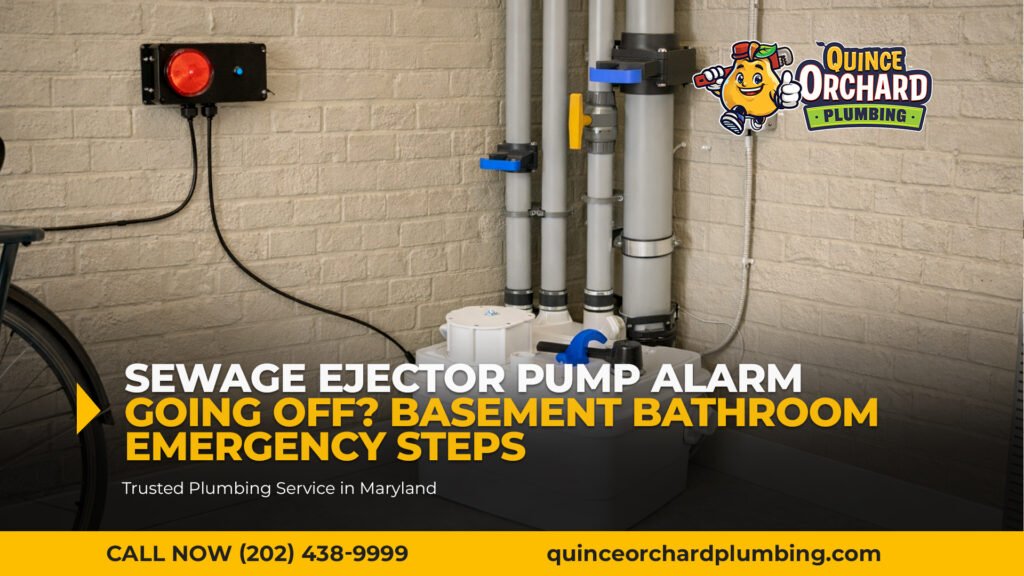
Sewage Ejector Pump Alarm Going Off? Basement Bathroom Emergency Steps

If your sewage ejector pump alarm is going off, treat it as a basement bathroom emergency. The alarm usually means the pit water level is too high—either the pump isn’t moving waste out, or it can’t keep up. The right first steps can prevent a messy backup, protect your home, and reduce damage. Below is a practical, Maryland-homeowner-safe guide for Montgomery County (Gaithersburg 20878, Rockville, Germantown, North Potomac, Derwood, Kentlands, and nearby areas). What the alarm typically means Most alarms are triggered by a high-water float inside the ejector basin. Common reasons: If you’re seeing recurring basement drainage issues, a Video Camera Sewer Inspection is often the fastest way to identify restrictions before you end up with a full backup. Emergency steps: what to do right now (in order) 1) Stop using water immediately Do not flush and avoid using: This alone can prevent the pit from overflowing. 2) Look for signs of active backup Check quickly (no deep dive yet): If you see active backup or sewage on the floor, stop and call a plumber—this is no longer a “simple reset” situation. If the problem may relate to the main line, we typically start with Sewer Line Repair & Replacement or a Video Camera Sewer Inspection to confirm the cause. 3) Check if the pump is running Stand near the basin cover and listen: 4) Confirm power (fast checks) If the area is wet around outlets or cords, don’t touch anything—turn off the breaker and call a pro. 5) Silence the alarm (only after steps above) Most alarms have a silence button. Silencing is fine—but don’t ignore the cause. If the level keeps rising, the alarm will come back (and the pit may overflow). Need help fast with a sewage ejector pump alarm or basement backup risk? Call Quince Orchard Plumbing for local service in Montgomery County, Maryland. Safe homeowner checks (only if the area is dry and you’re comfortable) A) Check the alarm panel lights Many panels show: This can help you understand whether it’s an overflow risk vs a nuisance trigger. B) Identify the #1 failure point: the float If you can safely open the lid (some lids are bolted/sealed), the most common issue is: If you’re not 100% comfortable, stop here. A sewage pit is not a “bare hands” DIY project. C) If the pump is running but level isn’t dropping Likely causes: This is typically a service call, not a reset. Quick troubleshooting table What you see Likely cause What to do Alarm on, pump silent Power issue, failed float, dead pump Check breaker/GFCI/plug; call if still silent Pump runs, alarm still on Not pumping out / backflow Stop water use; call for diagnosis Alarm keeps returning after “silence” Level still rising or float issue Treat as active issue, not an alarm problem Sewage smell / water on floor Backup is happening Avoid contact, stop water use, call immediately Repeated alarms in storms Inflow/infiltration or sewer restriction Consider Video Camera Sewer Inspection When to replace vs repair an ejector pump (simple rule) You can often repair if: You should consider replacement if: If the underlying issue is a main sewer restriction, repairs to the ejector alone won’t solve it—this is where Sewer Line Repair & Replacement and/or a Video Camera Sewer Inspection can save you from repeat emergencies. Prevent the next alarm: upgrades that actually matter 1) Install a high-quality alarm and test it Test the high-water alarm quarterly. Batteries (if present) should be replaced on a schedule. 2) Add a backup plan (especially for finished basements) Options include: 3) Keep discharge components serviceable A lot of failures come down to: 4) If you’ve ever had drain gurgling, slow whole-house drains, or odor Don’t wait for the next alarm—get a Video Camera Sewer Inspection to rule out main line restrictions or root intrusion. 5) After any sewage overflow, consider backflow/cross-connection safety Flooding and contamination events can create risks in certain plumbing setups. If you’re concerned, an evaluation via Backflow Prevention Services can help ensure your potable water system remains protected. Need help fast with a sewage ejector pump alarm or basement backup risk? Call Quince Orchard Plumbing for local service in Montgomery County, Maryland. Service Area (Maryland only) Quince Orchard Plumbing serves Gaithersburg (20878), Rockville, Germantown, North Potomac, Darnestown, Montgomery Village, Potomac (north), Derwood, Kentlands, and Washington Grove.

Helpful Guides for Gaithersburg

Water Heater Leaking From the Bottom: Causes, Safe Checks & When to Replace

Seeing water around the base of your water heater is stressful—especially in a basement, garage, or utility closet where leaks can spread quietly. The good news is that a “bottom leak” doesn’t always mean the tank is dead. The bad news is that some bottom leaks do mean the tank has reached end-of-life and replacement is the safest path. In this guide, I’ll walk you through safe first steps, the most common causes, and a simple decision process to know when it’s time to replace. This is written for homeowners in Montgomery County, Maryland—including Gaithersburg (20878), Rockville, Germantown, North Potomac, Derwood, and nearby areas—where many homes are 25–40 years old and water heaters often fail without much warning. What to do in the first 5 minutes (safety first) If the leak is active or the puddle is growing, treat it like a water damage risk first, and a “plumbing diagnosis” second. 1) Turn off power or gas If you smell gas or hear hissing: leave the area and call your gas utility or emergency services. 2) Shut off the cold water supply to the heater Find the cold-water shutoff valve on the pipe feeding the top of the tank and close it (clockwise). 3) Contain water and protect the area 4) If you need to stop pressure fast (optional) Open a hot water faucet nearby for a few seconds to relieve pressure. If you’re not sure what you’re seeing—or you want a professional to handle this safely—start with Water Heater Services and we’ll guide you from there. Need help with a leaking water heater? Call Quince Orchard Plumbing for fast, local service in Montgomery County, Maryland. Important: a puddle at the bottom doesn’t prove the bottom is leaking Water runs downhill. A slow drip from a connection up top can travel down the jacket and pool underneath, making it look like a bottom leak. Quick test:Dry the outside of the tank with a towel, then check again in 5–10 minutes: 7 common causes of “water heater leaking from the bottom” 1) Drain valve (boiler drain) is leaking This is one of the most common “false tank failures.” The drain valve sits low and can drip slowly.What you’ll see: water beads or drips right at the valve outlet. Safe check:Dry it and watch the valve area closely. If it’s dripping from the valve stem or body, it may need replacement. 2) Condensation (not a leak) In humid weather—or if very cold water is entering the tank—condensation can form and drip down.What you’ll see: light sweating, usually intermittent, often without rust streaks. Safe check:If the puddle is small and stops after the heater runs and warms up, condensation is possible. If it’s steady or increasing, keep diagnosing. 3) Temperature & Pressure relief (T&P) discharge is dripping The T&P valve discharge pipe can dump water if the system is over-pressurized or overheated.What you’ll see: water coming from the discharge tube, often nearby and easy to miss. Why it matters:Persistent T&P discharge can indicate high water pressure or thermal expansion. If you’re seeing pressure-related issues in the home, we can evaluate supply conditions through Water Line Repair as part of the bigger picture. 4) Loose or failing plumbing connections (water runs down to the base) Connections at the top (hot outlet, cold inlet, nipples, flex lines) can drip and track down the tank shell.What you’ll see: dampness around the top connections, then water trails down. 5) Electric water heater: heating element gasket leak (looks like a bottom leak) On electric units, a failing element gasket can leak and run down to the base.What you’ll see: moisture that seems to start mid-lower section, then pools under the tank. 6) Internal tank corrosion (true tank leak) If the steel tank has corroded through at the bottom seam, the tank itself is failing.What you’ll see: persistent puddle that returns quickly, often with rust staining. 7) Sediment buildup causing overheating and stress Mineral sediment settles at the bottom of the tank. Over time, it can reduce efficiency and contribute to premature failure—especially in older units that haven’t been flushed regularly. Safe inspection checklist (10–15 minutes) Use this quick checklist after you’ve shut off power/gas and water: If the leak source is unclear, say “yes” to professional help. Water heaters combine electricity/gas + pressure + heat—and guessing wrong can get expensive fast. Repair vs replace: a simple decision tree You can often repair when… In these cases, a pro repair visit through Water Heater Services is usually the most efficient next step. You should strongly consider replacement when… When a tank is leaking internally, patching isn’t a real fix—replacement is the safe fix. Prevention: reduce the chance of water damage from the next failure Even a well-maintained heater can eventually fail. These upgrades help limit damage: If your home has irrigation, specialty plumbing, or cross-connection risk points, it’s also a good time to confirm protective devices are in place and working with Backflow Prevention Services. Need help with a leaking water heater? Call Quince Orchard Plumbing for fast, local service in Montgomery County, Maryland. One more “hidden” risk: floor drains and backups If you attempt to drain a leaking heater and notice a floor drain backing up, slow drainage, or sewage odors, that’s a separate issue worth addressing before it becomes a bigger mess. A Video Camera Sewer Inspection can identify blockages or root intrusion, and if needed we handle Sewer Line Repair & Replacement. Service Area (Maryland only) Quince Orchard Plumbing serves Gaithersburg (20878), Rockville, Germantown, North Potomac, Darnestown, Montgomery Village, Potomac (north), Derwood, Kentlands, and Washington Grove.

Helpful Guides for Gaithersburg

Water Heater Size Guide: What Gallon Capacity You Actually Need (1–6 People)

If you’re shopping for a new water heater in Montgomery County, MD, the question usually sounds simple: “Do I need a 40, 50, 60, or 80-gallon tank?” In reality, the right size depends on how your household uses hot water during your busiest hour—not just how many people live in the home. https://www.energy.gov/energysaver/sizing-new-water-heater. At Quince Orchard Plumbing, we help homeowners across the Gaithersburg area choose water heater sizes that match real-life usage (and avoid the two common pain points: running out of hot water, or overpaying for capacity you’ll never use). Quick sizing chart: tank gallons for 1–6 people Use this as your starting point—then confirm with the “Peak Hour” method (next section). Household size Typical tank size range When to size up 1 person 30–40 gallons Large soaking tub, frequent laundry, guests 2 people 40–50 gallons Back-to-back showers, high-flow showerheads 3 people 50–60 gallons 2+ bathrooms used at the same time 4 people 60–75 gallons Morning “rush hour” + laundry/dishwasher together 5 people 75–80 gallons Multiple showers + heavy daily hot water use 6 people 80 gallons (or consider tankless/HPWH) High simultaneous demand or large tubs Important: gallons alone can mislead. Two 50-gallon tanks can perform very differently depending on recovery rate and design. That’s why the First Hour Rating is the metric we care about most. The number that matters most: First Hour Rating (FHR) For storage tanks (including heat pump water heaters with a tank), the U.S. Department of Energy recommends sizing using First Hour Rating—the amount of hot water a unit can deliver in an hour starting with a full tank. How to use FHR the right way DOE also notes that the EnergyGuide label for conventional storage heaters lists FHR as “Capacity (first hour rating).” Step-by-step: calculate your “Peak Hour” hot water demand (in 5 minutes) DOE provides a simple worksheet approach with typical gallons used per activity. https://www.energy.gov/energysaver/sizing-new-water-heater Quick Peak Hour worksheet (copy/paste) Pick your busiest hour (usually weekday mornings): Total Peak Hour Demand = ____ gallonsNow choose a unit with FHR ≥ that number. DOE’s example shows a sample peak-hour total of 66 gallons and recommends choosing a heater with FHR of 66+ gallons. Need help choosing the right size or replacing a water heater? Call Quince Orchard Plumbing for fast, local service in Montgomery County, Maryland. A practical guide by household size (with real-world “rush hour” patterns) Below are common patterns we see in Gaithersburg, Rockville, and Germantown-area homes, where plumbing layouts and fixtures can vary and change your “real” peak demand. 1–2 people: usually 40–50 gallons (but confirm your peak hour) Most 1–2 person households do fine with 40–50 gallons, unless you have: If you want a confident pick (and a clean install), start with Water Heater Services to match capacity, fuel type, venting, and efficiency to your home. 3 people: typically 50–60 gallons A third person often adds “overlap” (someone showers while dishes or laundry is running). Many families in townhomes in Kentlands or Montgomery Village hit peak demand in a single hour without realizing it. 4 people: 60–75 gallons is common Four-person households are where undersizing shows up fast: If your peak-hour math is near the edge, size up slightly rather than living with daily scheduling stress. 5–6 people: 75–80 gallons (or consider alternatives) Large households can outgrow standard tank comfort quickly—especially if multiple bathrooms are used at once. This is where we often discuss: DIY vs calling a plumber: a quick decision guide DIY is reasonable if: Call a pro if: For safe, code-compliant installation and long-term reliability, start with professional water heater installation and replacement. When the problem isn’t the size (symptoms that point elsewhere) If you’re running out of hot water, the tank might not be “too small.” Common causes include: And if you notice pressure drops, unexplained water near the heater, or moisture issues, it’s smart to rule out supply-side problems with Water Line Repair. If a leak or discharge is overwhelming a floor drain (or you’re seeing recurring backups), a Video Camera Sewer Inspection can identify hidden issues before they become emergencies—and if needed, we can help with Sewer Line Repair & Replacement. Need help choosing the right size or replacing a water heater? Call Quince Orchard Plumbing for fast, local service in Montgomery County, Maryland. FAQ: water heater sizing (Montgomery County, MD) Is a 40-gallon tank enough for 2 people? Sometimes—if you’re not doing back-to-back showers and laundry at the same time. If you’re close to the limit, 50 gallons is often a more comfortable “buffer.” Should I size for the future (kids, guests, resale)? Yes. Household size can change, and slight upsizing can make sense if you expect more simultaneous use over time. Does climate affect the size I need? It can. Colder incoming water increases the workload and can reduce performance if the unit isn’t sized correctly. If I switch to a heat pump water heater, can I downsize? Usually not. Heat pump recovery can be slower, so many homeowners maintain or increase tank size to protect comfort. What temperature should I set my water heater to? Safety matters. Higher temperatures (like 140°F) increase scalding risk. If you’re unsure, we can help you balance comfort, safety, and appliance needs during Water Heater Services. Service Area (Maryland only) Quince Orchard Plumbing serves Gaithersburg (20878), Rockville, Germantown, North Potomac, Darnestown, Montgomery Village, Potomac (north), Derwood, Kentlands, and Washington Grove.

Helpful Guides for Gaithersburg

How to Prevent Sewer Gas Smells in Bathrooms and Basements

A faint sewer smell in a bathroom or basement is one of those problems that’s easy to ignore at first—and then suddenly feels urgent when it gets stronger. Beyond being unpleasant, sewer gas smells are a warning sign that something in your plumbing system isn’t working the way it should. In homes around Gaithersburg, Rockville, Germantown, North Potomac, and the rest of Montgomery County, these odors often show up in: The good news: many sewer gas issues are preventable with simple habits and basic maintenance. In this guide, we’ll explain the most common causes of sewer gas smells in bathrooms and basements, how to prevent them, and when you should call a professional plumber for a deeper inspection or Video Camera Sewer Inspection. What Is Sewer Gas (and Why It Matters)? Sewer gas is a mix of gases produced as wastewater and organic material break down in your plumbing and the public sewer system. Your home’s plumbing is designed to keep those gases safely contained inside the pipes—and out of your living space. That job is handled by: When you smell sewer gas in a bathroom or basement, it means one of those protections is failing: a trap is dry, a seal is broken, a vent is blocked, or a drain or sewer line has a defect. The Most Common Causes of Sewer Gas Smells Indoors In Montgomery County homes with basements and multiple bathrooms, we tend to see the same root causes again and again. 1. Dry P-Traps in Little-Used Fixtures Every sink, tub, shower, and floor drain should have a P-trap that holds water to block sewer gas. If the fixture isn’t used for a while—think guest bath or basement floor drain—that water can slowly evaporate. Once the water level in the trap drops too low: 2. Loose or Failed Toilet Wax Rings The base of each toilet is sealed to the drain with a wax ring or similar sealing gasket. If that seal fails due to movement, age, or improper installation, sewer gas can leak into the bathroom around the base of the toilet—even without visible water leakage. Warning signs include: 3. Problems With Vents (Roof Vents or Air Admittance Valves) Your plumbing vent system allows air into the pipes so water and waste can flow smoothly. If vents are: you can get pressure changes that pull water out of traps or push sewer gas into the house. 4. Floor Drains and Basement Traps That Dry Out Basement floor drains and utility room drains are notorious for sewer gas smells because they are: When the floor drain trap dries out, the basement can start to smell like an open sewer—even if everything else seems to be working fine. 5. Cracked or Damaged Sewer Lines Near the House In some cases, especially in older Gaithersburg and Rockville neighborhoods, sewer gas smells in basements are a sign of a more serious problem: a cracked or leaking sewer line under or near the foundation. That can happen when: These issues often show up along with slow drains, occasional backups, or damp spots near foundation walls. That’s when a Video Camera Sewer Inspection and possibly Sewer Line Repair & Replacement become part of the conversation. Simple Habits to Prevent Sewer Gas Smells The first line of defense is keeping traps wet and seals intact. These small habits go a long way in bathrooms and basements. 1. Run Water Periodically in Every Fixture For guest bathrooms, basement baths, and utility sinks: This keeps water in the traps and helps prevent smells before they start. 2. Top Off Floor Drains and Basement Traps Basement and garage floor drains need attention because they’re easy to forget. To keep them from drying out: If a particular drain refuses to stay wet or you’re unsure if it’s still needed, a plumber can evaluate whether it needs a trap primer, repiping, or another solution. 3. Make Sure Toilets Are Solid and Properly Sealed To help prevent sewer gas around toilets: Replacing a wax ring is a routine plumbing job, but it’s crucial for both odor control and preventing hidden water damage. 4. Avoid Unnecessary Connections and “Creative” Plumbing Over the years, many basements and bathrooms have been modified by previous owners. We still find: If your home has a history of “DIY” plumbing, it’s wise to have a licensed plumber inspect the layout, especially where sewage, sump pumps, and floor drains meet. In some cases, adding or improving Backflow Prevention Services is also important for keeping wastewater flowing in the right direction. How to Check for Venting Issues Because roof vents play a big role in preventing sewer gas smells, it’s natural to wonder if they’re blocked. As a homeowner, you don’t need to climb on the roof to get a sense that something might be wrong with venting. Signs that venting could be part of the problem include: A plumber can: When Sewer Gas Smells Mean a Bigger Problem Some situations call for more than DIY prevention. You should contact a professional plumber if: In these cases, we often recommend a Video Camera Sewer Inspection to see what’s happening inside your main drain and sewer line. If we find cracks, sags, or root intrusion, we may suggest targeted Sewer Line Repair & Replacement to solve the problem at its source. DIY vs. Calling a Pro: A Simple Decision Guide Here’s a quick way to think about sewer gas smells in your bathrooms and basement: A licensed plumber can test traps, check under-sink piping, inspect venting, and use camera equipment to look at your main sewer line. If needed, we’ll also check for issues that might call for Backflow Prevention Services or more extensive sewer repairs. Smelling sewer gas in a bathroom or basement? Call Quince Orchard Plumbing today for a professional inspection and repair in Montgomery County, MD. How Quince Orchard Plumbing Helps Montgomery County Homeowners At Quince Orchard Plumbing, we routinely help homeowners in Gaithersburg (20878), Rockville, Germantown, North Potomac, Darnestown, Montgomery Village, Potomac

Helpful Guides for Gaithersburg

Why Your Kitchen Sink Smells (and Plumbing Fixes That Actually Work)

If your kitchen sink smells bad, you’re not alone. Homeowners in Gaithersburg, Rockville, Germantown, North Potomac, and across Montgomery County deal with mysterious sink odors all the time. Sometimes it’s just old food in the drain; other times, it’s a warning sign of a deeper plumbing issue you don’t want to ignore. The key is figuring out what kind of smell you’re dealing with and where it’s coming from. That will tell you whether a simple cleaning will solve it—or whether it’s time to call a plumber to look at your drains, venting, or even your sewer line. In this guide, we’ll break down the most common causes of kitchen sink smells, the DIY fixes that actually work, and when issues in your Montgomery County home should be checked with a professional Video Camera Sewer Inspection or even Sewer Line Repair & Replacement. What Kind of Smell Is It? Different smells usually point to different problems. Before you grab bleach or a bottle of drain cleaner, take a minute to notice what you’re smelling: Once you can describe the smell, the next step is figuring out exactly where it’s coming from. Step 1: Find the Real Source of the Smell Stand at the sink and check carefully: Check the P-Trap Under your kitchen sink, there’s a curved section of pipe called the P-trap. It holds a small amount of water to block sewer gas from coming back into your home. Problems happen when: If the trap dries out, sewer gases can move freely into your kitchen, causing that unmistakable “sewer” smell. Look at the Garbage Disposal If your kitchen sink has a garbage disposal, it’s a prime suspect for bad smells: Don’t Forget the Dishwasher Connection The dishwasher usually ties into the kitchen drain system through a branch connection or a disposal. If that connection is poorly installed or clogged, dirty water can: If you’re seeing dirty water in the sink after the dishwasher runs, or you’re concerned about cross-connections, it’s smart to have a plumber evaluate the setup and, if needed, make corrections as part of professional Backflow Prevention Services. DIY Fixes for a Smelly Kitchen Sink Once you’ve narrowed down where the smell comes from, you can tackle some safe, effective DIY steps. 1. Flush and Re-Fill the P-Trap If the sewer smell started after a vacation or long period of not using the sink, the fix might be simple: If the smell comes back quickly or doesn’t go away, the trap may not be holding water properly—or there may be a venting or deeper drain issue that needs professional attention. 2. Deep-Clean the Drain and Stopper The top few inches of your drain can hold a surprising amount of gunk. To clean it: This alone can dramatically reduce sour or musty smells in many sinks around Gaithersburg and Rockville homes. 3. Clean the Garbage Disposal the Right Way Skip the harsh chemical drain cleaners. Instead, try this approach: If you see cracks, leaks, or severe rust, it may be time to talk to a plumber about repair or replacement rather than trying to mask the smell. 4. Carefully Clean the Trap (If You’re Comfortable) For DIY-minded homeowners, you can sometimes remove and clean the P-trap yourself: If you’re not comfortable with this, that’s a great point to call a local plumber in Montgomery County to do a professional cleaning and inspection instead of risking a leak under the sink. 5. Use Gentle, Plumbing-Safe Cleaners For ongoing maintenance, enzyme-based or bio-based drain cleaners can help break down organic buildup in the drain line without the harshness of strong chemical drain cleaners. A few notes: When a Smelly Kitchen Sink Is Actually a Bigger Plumbing Problem Not every smell is just “dirty disposal” territory. There are times when odors from your kitchen sink are warning you about a more serious plumbing or sewer issue in your Montgomery County home. 1. Persistent Sewage Smell That Won’t Go Away If you’ve cleaned the drain, run water through the trap, and checked the disposal, but the sink still smells like sewage, it could indicate: When the smell is clearly “sewer gas,” especially if it’s worse after heavy use or rain, it’s time to have the system inspected professionally. A Video Camera Sewer Inspection can check for cracks, roots, or sags in the line that may be letting sewer gas and wastewater linger near the house. 2. Slow Drains and Odors in More Than One Fixture If you notice: you may not have a “kitchen sink problem”—you may have a whole-house drain or sewer problem. That often points to: In these cases, snaking the kitchen sink over and over won’t fix the underlying issue. A camera inspection and, if needed, Sewer Line Repair & Replacement are usually the real solutions. 3. Dirty Water Backing Up Into the Kitchen Sink If you see dirty water backing up into the kitchen sink when: you may be dealing with: This is more than just a smell problem—it can be a hygiene and safety issue. A licensed plumber can evaluate the layout, correct any improper cross-connections, and recommend options such as proper air gaps, high loops, or other Backflow Prevention Services as needed. Tired of a smelly kitchen sink? Call Quince Orchard Plumbing today to find and fix the real cause in your Montgomery County home. How Quince Orchard Plumbing Can Help For homeowners in Gaithersburg (20878), Rockville, Germantown, North Potomac, Darnestown, Montgomery Village, Potomac (north), Derwood, Kentlands, and Washington Grove, we see the same pattern again and again: When you call Quince Orchard Plumbing, we can: The goal is simple: get rid of the smell, protect your home, and make sure your plumbing system is working the way it should—without you having to keep guessing or pouring new chemicals down the drain every week. Service Area: Quince Orchard Plumbing proudly serves Gaithersburg (20878), Rockville, Germantown, North Potomac, Darnestown, Montgomery Village, Potomac (north), Derwood, Kentlands, and Washington Grove. Tired of a smelly kitchen sink? Let Quince

Scroll to Top