Prevention and Maintenance

Prevention and Maintenance

Top 5 Battery Backup Sump Pump Systems (2026): Reliable Options for Maryland Basements

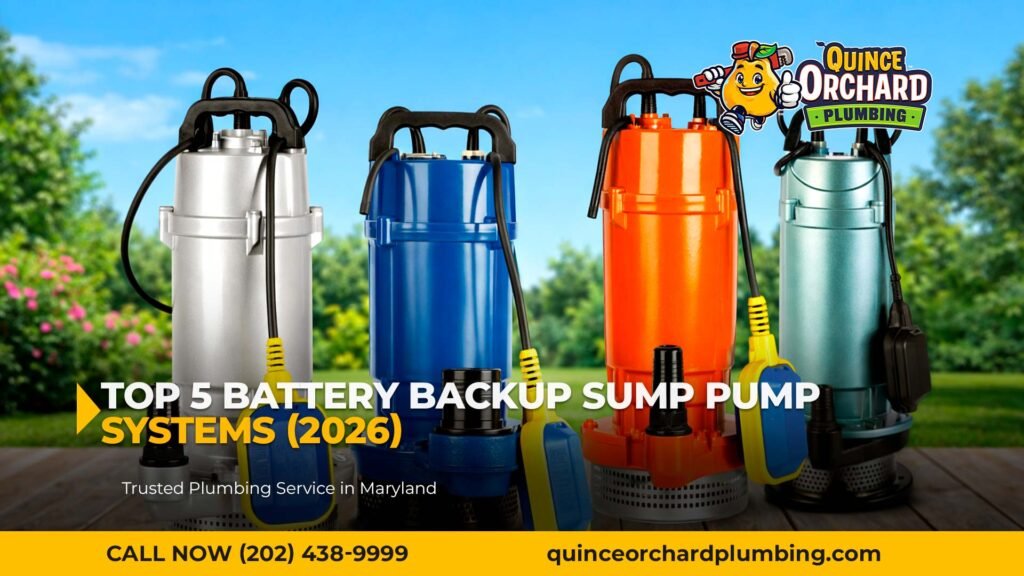
A battery backup sump pump is one of the smartest upgrades you can make for a Maryland basement. Even if your primary sump pump works perfectly, it still can’t pump water during a power outage. Meanwhile, storms and outages often happen together—so a backup system can prevent a flooded basement when you need protection most. This guide covers what to buy, what to check before installation, and which systems homeowners in Gaithersburg (20878) and nearby Montgomery County areas (Rockville, Germantown, North Potomac, Derwood, Kentlands, and more) tend to benefit from most. Battery backup sump pump: when you truly need one You should strongly consider a battery backup sump pump if: Also, keep expectations realistic: a backup pump buys you time and protection, but it won’t overcome every failure mode if the discharge setup is wrong (more on that below). For general sump pump care and maintenance basics, FEMA has a useful overview: Maintain your sump pump (FEMA). Battery backup sump pump: the “buying checklist” that prevents regrets Before you pick a system, run this quick checklist. Otherwise, you risk buying the “right” product for the wrong setup. 1) Choose a battery type that matches your goal 2) Look for a controller that actually protects you A strong controller should include: 3) Prefer dual-float switching (or a protected float design) Float failures cause many “it didn’t turn on” disasters. Therefore, redundancy matters. 4) Confirm discharge compatibility (this is huge) If you want a very practical inspection mindset, InterNACHI’s sump pump guide is helpful: Sump Pump Operation and Inspection (InterNACHI). Want a battery backup sump pump installed and tested the right way for your basement layout? Call Quince Orchard Plumbing for local help in Montgomery County, MD. Battery backup sump pump systems: 5 reliable picks (2026) Below are five widely used options across different budgets and “risk levels.” In practice, the best choice depends on how much water you need to move and how long your outages can last. 1) Battery backup sump pump pick: Zoeller AquaNot Fit 508 This is a strong “pro-grade” option for homeowners who want a high-quality backup system with serious monitoring features. It’s especially attractive when you want a system that can also assist the primary pump during heavy inflow (not only during outages).Best for: higher-risk basements, frequent storms, homeowners who want premium monitoring. 2) Battery backup sump pump pick: PHCC Pro Series 2400 (A/C–D/C backup) This system is popular because it can help during heavy inflow and then switch to battery during outages. In addition, it emphasizes monitoring and automatic operation, which helps when you aren’t home.Best for: homeowners who want a “set it and test it” style backup system. 3) Battery backup sump pump pick: Liberty Pumps Model 441 Liberty’s 441 is a widely used 12V backup system designed to run alongside a primary pump. It’s a solid fit when you want a straightforward backup that’s easy to pair with an existing setup.Best for: homeowners who want a reliable brand and a clean, standard backup install. 4) Battery backup sump pump pick: Basement Watchdog Big Dog CONNECT (AC/DC) This style of system focuses heavily on monitoring and alarms, and it’s often chosen by homeowners who want visibility into battery/pump status. Additionally, it’s a common pick for finished basements where “I want alerts” matters as much as pumping.Best for: finished basements, homeowners who value alarms/monitoring. 5) Battery backup sump pump pick: WAYNE ESP25 (12V backup system) WAYNE’s ESP25 category is a common “add-on backup” style solution that pairs with an existing primary pump. It’s often used as a practical upgrade when you want a backup pump, charger, and alarm package without reworking the entire pit.Best for: typical residential pits that need a straightforward backup layer. Battery backup sump pump: what to check before installation Even the best battery backup sump pump will disappoint if the pit or discharge setup is flawed. So, before you install anything, confirm these items. 1) Pit size and float clearance First, make sure floats move freely without rubbing the pit wall, cords, or the primary pump. If the float sticks, the pump won’t start. 2) Check valve strategy (stop backflow and short-cycling) Next, confirm that pumped water doesn’t fall back into the pit immediately. Otherwise, both pumps can short-cycle, and batteries can drain faster. 3) Discharge line condition and freeze risk Then, verify the discharge line exits and drains properly. If it holds water in winter, it can freeze and block flow. As a result, the pump runs but the water level doesn’t drop. 4) Power and outlet setup Finally, avoid extension cords and overloaded circuits. A dedicated outlet reduces nuisance trips and improves reliability. Battery backup sump pump: a simple maintenance plan A backup system only helps if you test it. Also, if your basement ever floods, dry it quickly to reduce mold risk. EPA has a straightforward guide here: Mold cleanup after disasters (EPA). Want a battery backup sump pump installed and tested the right way for your basement layout? Call Quince Orchard Plumbing for local help in Montgomery County, MD. Important: basement flooding is not always a sump pump problem Sometimes homeowners think “my sump failed,” but the water is actually from something else. For example: Additionally, after any major basement water event, you may want to confirm potable system protection where applicable via Backflow Prevention Services. Service Area (Maryland only) Quince Orchard Plumbing serves Gaithersburg (20878), Rockville, Germantown, North Potomac, Darnestown, Montgomery Village, Potomac (north), Derwood, Kentlands, and Washington Grove.
Prevention and Maintenance

Best Frost-Free Hose Bibs for Maryland Winters: 5 Picks + How to Prevent Wall Freeze Damage

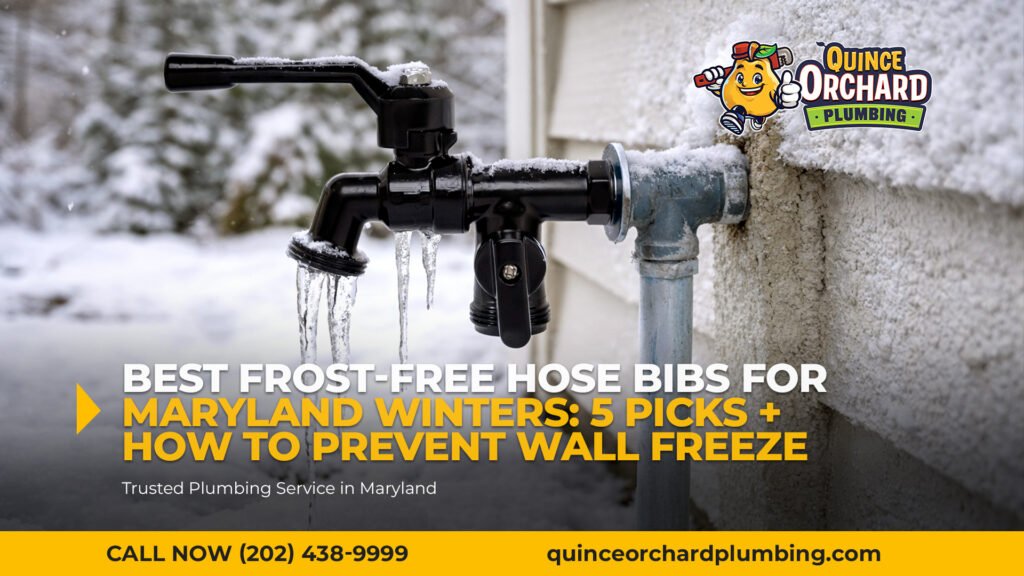
A frozen outdoor faucet doesn’t just “break the spigot.” The real damage usually happens inside the wall, where a short section of pipe freezes, expands, and bursts—then leaks silently until you notice stains, mold, or a soaked basement ceiling. In Montgomery County winters (Gaithersburg 20878, Rockville, Germantown, North Potomac, Derwood, Kentlands, and nearby), the best upgrade for most homes is a frost-free (freezeless) hose bibb installed correctly—and winterized correctly (yes, still). WSSC specifically recommends disconnecting hoses and draining the line to the hose connection as part of winter prep. If you suspect an outdoor faucet froze and now you have a hidden leak (water bill spike, damp drywall, wet basement), start with Water Line Repair. What “frost-free” actually means (and the mistake that causes most freezes) A frost-free hose bibb shuts water off inside the heated portion of the home, not at the exterior handle. When you close the faucet, the water in the outer tube is supposed to drain out. Two critical realities: When a frost-free hose bibb is worth it in Maryland It’s usually a smart upgrade if: Worried your outdoor faucet froze or you need a frost-free upgrade? Call Quince Orchard Plumbing for fast, local help in Montgomery County, MD. 5 frost-free hose bib picks that perform well in real homes These are “pro-grade” families of products we commonly see used because they’re serviceable, widely supported, and designed for freezing climates. 1) Woodford Model 19 (Anti-siphon + freeze protection extras) Best for: homeowners who want built-in backflow protection and added freeze-damage safeguards.Why it’s a strong pick: Model 19 includes an integral anti-siphon/backflow device and is designed for year-round use.Great fit for: families who sometimes forget hoses—because this line emphasizes freeze-rupture protection features. 2) Woodford Model 17 (classic freezeless wall faucet—install quality matters) Best for: straightforward replacements where you can ensure proper slope/drainage.Why it’s a strong pick: widely used, serviceable, and backed by clear installation guidance emphasizing correct install and drainage to prevent freezing. 3) PRIER C-144 (anti-siphon, traditional operation) Best for: homeowners who want anti-siphon protection and a proven wall-hydrant design.Why it’s a strong pick: PRIER highlights anti-siphon/backflow protection in the C-144 line, and their instructions confirm the hydrant should drain briefly after shutoff. 4) PRIER P-164 (quarter-turn convenience) Best for: anyone who prefers quick quarter-turn operation (especially seniors or busy households).Why it’s a strong pick: PRIER’s P-164 is designed for freezing climates with the shutoff inside the structure and a quarter-turn seal design. 5) A.Y. McDonald Frostproof Sillcocks (lots of configuration options) Best for: homes where you want multiple inlet/PEX configurations or a specific layout match.Why it’s a strong pick: A.Y. McDonald offers a broad frostproof sillcock lineup aimed at durable plumbing valve performance. Before you buy: the 4 checks that prevent “it still froze” and “it leaks in the wall” 1) Choose the correct length (most important) Frost-free bibs come in different stem lengths (4″, 6″, 8″, 10″, 12″, 14″+). The shutoff point must land inside the heated space, not in the cold wall cavity. Rule of thumb: 2) Confirm you have a way to shut off the supply (or add one) An interior shutoff makes winterizing and future repairs dramatically easier. WSSC notes the shutoff valve is typically inside the home feeding the outdoor hose connection and recommends draining the line. 3) Check for backflow protection needs (anti-siphon) Many jurisdictions expect an anti-siphon/vacuum breaker for outdoor faucets. If you want the setup evaluated or tested as part of a broader potable-water safety plan, that falls under Backflow Prevention Services. 4) Verify drainage pitch on install Manufacturers warn improper installation/operation can freeze and burst, and Woodford’s guidance emphasizes installation details that support drainage.Bottom line: if the faucet can’t drain, it’s not “frost-free” in practice. How to prevent wall freeze damage (copy/paste winter checklist) Do this before the first hard freeze: Common failure points (why frost-free hose bibs still fail) Worried your outdoor faucet froze or you need a frost-free upgrade? Call Quince Orchard Plumbing for fast, local help in Montgomery County, MD. DIY vs calling a pro DIY can be okay if: Call a pro if: For leaks, replacements, or re-piping tied to outdoor faucets, start with Water Line Repair. Service Area (Maryland only) Quince Orchard Plumbing serves Gaithersburg (20878), Rockville, Germantown, North Potomac, Darnestown, Montgomery Village, Potomac (north), Derwood, Kentlands, and Washington Grove.
Prevention and Maintenance

Best Smart Water Shutoff Valves + Leak Detectors (2026): Prevent Flood Damage

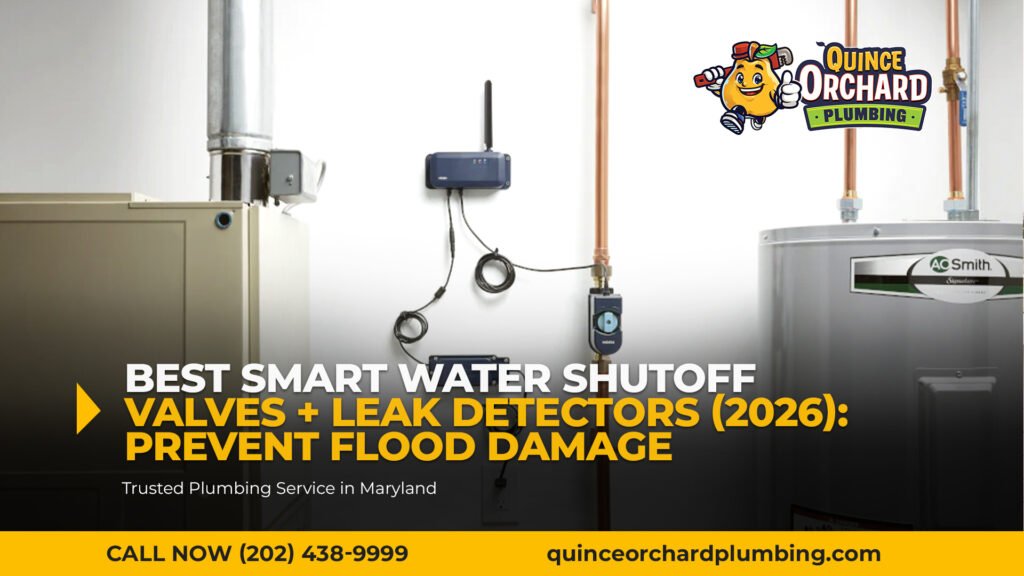
Water damage is one of the fastest ways to turn a “small plumbing issue” into a five-figure renovation—especially in Maryland homes with finished basements, utility rooms, or second-floor laundry. The smartest setup in 2026 is a two-layer defense: This guide is written for homeowners in Montgomery County, MD—Gaithersburg (20878), Rockville, Germantown, North Potomac, Derwood, Kentlands, and nearby areas—where winter freeze risks, older shutoff valves, and basement mechanical rooms are common. If you want this planned and installed cleanly (and tested), our team can help through Water Line Repair and Water Heater Services. First: smart shutoff vs leak detector (what each one does) Smart water shutoff valve (whole-home) Installed on the main water line. It monitors flow/pressure patterns and can automatically shut off water during a major leak (depending on settings and device). Best for: burst pipes, failed hose bibs, water heater blowouts, supply line ruptures, “nobody’s home” disasters. Leak detectors (point sensors) Small sensors placed near common leak points (water heater pan, under sinks, behind toilets, near sump pit overflow point). They alert you fast—some can trigger an automatic shutoff if paired to a valve/controller. Best for: slow drips, under-sink leaks, toilet supply leaks, early detection before mold and flooring damage. Pro rule: If you can only do one thing today, start with leak detectors in the highest-risk spots. If you want the strongest protection, add the whole-home shutoff. Want real flood protection—not just alerts? Call Quince Orchard Plumbing for smart shutoff valve and leak detector planning in Montgomery County, Maryland. What to look for in 2026 (features that actually matter) For whole-home shutoff valves For leak detectors 2026 Pro picks: whole-home smart shutoff valves These are widely recognized options that fit different home situations and budgets. 1) Flo by Moen Smart Water Shutoff Best for: homeowners who want strong automation + detailed monitoringWhy it’s a top pick: automatic shutoff for major leaks, usage insights, and an ecosystem that can scale (valve + detectors). 2) Phyn Plus v2 Smart Water Assistant + Shutoff Best for: homeowners who want advanced detection and a strong “no nonsense” shutoff systemWhy it’s a top pick: pressure-based leak detection and whole-home shutoff, with a strong reputation among smart shutoff options. 3) YoLink Valve Controller + “Bulldog” Valve Robot (retrofit style) Best for: when you want shutoff automation without cutting the main line (fits certain setups)Why it’s a top pick: can pair with leak sensors and trigger shutoff; good range in some home layouts. Requires correct planning so it’s reliable. 4) Leak Defense System (smart shutoff + sensors approach) Best for: a system built around sensors + shutoff logicWhy it’s a top pick: often used in more “systemized” installs where multiple leak points are monitored. 5) “Monitoring-only” add-on (if shutoff isn’t possible yet) If your main shutoff is in a tough location or you’re not ready for main-line work, a monitoring-first option can still add value—just remember it won’t physically stop water without a valve. 2026 Pro picks: leak detectors (best places to start) 1) Flo by Moen Smart Water Detector Great for basements and utility rooms because it can detect water + humidity/temperature (useful for freeze risk awareness). Pairing it with a shutoff system gives you the best outcome. 2) First Alert water leak alarm style detectors Simple, loud, and effective—perfect for under-sink placement and quick alerts. 3) YoLink leak sensors (long-range ecosystem style) Good if your home layout makes Wi-Fi sensors unreliable in far corners. 4) A “multi-sensor” kit approach (kitchen + baths + basement) In real homes, the best move is usually 3–6 sensors deployed intelligently, not a single sensor in one spot. The placement plan that prevents real flood damage (copy/paste checklist) Priority 1: basement mechanical area Priority 2: kitchen + laundry Priority 3: bathrooms Pro tip: Put at least one sensor where you’ll hear it, not only where it might leak. Want real flood protection—not just alerts? Call Quince Orchard Plumbing for smart shutoff valve and leak detector planning in Montgomery County, Maryland. DIY vs calling a pro DIY is fine for: Call a pro for: FAQ Should I get a smart shutoff even if I already have leak detectors? Yes—detectors alert you, but the valve can stop the water when you’re asleep or away. Do smart shutoff valves work if Wi-Fi goes out? Some systems keep protective behavior even during Wi-Fi loss, but you should treat Wi-Fi as a risk factor and plan accordingly. What’s the single best “starter kit” approach? 3–6 leak sensors (basement + kitchen + laundry) now, then add a whole-home shutoff valve next. Service Area (Maryland only) Quince Orchard Plumbing serves Gaithersburg (20878), Rockville, Germantown, North Potomac, Darnestown, Montgomery Village, Potomac (north), Derwood, Kentlands, and Washington Grove.
Prevention and Maintenance

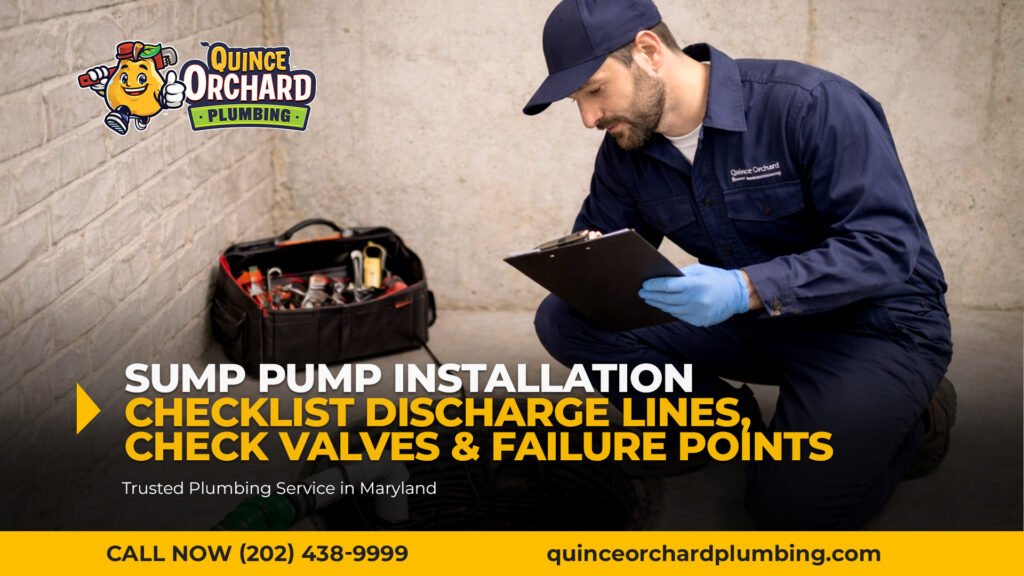
Sump Pump Installation Checklist: Discharge Lines, Check Valves & Failure Points

A sump pump can be “installed” and still fail when you need it most—usually because of the discharge setup, a bad check valve configuration, or simple failure points like a stuck float or a frozen line. This checklist is written for Maryland basements in Montgomery County (Gaithersburg 20878, Rockville, Germantown, North Potomac, Derwood, Kentlands, and nearby areas). Use it to verify a new install, troubleshoot an existing system, or prep your home before the next heavy storm. Safety first (before you touch anything) Installation checklist (the parts that actually prevent failures) 1) Sump pit basics Pro note: If your “sump water” looks oily, rusty, or hot, or you have unusual pressure-related water events, it may be a supply-side leak. Consider Water Line Repair to rule that out. 2) Pump placement and discharge size 3) Check valve: placement and orientation A check valve prevents pumped water from falling back into the pit (which causes short cycling and early failure). Checklist Common check valve mistakes 4) Discharge line routing (this is where most “floods” are born) Your discharge line must move water away from the home reliably in heavy rain—without freezing or clogging. Checklist 5) Anti–short cycling setup (protects the motor) Short cycling kills pumps. Checklist 6) Electrical: the “silent” failure category A perfectly plumbed sump system still fails if the electrical setup is unreliable. Checklist Need a sump pump install or backup setup done right? Call Quince Orchard Plumbing for reliable, local service in Montgomery County, Maryland. Backup options checklist (strongly recommended in Montgomery County) Storms and outages often happen together. If your basement is finished in Kentlands, Rockville, or Montgomery Village, a backup is not optional. Battery backup sump pump Water-powered backup (municipal water only) Backup power (generator or power station) The most common failure points (and how to catch them early) 1) Stuck float switch Signs: Pump doesn’t turn on, or runs nonstop.Fix: Verify float has clear travel; remove debris; consider a more reliable switch style if repeat failures happen. 2) Frozen discharge line Signs: Pump hums/runs, pit water doesn’t drop, or water returns immediately.Fix: Correct exterior slope/drain-down, reduce exposure, and adjust routing. 3) Bad check valve or bad placement Signs: Rapid cycling, loud “thunk,” frequent runs during light seepage.Fix: Replace with a quality valve and service-friendly configuration. 4) Power/GFCI trips Signs: Everything looks fine, but pump is off after a storm.Fix: Dedicated circuit, correct outlet, reduce shared loads, add alarm. 5) Debris clogging the impeller Signs: Weak pumping or noisy operation.Fix: Clean pit; consider a better sealed lid; address drainage sources feeding debris. Quick test procedure (do this before storm season) Need a sump pump install or backup setup done right? Call Quince Orchard Plumbing for reliable, local service in Montgomery County, Maryland. DIY vs call a pro DIY is reasonable if: Call a pro if: If the basement mechanical area includes a water heater, it’s smart to protect that setup too—leaks in tight utility rooms can cause major damage. We can coordinate that through Water Heater Services. If flooding or backflow events raise concerns about cross-connection safety, consider an evaluation via Backflow Prevention Services. Service Area (Maryland only) Quince Orchard Plumbing serves Gaithersburg (20878), Rockville, Germantown, North Potomac, Darnestown, Montgomery Village, Potomac (north), Derwood, Kentlands, and Washington Grove.

Prevention and Maintenance

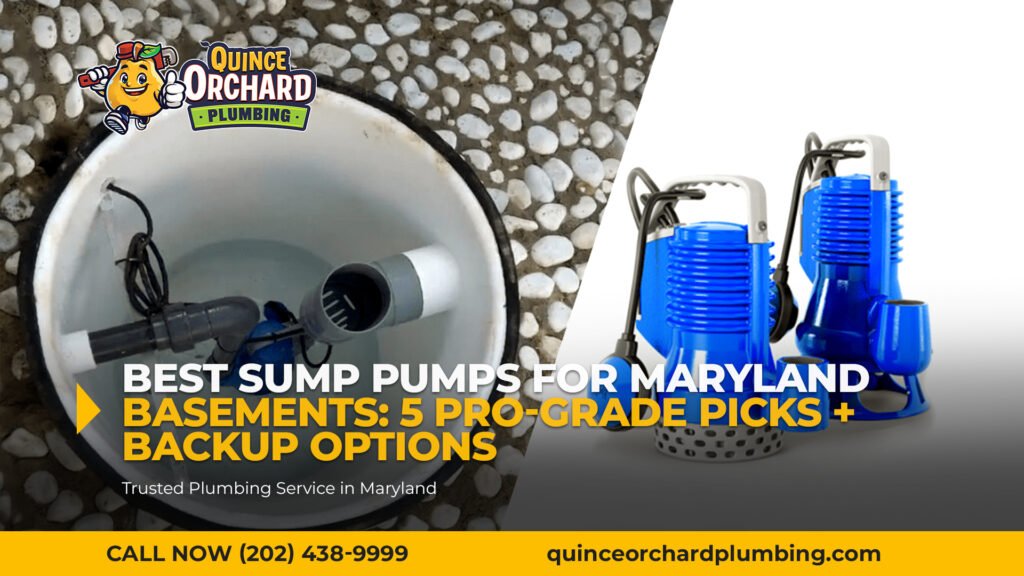
Best Sump Pumps for Maryland Basements: 5 Pro-Grade Picks + Backup Options

If you have a basement in Maryland, you already know the pattern: heavy rain, saturated soil, rising groundwater—and suddenly the sump pit becomes the most important “appliance” in the house. In Montgomery County (Gaithersburg 20878 and nearby areas like Rockville and Germantown), we see sump pumps fail for the same reasons over and over: undersized pumps, poor float setups, no backup, and discharge lines that freeze or clog. This guide breaks down what matters in real homes, then gives you five pro-grade sump pump picks plus the backup options that actually prevent basement flooding during storms and power outages. If you want a pro to size it, install it cleanly, and verify your discharge setup, we can help through Water Heater Services (we frequently coordinate water-heater protection and basement mechanical areas when water intrusion is involved). First: confirm you actually need a sump pump solution (not a plumbing emergency) A sump pump is for groundwater and rainwater seepage, not plumbing failures. Call a plumber right away if you notice: If it’s clean groundwater in the sump pit, keep reading. What “pro-grade” really means for sump pumps When we say “pro-grade,” we’re usually looking for: For a deep, homeowner-friendly overview of sump pumps and what to look for, This Old House has a helpful guide (external):This Old House – Best Sump Pumps Need a sump pump upgrade or backup system installed? Call Quince Orchard Plumbing for fast, local help in Montgomery County, Maryland. How to choose the right sump pump for a Maryland basement 1) Pick submersible for most basements Submersible pumps are quieter, safer, and more typical for modern installs. Pedestal pumps can work, but they’re less common for finished basements. 2) Size by your “worst day,” not your average day Most homes do well with a 1/3 HP cast iron pump. If you have a high water table, frequent heavy inflow, or a history of storm flooding in North Potomac, Darnestown, or Montgomery Village, stepping up to 1/2 HP can make sense—especially if your discharge run is long or has significant vertical lift. 3) Don’t ignore the switch The pump body matters, but the float/switch setup is often the real failure point. 4) Make sure your discharge is done right A great pump still fails if the discharge is wrong. The 5 pro-grade picks we like (and why) These are widely used, contractor-trusted models. Exact configurations can vary (switch type, cord length, etc.), so match the model style to your pit and layout. 1) Zoeller M53 (cast iron, workhorse for most homes) Best for: Most typical Maryland basements with standard seepageWhy it’s a pro favorite: Durable cast iron build, strong reliability track record, and a “just works” profile for average residential needs. 2) Liberty Pumps 257 (cast iron, excellent for tight sump pits) Best for: Smaller pits or setups where a compact float design mattersWhy it’s pro-grade: Liberty’s heavy cast iron construction and professional switching options make it a great fit when space is limited. 3) Little Giant 6EC-CIA-RF / 6-CIA (cast iron, continuous-duty style) Best for: Homeowners who want a robust cast-iron pump with a long service lifeWhy it’s pro-grade: Cast iron body and a solid reputation in sump/light effluent applications (ideal for many residential pits). 4) Zoeller M63 (step-up option when you want more performance headroom) Best for: Homes with heavier inflow, frequent storms, or more demanding discharge runsWhy it’s pro-grade: A higher-capacity step-up that keeps you safer on the worst-weather days without jumping into extreme commercial territory. 5) Liberty Pumps 287 (step-up, high-inflow basements) Best for: Higher water table neighborhoods, bigger pits, or homes that have overwhelmed smaller pumpsWhy it’s pro-grade: A stronger class option for “my sump runs hard during storms” situations—great when you want extra margin. Backup options (this is what prevents the disaster) A sump pump without backup is a gamble—because storms and outages often happen together. Option A: Battery backup pump (most common, best overall protection) A dedicated 12V battery backup pump sits in the same pit and activates when: What to look for: Option B: Water-powered backup (works during outages without a battery) Water-powered backups use municipal water pressure to move sump water out—no electricity required. This can be a strong option in areas with reliable municipal pressure and no well system. A well-known example is Liberty’s water-powered backup concept (external):Liberty Pumps – SumpJet (water-powered backup) Important: Water-powered backups rely on municipal water (not ideal for well systems), and performance depends on water pressure and plumbing layout. Option C: Backup power for your primary pump (inverter/power station or generator) This can work well if: But it’s only as good as your backup power plan (fuel, maintenance, runtime, safe setup). Need a sump pump upgrade or backup system installed? Call Quince Orchard Plumbing for fast, local help in Montgomery County, Maryland. Quick “what should I buy?” decision guide Most Maryland homes (standard seepage, typical pit) Higher-risk homes (history of flooding, high water table, heavy storms) Finished basements (Kentlands, Derwood, Rockville neighborhoods with finished lower levels) Maintenance checklist (do this before storm season) A simple inspection routine prevents most “it failed when I needed it” problems. For a thorough inspection overview, InterNACHI has a solid guide (external):InterNACHI – Sump Pump Operation & Inspection DIY vs calling a pro DIY may be reasonable if: Call a pro if: If you’re unsure, we can evaluate the setup and recommend the correct configuration for your home through Water Heater Services (we often address basement mechanical areas holistically) or, if drainage symptoms point to backups, start with Video Camera Sewer Inspection. Need a sump pump upgrade or backup system installed? Call Quince Orchard Plumbing for fast, local help in Montgomery County, Maryland. Service Area (Maryland only) Quince Orchard Plumbing serves Gaithersburg (20878), Rockville, Germantown, North Potomac, Darnestown, Montgomery Village, Potomac (north), Derwood, Kentlands, and Washington Grove.

Prevention and Maintenance

Trenchless Sewer Repair in Maryland: When It’s Possible and When It’s Not

For many homeowners in Gaithersburg, Rockville, Germantown, North Potomac, and across Montgomery County, the idea of digging up the entire yard to fix a broken sewer line is a nightmare. Patios, driveways, landscaping, mature trees – one trench can destroy years of investment. That’s why trenchless sewer repair has become such a popular topic in Maryland. It promises “no-dig” or “minimal-dig” solutions that can rehab or replace a buried pipe without tearing up the whole property. But trenchless methods are not magic, and they aren’t the right choice in every situation. Sometimes they’re the perfect solution; other times, traditional excavation is still the safest long-term fix. In this guide, we’ll explain what trenchless sewer repair is, when it typically works well for Maryland homes – and when it’s not possible or not recommended. We’ll also show you how services like Video Camera Sewer Inspection and Sewer Line Repair & Replacement fit into the picture. What Is Trenchless Sewer Repair? “Trenchless” simply means repairing or replacing a buried pipe with minimal digging. Instead of opening a long trench from your house to the street, the work is done through existing access points or a few small entry pits. For residential sewer laterals in Maryland, two main trenchless methods are common: Both options can be excellent alternatives to full-scale excavation when the existing line still has enough structural integrity and the site conditions are suitable. How Sewer Responsibility Works in Maryland Before deciding on trenchless vs. traditional repair, it helps to understand who owns what: When that private lateral cracks, sags, or lets roots in, you’re the one who has to fix it. Trenchless sewer repair is one of the tools that can make that repair faster and less disruptive, especially in established neighborhoods with finished basements, driveways, and mature landscaping. When Trenchless Sewer Repair Is Usually Possible Every property is different, but in general, trenchless methods work best when the existing pipe is damaged but not destroyed. Here are common situations where trenchless repair is often a good option for Maryland homeowners: 1. The Pipe Is Cracked, Leaky, or Root-Intruded – but Not Collapsed Trenchless lining and bursting are designed to deal with problems like: If the pipe still holds its basic shape and there is a clear path for cleaning equipment and a camera, trenchless repair is usually on the table. 2. There’s Enough Straight Run and Access for Equipment Trenchless systems need access points to feed in the liner or bursting head. Often, we can use an existing cleanout, a pulled toilet, or one or two small entry pits in the yard. Trenchless works best when: 3. You Want to Protect Landscaping, Hardscape, or a Finished Basement If your sewer line runs under: then trenchless repair can save you thousands of dollars in restoration costs alone. You still invest in the pipe repair itself, but you avoid re-pouring concrete, replacing hardscape, and rebuilding your yard from scratch. 4. You’re Dealing With Infiltration and Root Problems When the main problem is groundwater or stormwater infiltrating through defects – or roots coming in through joints – lining can be an excellent solution. A properly installed liner creates a smooth, joint-free interior surface that blocks roots and stops infiltration without changing the route of the pipe. When Trenchless Sewer Repair Is Not a Good Option Despite the benefits, trenchless sewer repair is not possible or not advisable in certain situations. In those cases, a traditional excavation (or a hybrid approach) is often the better long-term fix. 1. The Pipe Is Fully Collapsed or Severely Deformed Trenchless methods rely on being able to pull a cable, liner, or bursting head through the existing pipe. If the pipe is: then there is no “path” to follow. In these cases, we may need to excavate and replace that section – sometimes combining open trench for the worst area with trenchless methods for the rest of the line. 2. There Is a Severe Belly (Sag) in the Line A “belly” is a low spot in the sewer line where water and waste collect instead of flowing downhill. Lining a pipe with a significant belly often just creates a smoother belly – it does not correct the grade. If camera inspection shows a long, deep sag that regularly holds water, full or partial excavation may be needed to re-establish proper slope and protect your home from recurring backups. 3. Major Offsets, Gaps, or Misaligned Joints When joints are badly offset – think one section of pipe significantly higher or lower than the next – pushing a liner or bursting head through can be risky or impossible. In these cases, we may recommend: 4. Complex Layouts or Limited Access Trenchless repair can be challenging when: In tight urban lots or older properties with unusual piping, conventional excavation or a hybrid strategy may simply be safer and more predictable. 5. When Local Codes or Conditions Require a Different Approach In Maryland, work on sewer laterals still has to meet plumbing codes and any applicable utility standards. In some cases, especially near the connection to the public main, certain methods or materials may be required or prohibited. That’s why any trenchless plan needs to be designed and permitted by a licensed contractor who understands local requirements – not just a “one size fits all” national solution. How We Decide Between Trenchless and Traditional Repair At Quince Orchard Plumbing, we don’t lead with a specific method. We start with a simple goal: find the most reliable, cost-effective way to fix your sewer line for the long term. That usually begins with a Video Camera Sewer Inspection. During the inspection, we: From there, we can walk you through options, which often fall into one of these categories: Pros and Cons of Trenchless Sewer Repair for Maryland Homeowners Benefits of Trenchless Methods Limitations to Keep in Mind The key point: trenchless repair is a tool, not a magic wand. Used in the right situations, it’s fantastic. Used in the wrong situations, it

Prevention and Maintenance

Tree Roots in Sewer Lines: Early Warning Signs for Montgomery County Yards

If you live in Montgomery County, MD—especially around Gaithersburg (20878), Rockville, Germantown, North Potomac, Darnestown, Montgomery Village, Potomac (north), Derwood, Kentlands, or Washington Grove—mature trees and established yards are part of the charm. They can also be an early warning system. When tree roots find moisture near a sewer pipe joint or tiny crack, they can start a slow invasion that turns into recurring clogs, sewer odors, and eventually backups. Below is a practical guide to spot early warning signs, confirm the cause quickly, and choose the right next step before it becomes an emergency. Quick Take (Read This First) Why Roots Get into Sewer Lines Roots don’t break into a perfectly sealed pipe “just because.” They follow moisture. The most common entry points are: Once a few root strands get inside, they grow and catch debris (paper, grease, sludge). That turns a small restriction into recurring clogs—and eventually a full blockage. Early Warning Signs Inside Your Home 1) Slow drains in multiple fixtures One slow sink can be a local clog. But if the kitchen sink, tub, and toilet all seem slower than usual, that’s a common main-line symptom. 2) Recurring toilet clogs (especially “almost” overflows) If your toilet frequently threatens to overflow, clears slowly, or needs repeated plunging, don’t treat it like bad luck—especially if other drains are also acting up. 3) Gurgling sounds from drains or toilets Bubbling or gurgling often happens when air is trapped behind a restriction. Repeated gurgling across the home is a big clue that the main line isn’t flowing normally. 4) Sewer odors that come and go Sewer smells (especially after running water) can happen when the line can’t drain properly due to a partial blockage. 5) Backup in a tub, shower, or floor drain (late-stage warning) If wastewater backs up, stop using water and get it checked immediately. At that point, you’re beyond “maintenance” and into “damage control.” Early Warning Signs in Your Yard Montgomery County lawns often show clues before the inside of the home becomes a problem. Watch for: Yard checklist: 4 signals you shouldn’t ignore Important: A wet spot could also be a pressurized water leak, not sewer. If you suspect a water supply issue, start with Water Line Repair to pinpoint and correct the source. “Is It Really Roots?” Common Look-Alikes Use this quick guide to avoid misdiagnosing the problem: When symptoms point to the main line, the next step should be visual confirmation with Video Camera Sewer Inspection. The Fastest Way to Confirm Roots (Without Guessing) A sewer camera inspection is the cleanest diagnostic move because it answers: That’s why we typically recommend starting with Video Camera Sewer Inspection—it prevents wasted time and helps us choose the most cost-effective fix. Solutions: What Actually Works (and What’s Temporary) Option 1: Root cutting (restore flow) A mechanical cutter clears roots so the pipe can drain again. This can be effective short-term, especially if the intrusion is mild. But: if the pipe joint or crack remains, roots often return. Option 2: Deep cleaning (improve flow after clearing) Depending on pipe condition, deep cleaning can help flush buildup and improve flow after roots are cleared. The right approach depends on what the camera shows. Option 3: Repair or replacement (the “stop it from coming back” fix) If the camera reveals a separated joint, crack, or collapsed section, the durable solution is fixing the defective area—often through Sewer Line Repair & Replacement. Rule of thumb: Clearing roots is symptom control. Repairing the line is prevention. DIY vs. Call a Professional DIY is reasonable if: Safe DIY steps: Call a pro if: In these cases, start with Video Camera Sewer Inspection to confirm the cause and map the fix. Worried about tree roots in your sewer line? Call Quince Orchard Plumbing today for a professional camera inspection in Montgomery County, MD. Prevention: How to Reduce Repeat Root Problems If your property has a history of root intrusion in Gaithersburg, Rockville, or nearby communities like Derwood or Montgomery Village, prevention is mostly about reducing repeat cycles: FAQs Do roots mean I must remove the tree? Not necessarily. In many cases, the real issue is a pipe joint or small defect that allowed roots in. Removing a tree doesn’t automatically fix a compromised line. Why does the problem come back after it’s cleared? Because the entry point is still there. Roots can return unless the defective section is repaired. What if I’m not sure if it’s sewer or water line? A yard wet spot can be either. If it looks like a pressurized leak, we start with Water Line Repair. If it’s drainage/backups, we start with Video Camera Sewer Inspection. Should I worry about contamination after a backup? After sewer backups, it’s smart to evaluate cross-connection safety—especially in properties with irrigation or special plumbing setups—through Backflow Prevention Services. What about hot water issues? If you’re also dealing with inconsistent hot water (separate from sewer symptoms), we can help with Water Heater Services. Service Area (Maryland only) Quince Orchard Plumbing serves homeowners in Montgomery County, MD, including Gaithersburg (20878), Rockville, Germantown, North Potomac, Darnestown, Montgomery Village, Potomac (north), Derwood, Kentlands, and Washington Grove. Need Help Now? If you’re dealing with recurring clogs, gurgling drains, or yard warning signs, the fastest next step is a Video Camera Sewer Inspection. If the line is damaged, we can resolve it with Sewer Line Repair & Replacement. Need local help? Call Quince Orchard Plumbing for fast, professional service in Montgomery County, MD.

Prevention and Maintenance

Toilet Keeps Running? 6 Fixes That Save Water in Montgomery County

A running toilet is one of the easiest ways to silently waste water—and the worst part is, many homeowners don’t notice it until the bill jumps or the toilet starts “refilling” every few minutes. The good news: most running-toilet issues come from a few common parts, and you can often stabilize the problem quickly. Below are 6 practical fixes I recommend for homeowners across Montgomery County (Gaithersburg included). Quick safety tip: If water is rising close to the rim or you suspect overflow, shut off the toilet’s angle stop valve behind the toilet first (turn clockwise). First: confirm what “running” means A toilet usually “keeps running” in one of these ways: Now let’s fix it. Fix #1: Check the handle + chain (the fastest win) Sometimes the handle doesn’t fully reset, and the flapper stays slightly lifted. What to do: If the chain is too short, it can hold the flapper open and cause nonstop running. Fix #2: Replace or reseat the flapper (the #1 cause of “ghost refills”) A worn flapper doesn’t seal the flush valve opening, so water slowly leaks from tank to bowl—then the fill valve turns on to “top off” the tank. What to check: Fast test: Press the flapper down gently. If the running stops, the seal is the issue. Fix #3: Adjust the float so the tank stops at the right level If the water level is set too high, it can spill into the overflow tube, causing continuous refill. What to do: This is one of the simplest water-saving tweaks you can make. Fix #4: Clean or replace the fill valve (hissing, slow shutoff, constant refill) Fill valves can get worn or clogged with debris, leading to poor shutoff and constant running. Symptoms it’s the fill valve: If you replace it, do it cleanly and check for leaks afterward at the supply connection. If you notice supply-line leaking or a shutoff valve that won’t fully close, that’s when you want a pro involved:👉 Water Line Repair Fix #5: Inspect the overflow tube + refill tube placement The small refill tube should direct water into the overflow tube—but it shouldn’t be shoved deep into it. If it’s inserted too far, it can siphon water and keep the fill cycle going. What to do: A cracked overflow tube or flush valve assembly often means a more involved tank repair. Fix #6: If you still have issues, it may be pressure, a failing shutoff, or a bigger drain problem Most running toilets are tank-part issues. But if you’re also seeing: …you may be dealing with something beyond the tank. If it’s supply-side hardware (valves/lines):👉 Water Line Repair If multiple fixtures are backing up or the toilet overflows repeatedly: start with diagnosis:👉 Video Camera Sewer InspectionIf the line is damaged or repeatedly obstructed:👉 Sewer Line Repair & Replacement Still hearing your toilet refill or hiss? Contact Quince Orchard Plumbing—we’ll stop the water waste fast and fix the root cause the right way. A quick “save water now” checklist Before you close the tank lid, confirm:

Prevention and Maintenance

Hydrojetting vs. Snaking: Best Options to Keep Your Drains Clear Long-Term

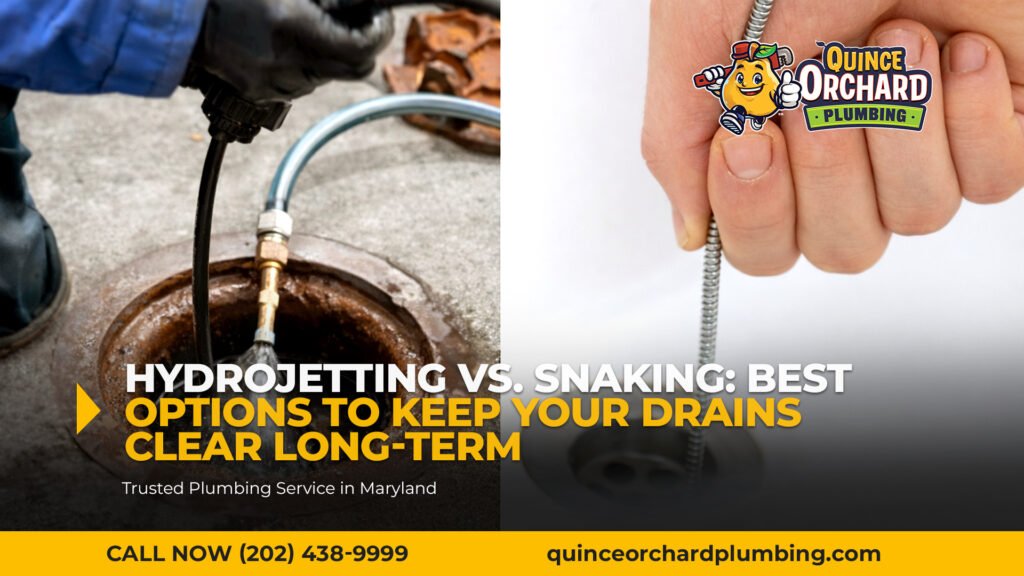
If you’ve dealt with the same slow drain or clog more than once, you’ve probably asked the exact question I hear all the time in Gaithersburg: “Do I need hydrojetting, or will snaking do the job?” Here’s the truth: both work, but they solve different problems. Snaking is often the fastest way to restore flow. Hydrojetting is usually the better choice when your goal is long-term performance—especially if buildup, grease, soap scum, or roots keep coming back. At Quince Orchard Plumbing, our approach is simple: we show up fast, work clean, and focus on fixes that actually hold up, not just quick relief. What “snaking” really does (and why it’s still useful) A drain snake (auger) is designed to break through a blockage and reopen the pathway so water can move again. Snaking is best for: Snaking is not ideal for: In plain terms: snaking often creates a hole through the clog, but it doesn’t always “reset” the pipe back to clean. What hydrojetting really does (and why it lasts longer) Hydrojetting uses high-pressure water to scour the inside of the pipe, removing: Hydrojetting is best for: Hydrojetting isn’t always the first step if: That’s why, when a clog is repetitive or severe, I often recommend confirming what’s happening inside the pipe first. Video Camera Sewer Inspection A camera inspection takes you from “guessing” to knowing—and it helps you avoid paying for the wrong solution. The big difference: “restore flow” vs “restore performance” Here’s how I frame it: If your drain backs up once every few years, snaking may be perfectly fine.If it backs up every few weeks or months, you’re usually dealing with a deeper cause—buildup, roots, or pipe condition. Which option is best for Gaithersburg homes long-term? In Gaithersburg and nearby townhome communities, I see recurring drain issues most often tied to: That’s when the best long-term path tends to look like this: Step 1: Diagnose the line (if it’s recurring or severe) If you’ve had repeat backups, slow drains that return, or multiple fixtures acting up, start here: 👉 Video Camera Sewer Inspection Step 2: Choose the right cleaning method Step 3: Fix the root cause if the pipe is damaged If the camera reveals offsets, bellies, cracks, or collapse risk, cleaning alone won’t be the “forever” solution. 👉 Sewer Line Repair & Replacement That’s how you stop paying for the same problem repeatedly. Common scenarios (and what I’d recommend) 1) “My kitchen sink clogs every couple months” This is often grease + buildup.Best long-term option: hydrojetting (after confirming the line can handle it if needed). 2) “One bathroom sink is slow, everything else is fine” This is usually localized (hair/soap).Best option: snaking, plus cleaning the trap/aerator as appropriate. 3) “Basement drain backs up during heavy usage or storms” This can be a mainline issue, root intrusion, or sewer line condition.Best first step: camera inspection.👉 Video Camera Sewer InspectionIf the line is compromised:👉 Sewer Line Repair & Replacement 4) “We’ve snaked it twice and it keeps coming back” That’s a red flag for buildup, roots, or damage.Best next step: stop guessing—inspect and decide from evidence. Tired of repeat clogs? Book a camera inspection with Quince Orchard Plumbing and get a clear plan—then choose the right fix (snaking, hydrojetting, or repair) based on what’s actually in the line. How to keep drains clear long-term (without constant calls) If you want fewer surprises, this is the maintenance mindset I recommend: This is exactly how we operate at Quince Orchard Plumbing: fast response when you need it, clean work, and a fix that’s built to last—because long-term trust matters more than a temporary patch.

Prevention and Maintenance

Water Quality in Gaithersburg: What Homeowners Should Know About Taste, Odor and Sediment

If you’ve ever poured a glass of water in Gaithersburg and thought, “Why does this taste off?” or noticed a weird smell, cloudiness, or tiny particles in the bottom of the cup—you’re not alone. The good news is that most water-quality complaints come from a handful of predictable causes, and once you know what to look for, you can usually fix the problem (or at least pinpoint whether it’s a plumbing issue inside the home vs. something coming from the main supply). In this guide, I’m going to walk you through taste, odor, and sediment—what they typically mean, what you can check in 5–10 minutes, and when it’s time to call a plumber. First: Is the issue on all faucets, or just one? This is my favorite “fast diagnostic” because it narrows things down immediately. If you do nothing else, do this: Taste issues: what “metallic,” “chlorine,” or “earthy” usually means Chlorine taste A mild chlorine taste can happen in municipal systems, especially after certain maintenance events. If the taste is temporary and doesn’t show up as discoloration, it’s often not a plumbing failure. What I do at home first When I’d call a plumber Metallic taste Metallic taste often points to older internal plumbing, corroded fittings, or a failing service line. Quick checks If you’re seeing metallic taste along with rusty tint, it’s worth having your supply side evaluated. In many cases, addressing aging piping or a compromised line is the long-term fix.👉 Water Line Repair Earthy / musty taste Sometimes this is seasonal, but if it’s only one fixture, it can be localized buildup. What I check Odor issues: the most common smells and what they actually indicate “Rotten egg” smell (sulfur smell) If the odor is strongest on hot water, I immediately suspect the water heater. Water heaters can develop odor issues depending on age, maintenance, and internal conditions. How to confirm This is a very fixable problem, and it’s often cheaper to address early than to wait for a bigger failure.👉 Water Heater Services “Sewage” smell This one gets misdiagnosed all the time. A “sewage” smell is frequently not the water itself—it’s often drain/sewer gas coming from a dry trap, venting issue, or a deeper sewer-line problem. Fast test If odor is recurring—especially in basements or lower-level fixtures—a camera inspection can quickly confirm whether there’s a blockage, damage, or buildup contributing to sewer odors.👉 Video Camera Sewer InspectionAnd if the line is damaged or repeatedly obstructed:👉 Sewer Line Repair & Replacement Chemical smell If water smells strongly chemical (or the smell suddenly changes across the whole home), treat it seriously: Sediment in water: why you’re seeing particles, cloudiness, or “brown water” Sediment usually shows up as: Common causes inside the home Quick checks I recommend If you’re seeing recurring brown water, don’t ignore it. Sediment can shorten fixture life, clog aerators, and create bigger plumbing issues over time. Backflow prevention: a “water safety” piece homeowners overlook When we talk about water quality, most people think taste and odor—but water safety matters just as much. Backflow prevention is about protecting the potable water supply from contamination due to reverse flow conditions. If your property needs testing, repair, or installation, this is where you want a licensed pro handling it.👉 Backflow Prevention Services When this is a “wait and see” vs. a “call now” situation Usually OK to monitor (briefly) Call a plumber if you have any of these Not sure what’s causing the taste, odor, or sediment in your water? Contact Quince Orchard Plumbing to diagnose the issue and recommend the right repair—before it turns into a bigger problem. What I’d do next if you want a clear answer fast If you’re in Gaithersburg and want this solved without guesswork, my approach is simple: That’s how you get from “something seems off” to a real fix.

Scroll to Top