Savings, safety and quality

Savings, safety and quality

The Truth About Chemical Drain Cleaners: When They Help and When They Harm

Chemical drain cleaners are one of the most misunderstood “quick fixes” in plumbing. Sometimes they help. A lot of the time, they waste money, don’t solve the real problem, and can actually make the situation more dangerous—for you and for the plumber who comes after. I’m going to break it down clearly: when chemical drain cleaners can be reasonable, when they’re a bad idea, and what to do instead if you want drains that stay clear long-term. What chemical drain cleaners actually do Most chemical drain cleaners fall into a few categories: The key point: they work best on soft, organic buildup close to the drain opening—not on major obstructions deeper in the line. When chemical drain cleaners can actually help There are situations where a chemical drain cleaner can be a reasonable first attempt—if you’re careful. ✅ Best-case scenarios ✅ If you use one, follow these safety rules When chemical drain cleaners harm more than they help This is where most homeowners get burned (sometimes literally). ❌ 1) Full clogs (standing water) If the drain is fully blocked, the chemical often just sits there. That creates: ❌ 2) Recurring clogs If it clogs again and again, it’s rarely “just hair.” Common root causes include: That’s when the smartest move is diagnosis, not more chemicals:👉 Video Camera Sewer Inspection ❌ 3) Older or compromised piping Chemicals can accelerate issues in: If the line is compromised, chemicals won’t “fix” it—repairs will:👉 Sewer Line Repair & Replacement ❌ 4) Sewer backup symptoms If you have: …that’s not a “pour a bottle and hope” situation. Chemicals can create a hazardous mess without solving the backup. Start with inspection:👉 Video Camera Sewer Inspection ❌ 5) Safety risk to you and your home Chemical cleaners can cause: Never mix drain cleaners. Never mix drain cleaner with bleach, vinegar, or ammonia. The hidden downside: chemicals can make professional service harder Here’s the part most people don’t consider: if you pour chemicals and then call for help, the technician may be working around active caustic or acidic liquid in the line. That can: If you already poured chemicals, tell us before we begin. Better alternatives that are safer (and often work better) If you want a clean drain without chemical roulette: 1) Remove and clean the stopper + hair trap This is the #1 fix for tubs and bathroom sinks. 2) Plunger (used correctly) A good plunge can move a soft clog far better than chemicals. 3) Hot water flush for mild grease/soap buildup This won’t solve major clogs—but it can help with early-stage buildup. 4) If it’s recurring: inspect the line Recurrence is a “diagnose it” signal:👉 Video Camera Sewer Inspection 5) If the line is damaged: repair it If inspection shows pipe failure, repairs end the cycle:👉 Sewer Line Repair & Replacement Not sure if it’s a simple clog or a bigger sewer issue? Schedule a camera inspection with Quince Orchard Plumbing and we’ll help you solve the problem safely—without guessing. Quick decision guide Use this as your rule-of-thumb:

Savings, safety and quality

How to Find and Label Your Main Water Shutoff Valve in a Gaithersburg Home

If you only do one “emergency-prep” task as a homeowner, make it this: find your main water shutoff valve and label it clearly. When a pipe bursts, a supply line fails, or a water heater starts leaking, knowing exactly where to shut off water can be the difference between a quick cleanup and a major repair. I’m going to walk you through the fastest way to locate it in a typical Gaithersburg home or townhome—then how to label it so anyone in the house can find it instantly. What the main water shutoff valve actually controls Your main water shutoff stops pressurized water coming into your home. It helps for: But it will not stop: If you’re dealing with repeated backups or floor drain overflow, that’s when you’d look at: Step 1: Start where the water line enters your home In most Gaithersburg homes, the main shutoff is located near the foundation wall where the main water line enters. Your fastest search pattern: Common locations to check (in order) Pro tip: Follow the largest cold-water pipe you can find. The main shutoff is usually on that line before it branches to fixtures. Step 2: Know what you’re looking for (2 common valve styles) You’ll typically see one of these: 1) Ball valve (best / modern) 2) Gate valve (older) If your shutoff is an old gate valve, I strongly recommend planning an upgrade—especially if it’s hard to turn or doesn’t fully stop flow. If you suspect yours is failing, stuck, or corroded, this is the right service:👉 Water Line Repair Step 3: Test the valve safely (so you’re not “testing” it during a flood) Once you think you’ve found the main shutoff, test it when everything is calm: Important: If the valve feels like it’s going to snap, don’t force it. A broken shutoff becomes an emergency. If the valve doesn’t fully stop the water, it may be failing—and that’s exactly when you replace it before you need it.👉 Water Line Repair Step 4: Label it so a guest could find it in 5 seconds The goal is “zero confusion.” What I recommend labeling with Where to place labels Do this extra step (it’s worth it) Take a photo on your phone and share it in your family group chat with this message:“Main water shutoff is here. Turn OFF in emergencies.” Don’t confuse these shutoffs with the “main” Many homes have multiple valves. Here’s the quick difference: If you’re trying to stop a leaking heater quickly, yes, the heater shutoff helps—but the main shutoff is still the “master switch.”👉 Water Heater Services Want your home to be leak-ready? Quince Orchard Plumbing can help you locate, test, and upgrade your main shutoff valve—so you’re not scrambling during an emergency. What if your main shutoff is hidden, blocked, or hard to reach? This is more common than you’d think—especially in finished basements or storage-heavy utility rooms. If your valve is: …then it’s not an emergency valve. Fix the access now. A simple improvement is clearing the area and adding a clean path. A bigger improvement is upgrading/repositioning hardware when needed:👉 Water Line Repair

Savings, safety and quality

How to Read Your Water Heater’s Energy Label (and Stop Overpaying on Utilities)

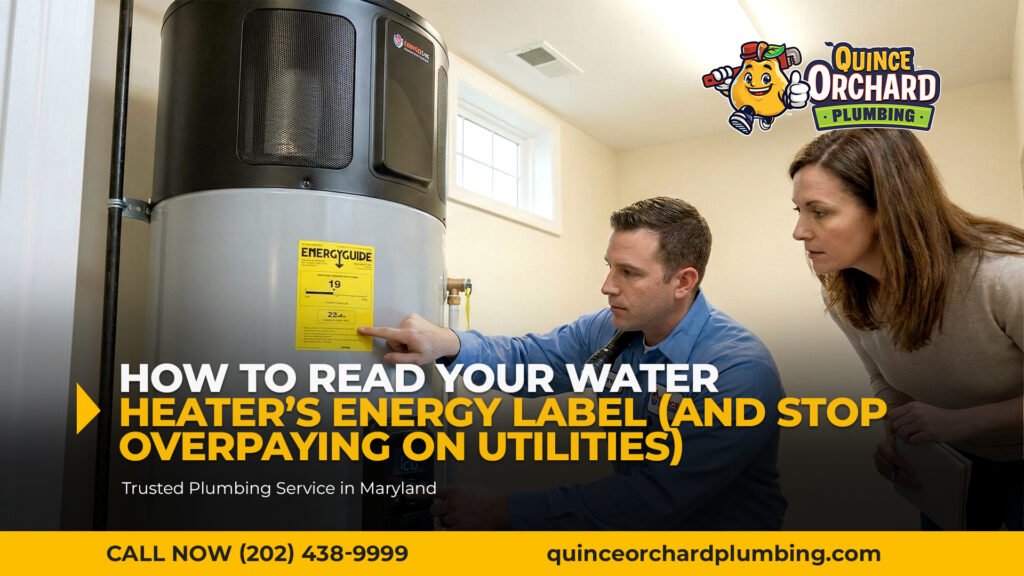
If you’ve ever stared at that bright yellow energy label on a water heater and thought, “Okay… but what does this actually mean for my bill?”—you’re not alone. I’ve seen plenty of homeowners in Maryland pick a unit based on price or brand, then wonder why their utility costs don’t improve (or get worse). Here’s how I read a water heater’s energy label so you can compare models accurately, choose the right size, and stop paying for efficiency you’ll never actually get. What energy label you’re looking at (and where it matters) Most water heaters come with an EnergyGuide-style label that includes: That label is useful—but only if you know how to interpret it for your household. Step 1: Start with the “Estimated Yearly Energy Cost” (but don’t treat it like a promise) This number is a baseline estimate, not your actual bill. It assumes typical usage patterns, standard rates, and standardized testing conditions. I use it for one thing: ✅ Comparing apples-to-apples models (same fuel type, similar capacity) I don’t use it for: ❌ Predicting your exact bill to the dollar If you’re comparing two similar tanks and one has a noticeably lower yearly cost estimate, that’s often the first sign you’re looking at a better efficiency/value option. Step 2: Check the efficiency metric (the number that usually predicts long-term cost) Most newer labels reference an efficiency rating (commonly UEF). In simple terms: My rule of thumb: If your goal is to stop overpaying, you should weigh efficiency heavily—especially if you’re in the home long-term. If you’re not sure whether your current water heater is underperforming, leaking, or simply outdated, this is where an inspection helps:👉 Water Heater Services Step 3: Match the label to your household size (capacity beats “best efficiency” when you’re undersized) A super-efficient unit can still cost you more if it’s the wrong size. Here’s why: if your household “outgrows” the heater, you end up doing things that increase cost and wear: What I look for: If you constantly run out of hot water, choosing purely based on efficiency can backfire. You need right-sized + efficient. Step 4: Use the comparison range the right way (it tells you if you’re near the top or bottom) The label usually shows a scale comparing your model to similar units. This is one of the quickest “at a glance” checks: When two models have similar price tags, the one positioned better on that comparison range often wins over time. Need a 24/7 emergency plumber in Gaithersburg? Call Quince Orchard Plumbing for fast dispatch, clean service, and a clear plan to stop the damage now. Step 5: Know which type of water heater typically saves the most (without getting too “salesy”) Different technologies land on different parts of the efficiency spectrum. In many homes: The energy label helps you compare within a category, but if you’re switching categories (like changing fuel type or upgrading to a different system), you’ll want guidance so you don’t end up with the wrong fit. That’s exactly what we do during an evaluation:👉 Water Heater Services The hidden reasons people overpay (even with a “good” energy label) This is the part most labels don’t tell you: your plumbing conditions can make a great heater perform like an average one. The big culprits: If you suspect supply-side problems are affecting performance, it may be a broader plumbing issue:👉 Water Line Repair “Stop overpaying” checklist (fast wins that usually show up on the next bill) Here’s what I recommend before you replace anything: And if you want the quickest path to a clear recommendation:👉 Water Heater Services Need a 24/7 emergency plumber in Gaithersburg? Call Quince Orchard Plumbing for fast dispatch, clean service, and a clear plan to stop the damage now.

Savings, safety and quality

Emergency Plumbing 101: How to Stabilize a Leak Until the Plumber Arrives

When a leak starts, the goal isn’t to “fully repair” it on the spot—your goal is to stop the water, protect your home, and prevent the damage from spreading until we can get there. Below is exactly how I recommend stabilizing most leaks in a Gaithersburg home, step by step, without risky DIY moves. Step 1: Safety first (do this before you touch anything) If water is near outlets, appliances, or the electrical panel: If you smell gas or suspect a gas-related issue, leave the home and call emergency services + your utility. Step 2: Stop the water—fast (the “big win”) Option A: Shut off the fixture valve (fastest if it’s a sink/toilet) If the valve won’t turn, don’t force it hard—older valves can snap. Option B: Shut off the home’s main water (best for pipe leaks or unknown leaks) If the leak is: Shut off the main water valve. This immediately limits damage. If the issue looks like a supply-line failure, this is typically where professional repair begins:👉 Water Line Repair Step 3: Relieve pressure and reduce ongoing damage After you shut water off: Step 4: Identify what kind of leak it is (so you pick the right “temporary” move) 1) Toilet overflow If there’s a recurring backup or overflow pattern, the fastest way to stop guessing is a camera inspection:👉 Video Camera Sewer InspectionIf the line is damaged or repeatedly obstructed:👉 Sewer Line Repair & Replacement 2) Leak under a sink Common causes: Stabilize it: If the shutoff valve won’t stop the flow, go to main water shutoff and call.👉 Water Line Repair 3) Burst pipe / active spray This is “main shutoff immediately” territory. Then call for repair:👉 Water Line Repair 4) Water heater leaking First determine where the water is coming from: Stabilize it: For diagnosis and safe repairs/replacement:👉 Water Heater Services Step 5: Temporary “containment” tools that actually help (without pretending it’s a real repair) If you can safely access the leaking pipe and the water is off: These are temporary stabilization steps—if the pipe, fitting, or valve is failing, it needs a real repair. Need help right now? Shut off the water, contain the leak, and call Quince Orchard Plumbing for fast, clean emergency service in Gaithersburg. What NOT to do during a leak (these make things worse) The “call now” red flags Call immediately if you have:

Savings, safety and quality

Best Water-Saving Fixtures for Maryland Bathrooms: Showers, Faucets and Toilets

If you’re upgrading a bathroom in Maryland, I always like to start with the upgrades that lower water use immediately without making the bathroom feel “cheap” or low-pressure. The best part? Modern water-saving fixtures can feel better than older hardware—when you choose the right models and install them correctly. In this guide, I’ll break down my favorite water-saving showers, faucets, and toilets, what specs actually matter, and the common “gotchas” that make homeowners regret a purchase (like weak spray, noisy fill valves, or poor flushing). What “water-saving” really means (and what I look for first) When I’m choosing bathroom fixtures for long-term savings, I focus on three things: A good fixture should feel great on day one—and still work smoothly years later. 1) Water-saving showerheads that still feel powerful If you want the most noticeable improvement per dollar, start here. What I recommend looking for The most common shower complaint (and how to avoid it) If someone installs a low-flow showerhead and suddenly the shower feels weak, the cause is often not the showerhead—it’s usually: If multiple fixtures feel weak (not just the shower), that’s when it’s worth checking the supply side.👉 If pressure/flow issues suggests a bigger problem, start with: Water Line Repair Bonus upgrade that saves water and improves comfort A well-tuned water heater makes showers more consistent—especially in busy households. If hot water runs out fast, fluctuates, or the heater is aging, it’s hard to judge any “efficient” showerhead fairly.👉 Water Heater Services 2) Water-saving bathroom faucets that don’t feel “slow” Bathroom sinks are an underrated place to save water, because most older faucets waste a surprising amount during brushing, washing hands, shaving, etc. My go-to options One quick tip that prevents frustration If you install a high-efficiency faucet and it splashes everywhere, you typically need: Efficient doesn’t have to mean annoying. 3) Water-saving toilets: the best long-term “bill reducer” Toilets are usually the biggest water user in the bathroom, so upgrading an older model is often the most meaningful change. What I recommend for most Maryland homes Common toilet problems that waste water silently If you’re trying to save water, fixing a “quiet runner” can sometimes beat upgrading anything. How to choose the right fixtures for YOUR bathroom (simple checklist) Before you buy, I like to answer these: Shower checklist Faucet checklist Toilet checklist The #1 mistake I see with water-saving upgrades People buy efficient fixtures but ignore the system behind them. If you have: …those will make even the best “efficient” fixtures feel disappointing. If you suspect supply-side issues, start here:👉 Water Line Repair If the issue is hot-water performance (temperature swings, slow recovery, old tank), start here:👉 Water Heater Services And if you’re thinking about overall water safety/compliance upgrades as part of a remodel plan:👉 Backflow Prevention Services Ready to upgrade your bathroom fixtures and keep performance strong? Contact Quince Orchard Plumbing for help choosing and installing the right water-saving options for your Maryland home. My “best picks” summary for most Maryland bathrooms If you want a simple, reliable approach: That combo usually delivers the best long-term mix of savings, comfort, and fewer plumbing headaches.

Savings, safety and quality

Low-Flow Faucets & Showerheads: How Much Can You Really Save?

If you live in Gaithersburg or anywhere in Montgomery County, MD, you’ve probably seen “low-flow” or “WaterSense” labels on faucets and showerheads at the store. They promise to cut your water use, lower your bills, and still give you a comfortable shower. But how much can you really save in a typical home in Gaithersburg, Rockville, Germantown, or North Potomac? Is it just a few dollars a year—or does it actually move the needle on your water and energy bills? In this guide, we’ll walk through: All with a local lens on homes served by WSSC Water and similar utilities in Montgomery County. What “Low-Flow” Really Means Today Let’s clear up definitions first. Showerheads Bathroom Faucets In other words, “low-flow” doesn’t mean a sad trickle anymore. It means using current federal standards as a baseline and cutting 20–45% of the water use without sacrificing performance. How Much Water Do Showers and Faucets Actually Use? The EPA estimates that showering accounts for nearly 17% of indoor residential water use, adding up to almost 40 gallons per day for the average family. US EPA Let’s put that into a simple example for a typical Montgomery County household: With a standard 2.5 gpm showerhead: Switching to a 1.5 gpm low-flow showerhead: That’s a 40-gallon-per-day reduction, or about 14,600 gallons per year, just from showering. cranachhome.com The EPA’s more conservative calculation says that replacing a single standard showerhead with a WaterSense model can save the average family about 2,700 gallons of water per year, plus more than $75 per year in combined water and energy costs. US EPA+1 If your household takes longer showers, has more people, or upgrades more than one shower, your savings can be significantly higher than that baseline. Worried about hidden plumbing issues in your new home? Get a full plumbing inspection by trusted local experts — book yours now. What About Bathroom Faucets? Bathroom sinks get a lot of “small” use that adds up: handwashing, brushing teeth, shaving, quick face rinses, etc. According to EPA WaterSense: If you update: And because a chunk of that water is hot, you’re also trimming the energy use from your water heater. Water and Energy Savings in a Montgomery County Context In Maryland, the average monthly water and sewer bill is roughly in the mid-$40s, depending on usage and local rates. Real Estate Statistics+1 Water heating, according to the U.S. Department of Energy, typically represents about 18% of your home’s energy use, making it one of the biggest energy loads after space heating and cooling. The Department of Energy’s Energy.gov+1 Putting this together: Realistically, a household in Gaithersburg, Rockville, or Germantown that upgrades: can often save several thousand gallons of water per year, and tens of dollars per year in water and energy costs—without changing their daily habits at all. If your household has higher-than-average usage (multiple bathrooms, teenagers, long showers), the savings add up faster. “But Will My Shower Feel Weak?” – Comfort vs. Conservation This is the biggest fear we hear from homeowners: “I don’t want to stand under a drizzle just to save a few bucks.” The early low-flow models years ago did feel weak. Modern fixtures are completely different: In short: if you choose at least a WaterSense-labeled showerhead from a reputable brand, you should get a shower that feels as good—or in many cases better—than your older high-flow model, while using 20–40% less water. How to Estimate Your Own Savings: A Simple Bathroom Audit Here’s a quick DIY process you can use in Gaithersburg, North Potomac, or anywhere in Montgomery County to estimate your real savings. 1. Measure Your Current Shower Flow Use the “bucket test”: If you see ~2.5 gallons, you’re at the old standard. If you see ~2.0 or below, you may already have a WaterSense or low-flow head installed. 2. Check Your Bathroom Faucets Look for a marking near the tip of the spout or aerator: If you can’t find a marking, you can run the same 60-second bucket test in the sink (carefully), or simply plan to upgrade based on age and style. 3. Use the EPA Baselines Instead of building a complex spreadsheet, you can lean on the EPA estimates: Then adjust up or down based on your reality: Low-Flow Fixtures vs. Other Plumbing Priorities Low-flow fixtures are one of the easiest upgrades you can make:unscrew, swap, done. But they sit inside a larger plumbing picture. When Low-Flow Fixtures Are a Great First Step They’re ideal when: In these cases, a low-flow showerhead and faucet upgrade can be your “quick win.” When You May Need a Plumber in Addition to Low-Flow Fixtures If you install low-flow fixtures and still have: then it’s time to look beyond the fixtures themselves. A licensed plumber can: Low-flow showerheads and faucets help you use less water. Fixing leaks, correcting pressure problems, and updating an aging heater help ensure that every gallon you do use is doing useful work. Choosing Low-Flow Fixtures That Actually Feel Good When you’re ready to upgrade, here’s what we recommend as plumbers: If you’re planning a more involved bathroom remodel—moving plumbing, upsizing lines, or relocating your water heater—that’s a good moment to loop in a local plumber so the new low-flow fixtures are matched to the rest of the system, not just bolted onto whatever’s there. Worried about hidden plumbing issues in your new home? Get a full plumbing inspection by trusted local experts — book yours now. How This Fits into a Bigger Water-Saving Plan Low-flow faucets and showerheads are only one part of a larger picture that can include: The big picture is simple: you want the water you pay for to arrive reliably, be used efficiently, and leave your home safely. Low-flow fixtures hit the “used efficiently” part in an easy, budget-friendly way.

Savings, safety and quality

Air in Pipes & Low Pressure: Basic Diagnosis and When to Call a Pro

If you turn on a faucet and get a blast of air, sputtering water, or a weak trickle instead of a steady stream, it’s more than just annoying. Air in your plumbing lines and low water pressure often show up together—and they’re both telling you something about what’s happening inside your pipes. In Montgomery County, MD, many homes in areas like Gaithersburg, Rockville, Germantown, North Potomac, and the surrounding communities are 25–40 years old, with plumbing systems that have seen plenty of seasons and remodels. Those aging systems are more prone to leaks, corrosion, and pressure issues, which can let air into the lines or choke off flow if you don’t catch problems early. In this guide, I’ll walk you through: I’ll also point out where services like Water Line Repair, Video Camera Sewer Inspection, and Water Heater Services naturally come into play. Air in Pipes vs Low Pressure: How They Fit Together You can have: In simple terms: Your job as a homeowner is not to diagnose everything perfectly but to recognize patterns that help you decide: Signs You’re Dealing With Air in Your Pipes If you’re wondering whether there’s air trapped in your plumbing, look for these common signs: Some brief sputtering after the water has been off isn’t unusual. Persistent air, especially combined with low pressure, new noises, or dirty water, is a reason to look more closely. Experiencing air in your pipes or low water pressure? let our experts fix it fast—contact us today. Common Causes of Low Water Pressure in Montgomery County Homes Low water pressure by itself is extremely common. Before you assume the worst, it helps to sort it into categories: 1. One Fixture Only If only one sink, shower, or appliance has low pressure, it’s often a fixture-level issue, such as: These are usually good candidates for basic DIY cleaning, as long as you’re comfortable turning off water to that fixture and reassembling it. 2. One Area of the House If one bathroom or one side of the house has lower pressure: This is still diagnosable at home to a point, but it’s also where a pro starts to look at the layout of your plumbing and the materials used. 3. Whole-House Low Pressure If every faucet and shower in the home feels weak: This is where professional Water Line Repair and pressure testing come into play, so you don’t guess at leaks or start opening walls at random. 4. Low Pressure Only on Hot Water If cold water pressure is normal but hot is weak, that usually points toward: In these cases, having a plumber evaluate your heater and piping—through Water Heater Services—is often the fastest way to protect the equipment and restore comfortable flow. Experiencing air in your pipes or low water pressure? let our experts fix it fast—contact us today. Step-by-Step Basic Diagnosis for Homeowners Here’s a practical, basic diagnosis any homeowner in Gaithersburg, Rockville, Germantown, North Potomac, Darnestown, Montgomery Village, Potomac (north), Derwood, Kentlands, or Washington Grove can follow. Paso 1: Confirmar el patrón Walk the house and check: Make a quick mental note. This pattern is what you’ll eventually describe to a plumber if you need help. Step 2: Check the Easy Things First If one fixture suddenly jumps back to normal after cleaning or opening a valve, you’ve likely found the culprit. Step 3: Look for Leak Clues Low pressure can be a symptom of water escaping somewhere else. Walk around and look for: If you suspect a leak in the main line or a buried section, that’s a strong sign to bring in a professional for Water Line Repair before the damage spreads. Step 4: Consider Recent Changes Think back over the last few days or weeks: Those changes can introduce air into the system, shift debris into aerators, or leave a valve partly closed. If air and pressure issues started right after such work, it’s a clue that bleeding the lines and checking valves/aerators may be enough. If they persist, the work could have exposed a weak spot in older piping that now needs attention. Step 5: Bleed Air Out of the Lines Safely For mild, non-repeating air issues after a shutoff: If, after doing this, you still get constant sputtering, loud gurgling, or strange noises, there may be an issue that’s drawing air into the system—such as a leak or complex piping configuration that needs professional diagnosis. When Air in Pipes Is Normal (and When It’s Not) There are times when a little air in the lines is completely expected: Sputtering for a day or so, then returning to normal, is usually not a problem. You should pay closer attention and consider calling a pro when: In those situations, a licensed plumber can pressure-test the system and, if needed, use a Video Camera Sewer Inspection to see exactly what’s going on in buried lines. While camera inspections are typically for sewer and drain lines, they often come into play when we’re trying to sort out complex “air, noise, and low pressure” complaints that might involve both water and drain systems. How Air and Low Pressure Can Damage Plumbing Over Time It’s easy to treat air in the pipes as “just noisy,” but over time, these problems can lead to: In older homes around Gaithersburg, Rockville, and Germantown—many of which have galvanized or mixed piping—the combination of age, air, and low pressure is often a sign that it’s time to plan repairs or partial repiping rather than patching symptoms year after year. When to Call a Professional Plumber: A Simple Decision Guide Here’s a straightforward way to decide when to stop DIY and bring in a local pro like Quince Orchard Plumbing. You Can Usually Try DIY If: Call a Plumber Promptly If: In those cases, a professional can: How Quince Orchard Plumbing Approaches Low Pressure and Air-in-Pipe Problems When you call a local plumber for low pressure or air in your pipes, you don’t just want someone to guess. You want a

Savings, safety and quality

Hard Water at Home: Real-World Signs and Proven Fixes (Montgomery County, MD)

If your faucets collect a white crust, your glasses come out of the dishwasher cloudy, or showers feel… underwhelming, you’re likely dealing with hard water. Below I’ll translate the most common real-world signs into causes and fixes that make sense for homes in Gaithersburg (20878), Rockville, Germantown, North Potomac, Darnestown, Montgomery Village, Potomac (north), Derwood, Kentlands, and Washington Grove. Quick ID Guide: “What I see” → “What it means” → “What to do” Chalky white crust on faucets/showerheads → mineral scale (calcium/magnesium) → descale aerators/heads and consider whole-home softening/conditioning; scale can also narrow pipes and reduce flow. Crystal Quest Water Filters+1 Cloudy/spotty glassware, soap film on tubs → minerals reacting with soap (soap scum) → use rinse aids short-term; long-term, treat hardness to stop residue. Water-Right Dry skin/dull hair after showering → soap doesn’t lather/rinse well in hard water → conditioning or softening improves rinse-off feel. Crystal Quest Water Filters Sluggish showers / lower pressure over time → scale restricting showerheads or piping → descale fixtures; if house-wide, assess piping and heater. Water-Right Water heater rumbling, higher energy bills, less hot water → sediment/scale insulating the heat source → flush/descale and check anode; hardness accelerates wear and energy use. Matilija Pure Water Systems Rusty or green stains in bowls/fixtures → iron/copper in water or corrosion → testing + targeted filtration; inspect supply lines if staining persists. Water-Right Proven Fixes (ranked from “today” to “permanent”) 1) Today (DIY/maintenance) 2) Diagnose (fast and local) 3) Address the source (whole-home) 4) Fix side-effects (as needed) From cloudy glassware to noisy water heaters, hard water quietly damages your home every day. Let our licensed plumbers test your water, recommend the right solution, and protect your pipes and appliances for the long run. Water Heater + Hard Water: What to watch Hardness drives sediment that insulates heating surfaces, causing rumbling, longer heat-up, and higher utility costs; it can also reduce capacity. The fix is straightforward: flush/descale and monitor the anode; for tankless, plan periodic descaling. If symptoms persist, book Water Heater Services and we’ll restore efficiency or size a replacement if needed. Matilija Pure Water Systems Decision Tree (save this) Service Area (Maryland Only) We respond quickly across Gaithersburg (20878), Rockville, Germantown, North Potomac, Darnestown, Montgomery Village, Potomac (north), Derwood, Kentlands, and Washington Grove. From cloudy glassware to noisy water heaters, hard water quietly damages your home every day. Let our licensed plumbers test your water, recommend the right solution, and protect your pipes and appliances for the long run. FAQ Is hard water harmful? The minerals aren’t typically a health risk, but the scale they leave can drive up energy costs and shorten appliance life.  Can I fix this without salt? Yes—salt-free conditioners can reduce new scale adhesion. For heavy hardness and best “feel,” softeners are the gold standard.  How do I confirm hardness? Start with test strips; for exact numbers (gpg, iron, pH), book a professional test so we can size the solution correctly. 

Scroll to Top