Savings, safety and quality

Savings, safety and quality

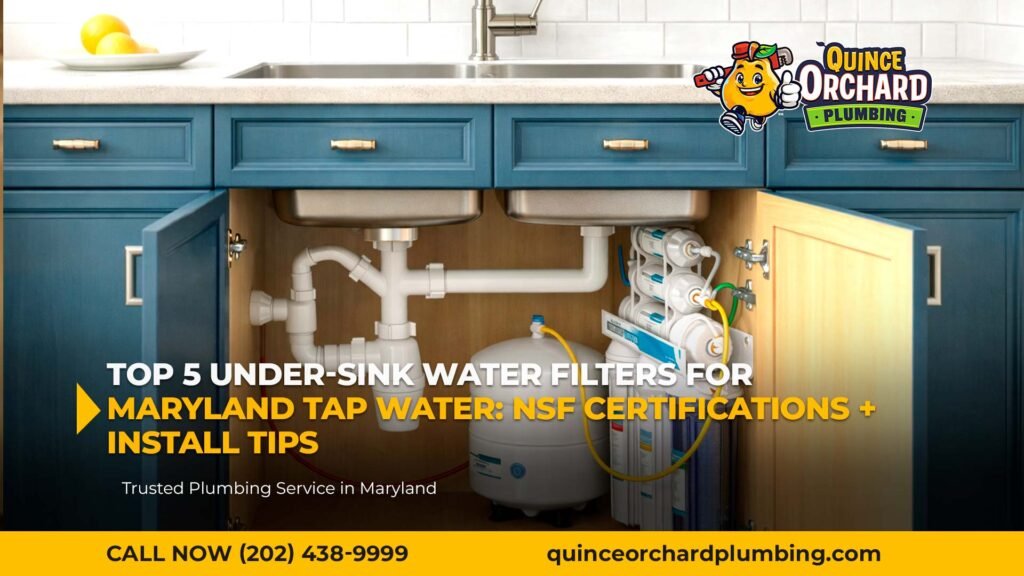
Top 5 Under-Sink Water Filters for Maryland Tap Water: NSF Certifications + Install Tips

Under sink water filters Maryland homeowners choose can make a noticeable difference in taste and peace of mind—especially at the kitchen faucet. In Montgomery County areas like Gaithersburg (20878), Rockville, Germantown, North Potomac, and Kentlands, many families want better drinking water without committing to a whole-house system. Because the “best” filter depends on what you’re trying to reduce, this guide focuses on NSF certifications, practical buying criteria, and installation steps that prevent leaks and low flow. Under sink water filters Maryland: start with your water quality baseline Before you buy anything, it helps to understand what you’re treating. Water quality can vary by neighborhood and provider; therefore, your local Consumer Confidence Report (CCR) is the best starting point. Once you know whether your main concern is chlorine taste, sediment, lead risk, or “overall improvement,” choosing the right filter type becomes straightforward. SF certifications that actually matter (skip the marketing noise) Instead of relying on vague claims like “lab tested,” look for NSF/ANSI certifications. These standards verify what a filter can reduce and under what conditions. Here’s the quick cheat sheet: To verify a specific product claim, use: NSF Certified Products Search Need help installing under sink water filters Maryland homeowners rely on—or dealing with low pressure, leaks, or line issues under the sink? Call Quince Orchard Plumbing for fast, local help in Montgomery County, MD. Top 5 picks: under sink water filters Maryland homeowners typically prefer Rather than pushing one brand, I recommend choosing the right filter category first. After that, compare models by certifications, flow rate, replacement cost, and cartridge availability. 1) High-performance carbon block (best for taste + strong daily flow) Best for: chlorine taste/odor, better flavor, and targeted reductionsLook for: NSF 42 + (ideally) NSF 53; add NSF 401 if you want broader coverageWhy it works: carbon block systems often keep a “normal faucet feel” without RO wastewater. Install tip: mount the bracket into solid cabinet framing so vibration doesn’t loosen fittings over time. 2) Reverse osmosis (RO) system (best for broad reduction) Best for: homeowners who want the most comprehensive under-sink optionLook for: NSF 58 + a clear maintenance scheduleWhy it works: RO can reduce a wider range of dissolved solids and contaminants. Trade-off: RO usually creates wastewater and may require a drain connection; consequently, installation quality matters more than with simple carbon systems. If your home already struggles with low pressure, RO can feel slow. In that case, it’s smart to address supply stability first. When pressure issues affect multiple fixtures, Water Line Repair can help rule out restrictions before you invest. 3) Ultra-filtration (UF) (best “middle ground” without RO) Best for: households that want excellent clarity while keeping strong flowLook for: micron rating + relevant NSF claims (varies by model)Why it works: UF can be a practical compromise—better filtration than basic systems, simpler than RO. 4) Quick-change cartridge systems (best for easy maintenance) Best for: busy families, rentals, and anyone who wants clean swapsLook for: NSF certifications + replacement schedule you’ll actually followWhy it works: quick-change designs reduce mess and increase compliance. Practical rule: pick a system with widely available cartridges. Otherwise, the “best” unit becomes a problem the first time replacements are hard to find. 5) High-capacity multi-stage systems (best for large households) Best for: families that drink a lot of filtered waterLook for: high capacity rating + stable mounting designWhy it works: fewer cartridge changes and consistent performance over time. Install tip: leave clearance for cartridge removal. In addition, avoid cramming the system into a corner where service becomes impossible. Installation tips that prevent leaks, low flow, and cabinet damage Most under-sink filter issues come from rushed installs. For that reason, use this checklist and you’ll avoid the most common mistakes. Tools & supplies Under-sink installation checklist Two “silent leak” warnings If the shutoff valve is old or won’t fully close, replacing it first often prevents a disaster. Similarly, if you suspect supply-side issues, Water Line Repair can help stabilize flow and pressure. DIY vs. pro install (quick decision) DIY is usually fine when: Call a plumber when: If an RO drain connection or persistent odors point to drain issues, a Video Camera Sewer Inspection can confirm what’s happening inside the line. When repairs are needed, Sewer Line Repair & Replacement is the next step. Need help installing under sink water filters Maryland homeowners rely on—or dealing with low pressure, leaks, or line issues under the sink? Call Quince Orchard Plumbing for fast, local help in Montgomery County, MD. FAQ: Under sink water filters Maryland homeowners ask about Do I really need NSF certification? Yes. NSF certification is a more reliable benchmark than vague “tested” claims; therefore, it’s the best way to compare performance apples-to-apples. Which is better: carbon, UF, or RO? Carbon is great for taste and targeted reduction with strong flow. UF is a solid middle ground. RO usually offers broader reduction, although it can be slower and creates wastewater. How often should I replace cartridges? It depends on capacity and usage. However, many households replace every 6–12 months (or per manufacturer guidance) to avoid flow loss and performance drop. Will an under-sink filter reduce water pressure? It can if cartridges clog, the system has low flow capacity, or supply pressure is already weak. Consequently, flow specs and a healthy shutoff valve matter. Service Area (Maryland only) Quince Orchard Plumbing serves Gaithersburg (20878), Rockville, Germantown, North Potomac, Darnestown, Montgomery Village, Potomac (north), Derwood, Kentlands, and Washington Grove.
Savings, safety and quality

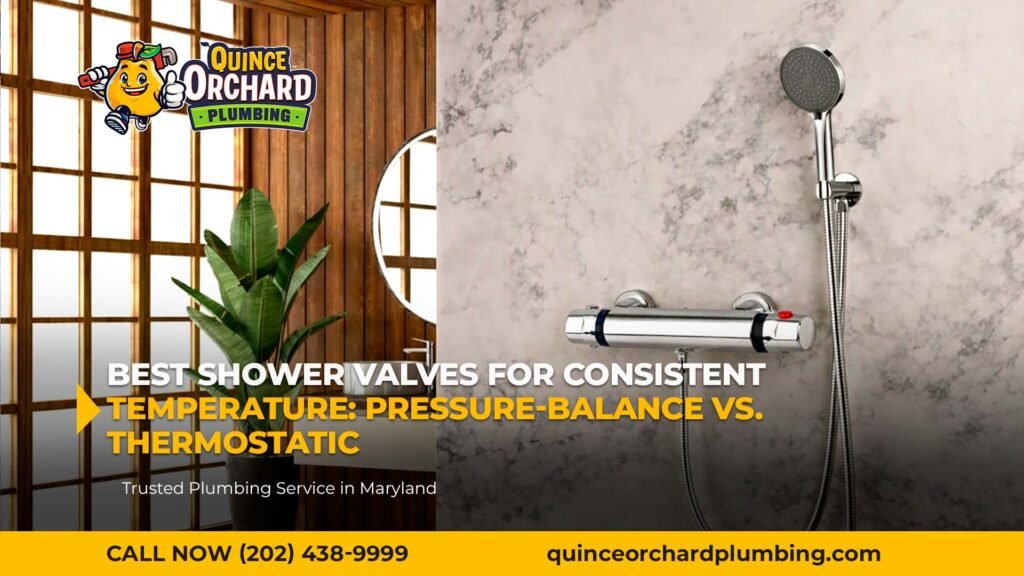
Best Shower Valves for Consistent Temperature: Pressure-Balance vs. Thermostatic (Install Guide)

When homeowners ask us about the best shower valves for consistent temperature, the reason is almost always the same: sudden hot/cold swings when someone flushes a toilet, runs the dishwasher, or turns on another faucet. In Montgomery County, MD—especially in Gaithersburg (20878), Rockville, Germantown, and North Potomac—these temperature shifts are common in older bathrooms, builder-grade setups, and remodels where the valve was never upgraded. Fortunately, you don’t have to “live with it.” Instead, you can choose a shower valve designed to stabilize temperature, and then install it correctly so it performs the way it should. In this guide, we’ll compare pressure-balance vs thermostatic valves, explain which one fits your home, and walk you through an install plan that prevents hidden leaks and repeat repairs. Best shower valves for consistent temperature: what “consistent” really means A steady shower temperature depends on two things working together: In other words, a great valve can’t fully overcome a bigger supply problem. For example, if water pressure is unstable throughout the home (not just the shower), the best long-term fix may start upstream. In that case, our Water Line Repair team can help diagnose restrictions, failing shutoffs, or supply issues that affect multiple fixtures. Best shower valves for consistent temperature: pressure-balance vs thermostatic Both valve types can improve comfort. However, they solve the problem differently. Pressure-balance shower valves (how they work) A pressure-balance valve keeps shower temperature safer by balancing pressure changes between hot and cold. So, when cold pressure drops (someone opens another fixture), the valve reduces hot flow too. As a result, you’re less likely to get a sudden blast of very hot water. Pros Cons Best for: most homes that want a reliable upgrade without going premium. Thermostatic shower valves (how they work) A thermostatic valve regulates the hot/cold mix to maintain a target temperature more precisely. Therefore, it typically offers better comfort during longer showers and in showers with multiple outputs. Pros Cons Best for: homeowners who want the most stable temperature experience and are investing in a higher-end shower. Quick comparison: which one should you choose? Feature Pressure-Balance Thermostatic Best benefit Anti-scald stability “Set and hold” temperature Comfort Good Excellent Cost Lower Higher Controls Often single-handle Often separate temp/volume Multi-head showers Sometimes Commonly preferred Practical takeaway: If your goal is safer, more stable showers for everyday use, a pressure-balance valve is often the best value. On the other hand, if you want premium comfort and dialed-in temperature control, thermostatic is usually the better choice. Signs the shower valve is the real problem (not the showerhead) A showerhead replacement won’t fix these issues: Also, if hot water is inconsistent across the house—long waits, fast cooling, or temperature drift—your water heater may be part of the equation. In that situation, our Water Heater Services can help evaluate settings, recovery, and performance. For safety context, you can reference: CPSC hot water scald safety. Need help choosing or installing the best shower valves for consistent temperature? Call Quince Orchard Plumbing for fast, local help in Montgomery County, MD. Install guide: how to replace a shower valve safely (rough-in to trim) Replacing a shower valve is different from swapping a faucet because the valve sits inside the wall. For that reason, planning and leak testing are non-negotiable. Before you start, confirm what you have Install steps (high-level, real-world sequence) Why depth matters: If the valve sits too deep or too shallow, the trim may not seal correctly. Consequently, you can end up with hidden moisture damage even if it “works.” For a standards reference on temperature/pressure control valves, see: ASSE standards overview. DIY vs. call a plumber (fast decision) DIY can be reasonable when: Call a plumber when: If pressure issues show up throughout the house, addressing stability first via Water Line Repair often saves time and money. Troubleshooting: still getting hot/cold swings after replacement? If you upgraded and the shower still isn’t stable, these causes are common: 1) Partially closed or failing shutoff valves Sometimes shutoffs don’t open fully, and the flow becomes unpredictable. As a result, the valve can’t mix consistently. 2) Debris in the cartridge After plumbing work, sediment can lodge in the cartridge. Therefore, the mixing behavior can drift until the cartridge is cleaned or replaced. 3) Water heater temperature and recovery issues If hot water is inconsistent, the valve can’t “create” stable hot water. In that case, schedule Water Heater Services to verify safe temperature, delivery, and recovery. For DOE guidance on temperature settings, see: U.S. Department of Energy – water heater temperature. 4) Supply restrictions (older lines) Older or partially restricted lines can cause uneven pressure. Consequently, the shower may change when other fixtures run. Need help choosing or installing the best shower valves for consistent temperature? Call Quince Orchard Plumbing for fast, local help in Montgomery County, MD. FAQ: Best shower valves for consistent temperature Which is better for consistent temperature: pressure-balance or thermostatic? Thermostatic usually provides the most consistent temperature. However, a quality pressure-balance valve is often the best value for most homes. Will a thermostatic valve fix low shower pressure? Not always. If low pressure is caused by restrictions or supply issues, you’ll need to fix the cause first. That’s why Water Line Repair can be the right next step. Can a bad shower valve cause constant dripping? Yes. A worn cartridge or damaged valve components can cause dripping even when the shower is “off.” Service Area (Maryland only) Quince Orchard Plumbing serves Gaithersburg (20878), Rockville, Germantown, North Potomac, Darnestown, Montgomery Village, Potomac (north), Derwood, Kentlands, and Washington Grove.
Savings, safety and quality

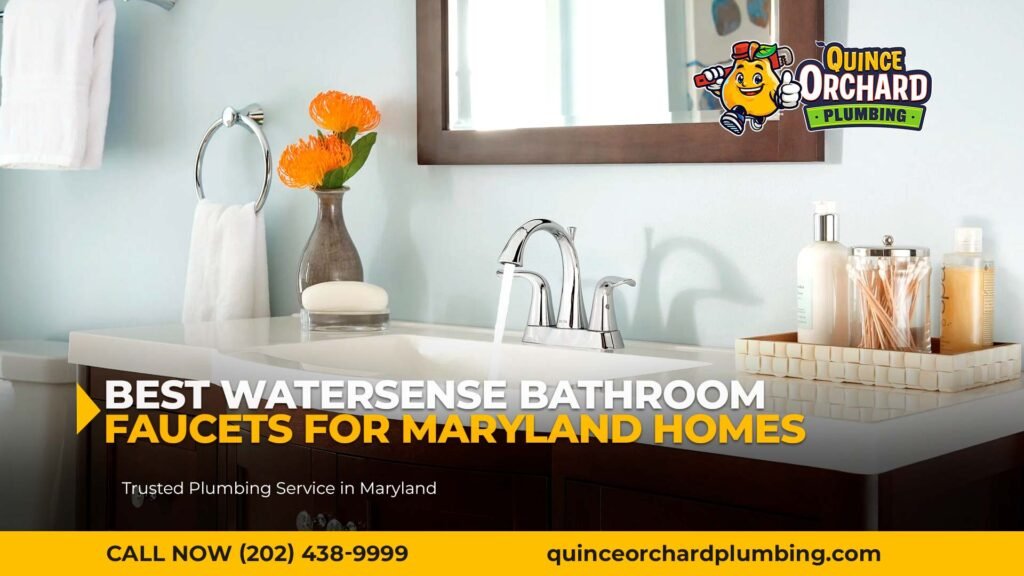
Best WaterSense Bathroom Faucets for Maryland Homes (2026): Top 5 Picks + Install Checklist

Choosing WaterSense bathroom faucets is one of the easiest upgrades you can make in a Maryland home. You get lower water use without sacrificing everyday comfort—especially if you pick a faucet with a durable finish, a solid cartridge, and a proven parts ecosystem. However, even the best faucet can drip or loosen if the install is sloppy, so this guide includes a pro install checklist too. This article is for homeowners in Gaithersburg (20878) and nearby Montgomery County areas including Rockville, Germantown, North Potomac, Darnestown, Montgomery Village, Potomac (north), Derwood, Kentlands, and Washington Grove. WaterSense bathroom faucets: what WaterSense actually means WaterSense labels help you identify bathroom faucets that meet EPA efficiency and performance requirements. Therefore, it’s a smart filter when you want water savings without buying “weak” fixtures.Reference: https://www.epa.gov/watersense/bathroom-faucets Also, if you care about material safety and certification, review: What to look for in 2026 When you compare WaterSense bathroom faucets, prioritize these real-world durability factors: Additionally, match the faucet to the sink setup (hole count, deck thickness, and vanity clearance) before you buy. Need help selecting or installing WaterSense bathroom faucets, or replacing old shutoffs to prevent leaks? Call Quince Orchard Plumbing for fast, local service in Montgomery County, MD. The best finishes for Maryland homes Maryland homes often deal with mineral spotting and everyday humidity. As a result, these finishes usually hold up best: In contrast, polished chrome looks great but shows spots more easily. WaterSense bathroom faucets: 5 reliable picks for Maryland (2026) These are dependable faucet “families” from brands with strong parts support. Importantly, choose the WaterSense-labeled version of the model/line when you purchase (check the listing or box). 1) Delta (Trinsic / Lahara-style lines) Best for: a durable, modern look with broad parts availability.Why it’s a strong pick: easy to service later and commonly stocked. 2) Moen (Genta / Align) Best for: smooth handle feel and reliable internals with easy replacement parts.Why it’s a strong pick: strong brand support and wide availability. 3) KOHLER (Hint / Devonshire) Best for: homeowners who want a premium feel and consistent build quality.Why it’s a strong pick: good finishing and a strong retailer ecosystem. 4) American Standard (Studio / Colony) Best for: budget-friendly WaterSense options that still feel solid.Why it’s a strong pick: practical replacements for rental properties or secondary baths. 5) Pfister (Jaida / Ladera) Best for: value-focused upgrades with good styling options.Why it’s a strong pick: often priced competitively while still offering serviceable parts. Tip: If you want to double-check whether a specific model is WaterSense-labeled, use the EPA WaterSense faucet resources above. https://www.epa.gov/watersense/bathroom-faucets WaterSense bathroom faucets: pro installation checklist Use this checklist to avoid leaks, loose handles, and call-backs. Before you remove the old faucet If a shutoff valve is seized or won’t fully stop water, don’t force it—old valves can fail. In that case, get help through Water Line Repair. Removal checklist Install checklist (the “no leak” sequence) After-install “performance” checks If hot water feels inconsistent after the install, the issue may relate to the heater or mixing behavior—check Water Heater Services. WaterSense bathroom faucets: when to call a plumber Call a plumber if: For valve/supply line work, start with Water Line Repair. Need help selecting or installing WaterSense bathroom faucets, or replacing old shutoffs to prevent leaks? Call Quince Orchard Plumbing for fast, local service in Montgomery County, MD. Service Area (Maryland only) Quince Orchard Plumbing serves Gaithersburg (20878), Rockville, Germantown, North Potomac, Darnestown, Montgomery Village, Potomac (north), Derwood, Kentlands, and Washington Grove.

Savings, safety and quality

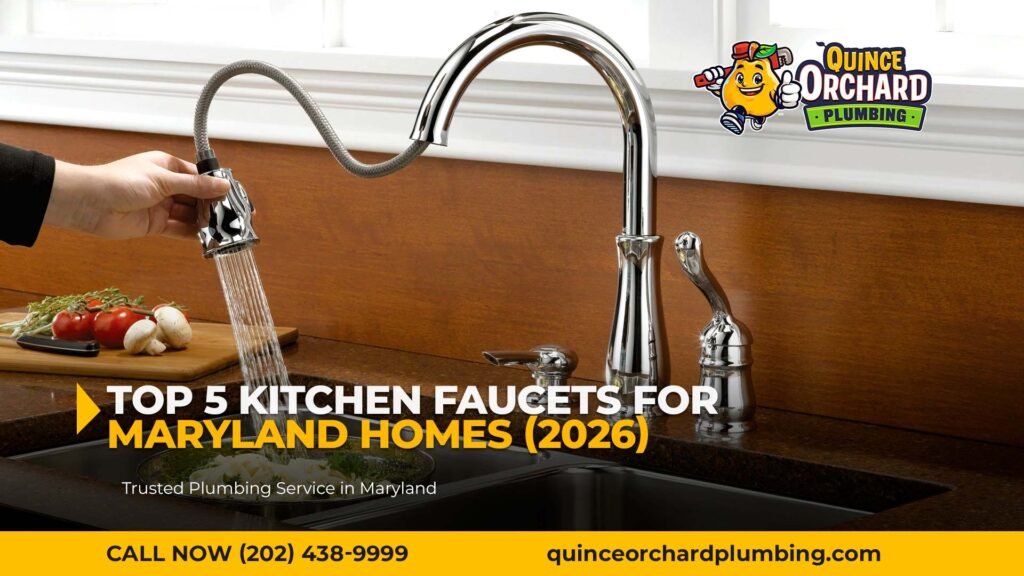
Top 5 Kitchen Faucets for Maryland Homes (2026): Durable Finishes + Pro Installation Tips

Choosing kitchen faucets for a Maryland home is less about “what looks nice” and more about what stays tight, resists spots, and doesn’t drip after a year of daily use. Fortunately, a few design and finish details make a big difference—especially in homes with hard-water residue, busy households, and high-use kitchens. This guide is for homeowners in Gaithersburg (20878) and nearby Montgomery County areas including Rockville, Germantown, North Potomac, Darnestown, Montgomery Village, Potomac (north), Derwood, Kentlands, and Washington Grove. Kitchen faucets: what “durable” really means in 2026 When you compare kitchen faucets, prioritize the parts that fail most often: For safety, look for lead-free certification marks and verified standards—CPSC explains the basics here Need help choosing or installing kitchen faucets—or replacing old shutoff valves to prevent leaks? Call Quince Orchard Plumbing for fast, local help in Montgomery County, MD. Kitchen faucets: durable finishes that hold up best If you want a faucet to stay looking clean with less wiping, these finishes usually perform best: Kitchen faucets: 5 reliable picks for Maryland homes (2026) These are popular, long-running lines with strong parts support and proven daily-use performance. (Choose the model variant that matches your hole count and finish.) 1) Delta Leland (pull-down) A well-known workhorse with broad availability and strong overall user satisfaction; it’s frequently recommended in tested roundups.Best for: families who want a classic high-arc pull-down that’s easy to live with. 2) Moen Arbor (pull-down) Consistently recommended for build quality and everyday ergonomics, and it’s a common “safe pick” for long-term serviceability.Best for: homeowners who want smooth handling and wide parts availability. 3) Delta Trinsic (pull-down) A modern, cleaner look that still lands in “top picks” lists.Best for: updated kitchens where you want a more minimal design but still want reliable internals. 4) Kohler Simplice (pull-down / touchless variants exist) Often highlighted as a strong upgrade pick, including touchless options depending on the exact model.Best for: homeowners who want a premium feel and a clean pull-down experience. 5) Moen “Spot Resist” series models (e.g., Sleek / similar pull-downs) If your top priority is fewer fingerprints and less spotting, Moen’s Spot Resist stainless finish is designed for that.Best for: busy kitchens where appearance and low-maintenance cleaning matter most. Kitchen faucets: what to check before you buy Before you order anything, confirm these three things (it prevents 80% of install headaches): If your shutoff valves or supply lines are questionable, it’s smarter to address that through Water Line Repair rather than risk a surprise leak. Kitchen faucets: pro installation tips that prevent leaks Here’s what makes installs last (especially in older homes): Also, if your hot-side pressure or temperature seems inconsistent after install, the issue may tie back to the heater or mixing behavior—check Water Heater Services. DIY vs calling a plumber DIY is fine if: Call a pro if: For under-sink valve and supply work, start here: Water Line Repair. If you want a safety reference on choosing faucets and lead-free certification marks, review CPSC guidance and NSF’s consumer resources Need help choosing or installing kitchen faucets—or replacing old shutoff valves to prevent leaks? Call Quince Orchard Plumbing for fast, local help in Montgomery County, MD. Service Area (Maryland only) Quince Orchard Plumbing serves Gaithersburg (20878), Rockville, Germantown, North Potomac, Darnestown, Montgomery Village, Potomac (north), Derwood, Kentlands, and Washington Grove.

Savings, safety and quality

Best Water Heater Expansion Tanks (2026): 5 Picks + How to Choose the Right Size

A water heater expansion tank helps protect your plumbing from pressure spikes caused by thermal expansion. As a result, it can reduce relief valve dripping, noisy pipes, and wear on fixtures—especially in homes with a closed system. Water heater expansion tank: what it does (and why you might need one) When water heats, it expands. In an open system, that extra volume can push back toward the supply. However, in a closed system (often created by a PRV, check valve, or backflow device), pressure can rise quickly and stress the water heater and connected fixtures. For a helpful overview of water heating basics, see DOE:https://www.energy.gov/energysaver/water-heating If you want a pro to confirm your system type and install correctly, start here: Water Heater Services. Water heater expansion tank: signs you may need one You may benefit from an expansion tank if you notice: Additionally, if whole-home pressure seems high or unstable, a PRV issue may be involved. In that case, start with Water Line Repair. Water heater expansion tank sizing: how to choose the right size Sizing is mainly about: Step 1: Find static PSI First, stop all water use. Then, check pressure at a hose bib with a gauge. Finally, write that PSI down. Step 2: Match precharge to PSI Next, set the expansion tank air precharge to match your home’s static PSI. Otherwise, the tank won’t accept expansion properly. Step 3: Use a sizing chart (best practice) Instead of guessing, use a proven chart. Amtrol’s sizing guide is a solid reference:https://s3.supplyhouse.com/product_files/Amtrol%20-%20142-149%20-%20Sizing%20Guide.pdf In general, many 40–50 gallon heaters pair with a smaller tank class, while larger heaters or higher PSI often need a bigger tank. Therefore, the chart is the safest way to avoid undersizing. Need the right water heater expansion tank size and a clean install? Call Quince Orchard Plumbing for Water Heater Services in Montgomery County, MD. 5 reliable picks (2026) Choose the correct size class first, and then pick the brand/model you can service easily later. Water heater expansion tank install: what matters most Even a correctly sized tank can underperform if the install is sloppy. If you suspect high pressure or a failing PRV, we can help through Water Line Repair. Common mistakes to avoid DIY vs call a pro DIY may be reasonable if: Call a pro if: Start here: Water Heater Services. Need the right water heater expansion tank size and a clean install? Call Quince Orchard Plumbing for Water Heater Services in Montgomery County, MD. Service Area (Maryland only) Quince Orchard Plumbing serves Gaithersburg (20878), Rockville, Germantown, North Potomac, Darnestown, Montgomery Village, Potomac (north), Derwood, Kentlands, and Washington Grove.
Savings, safety and quality

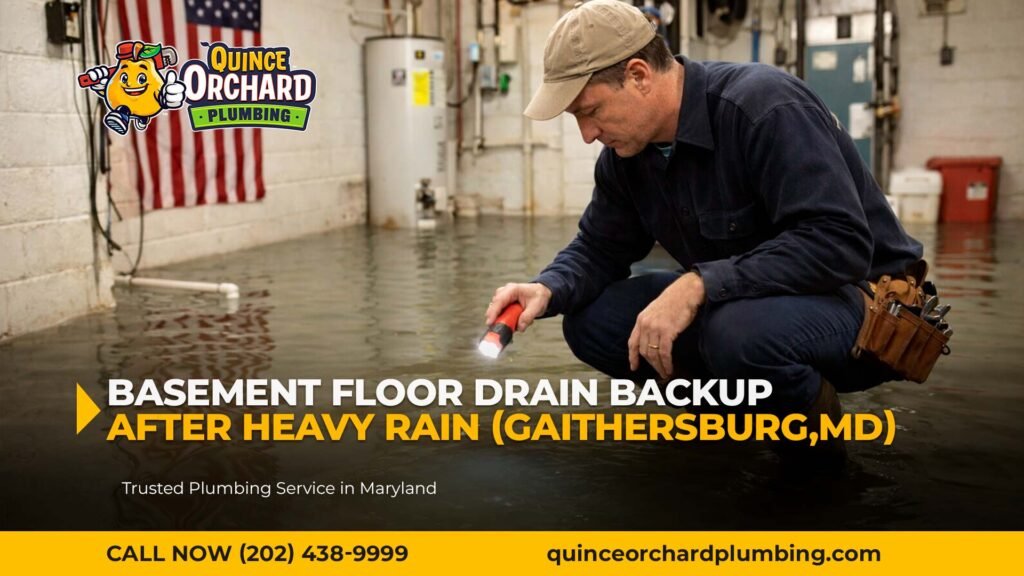
Basement Floor Drain Backup After Heavy Rain (Gaithersburg, MD): Causes, Quick Checks & When to Call

A basement drain backup after heavy rain is one of the most stressful plumbing problems because it can happen fast and cause damage quickly. However, a few safe checks can reduce the mess and help you figure out whether the issue is a sewer surcharge, a clogged house line, or a basement system problem. This guide is written for homeowners in Gaithersburg (20878) and nearby Montgomery County areas like Rockville, Germantown, North Potomac, Darnestown, Montgomery Village, Potomac (north), Derwood, Kentlands, and Washington Grove. Basement drain backup: first steps during heavy rain If you suspect a basement drain backup, take these steps right away: Is it sewage or clear water? Before troubleshooting, identify what’s coming up. Signs it’s sewage (treat as urgent) Signs it might be clear water If it’s sewage, call a plumber. If it’s clear water, act quickly anyway to prevent mold. For cleanup guidance after flooding, EPA has a helpful resource here: Flooded Homes Cleanup Guidance (EPA). Need help with a basement drain backup after heavy rain? Call Quince Orchard Plumbing for a sewer camera inspection and clear next steps in Gaithersburg and Montgomery County, MD. Basement drain backup after heavy rain: the most common causes 1) Municipal sewer surcharge (storm overload) During intense rain, the sewer system can surcharge. As a result, wastewater may push backward into the lowest opening—often a basement floor drain.Local note: WSSC Water explains sewer backups can be caused by issues in the main or the service line and responsibility can vary. Sewer Blockages & Backups (WSSC Water). Clue: backups happen during or right after storms, then improve later. 2) Partial blockage in your house sewer line (roots, buildup, offset) Heavy rain can increase flow and expose a restriction that’s “almost fine” on normal days. Therefore, you get backups when demand rises. If you want certainty fast, schedule Video Camera Sewer Inspection. 3) Sewer line belly (sag) or grade issue A belly is a low spot that holds water and solids. Snaking may help temporarily; however, the symptom often returns because the slope problem remains. If the camera confirms structural defects, repairs usually fall under Sewer Line Repair & Replacement. 4) Basement bathroom ejector pump issue If you have a basement bathroom, it may rely on a sewage ejector pump. When it fails, backups can appear quickly. Clue: ejector alarm, sewage smell near the pit, or basement fixtures are the only ones affected. 5) Not a drain backup at all (water heater or supply leak nearby) Sometimes the “backup” is actually water from a mechanical leak near the floor drain. If you see water around the heater, start with Water Heater Services. Basement drain backup: quick checks you can do safely These checks won’t solve everything, but they speed up diagnosis. Check 1: Are multiple fixtures slow or gurgling? 2: Does the basement drain backup happen only after heavy rain? 3: Locate the cleanout (don’t open if sewage is present) If you know where the sewer cleanout is, clear access so a plumber can work faster. Check 4: Confirm the sump pump works (if you have one) A sump issue can raise water levels and look like a drain problem. Meanwhile, a true sewer backup usually brings odor and dirty water. When to call for a basement drain backup Call immediately if: For diagnosis, start here: Video Camera Sewer Inspection.If damage is confirmed, you’ll likely need: Sewer Line Repair & Replacement. For general background on why sanitary sewers overflow and what contributes to it (wipes/FOG, system issues), EPA explains it here: Sanitary Sewer Overflow FAQ (EPA). Need help with a basement drain backup after heavy rain? Call Quince Orchard Plumbing for a sewer camera inspection and clear next steps in Gaithersburg and Montgomery County, MD. Service Area (Maryland only) Quince Orchard Plumbing presta servicios en Gaithersburg (20878), Rockville, Germantown, North Potomac, Darnestown, Montgomery Village, Potomac (norte), Derwood, Kentlands y Washington Grove .

Savings, safety and quality

Best WaterSense Showerheads for Low Pressure Homes: 7 Picks That Don’t Feel Weak

If your shower feels like a drizzle, a “high pressure” showerhead alone won’t always fix it—especially in older homes and townhomes (very common across Montgomery County, MD). Many properties in areas like Gaithersburg (20878), Rockville, Germantown, North Potomac, Derwood, and Montgomery Village are 25–40 years old, and low-pressure showers are often a mix of fixture design + plumbing conditions. The good news: you can get a satisfying shower while still saving water. You just need a WaterSense-labeled showerhead that’s engineered to feel stronger at ≤ 2.0 GPM, and you should rule out a few common “hidden” causes first. What WaterSense means (in plain English) A WaterSense-labeled showerhead is certified to use no more than 2.0 gallons per minute while still meeting performance requirements. In other words, it’s not supposed to feel weak just because it saves water. For low-pressure homes, that performance piece matters: you want spray designs that deliver better coverage, droplet “weight,” and pattern concentration at a regulated flow rate. Before you buy: 5 safe checks that often fix “low pressure” fast Do these first—because if the issue is upstream, even the best showerhead will disappoint. 1) Is it only one shower… or the whole house? If pressure is low across multiple fixtures, we often end up diagnosing the supply side and doing Water Line Repair work (or related pressure corrections) rather than swapping fixtures repeatedly. 2) Remove the showerhead (carefully) and test the flow With the showerhead off, turn the water on briefly: 3) Check for mineral buildup (hard water symptoms) Look for white crust or uneven spray jets. Many “low pressure” complaints are just scale. Soaking the showerhead in vinegar (if the manufacturer allows it) can help. 4) Verify the shower valve is opening fully Some single-handle valves don’t open fully if the cartridge is worn or debris is trapped. This is common in older homes around Kentlands, Washington Grove, and parts of Rockville. 5) Quick pressure reality-check (optional but useful) If you have (or can borrow) a simple hose-bib pressure gauge: If you suspect a pressure regulation issue, it’s usually worth a pro diagnosis before buying more fixtures. Low pressure shower in Gaithersburg, Rockville, or Germantown? Call Quince Orchard Plumbing for fast, local diagnosis and the right fix. What makes a WaterSense showerhead feel “strong” in low pressure homes? This is the part most “best showerhead” lists skip. The 4 features that matter most A quick decision guide 7 WaterSense showerhead picks that don’t feel weak (great for low pressure homes) 1) Delta H2Okinetic (PowerDrench-style) fixed head — Best overall “strong feel” Why it works: H2Okinetic designs are made to feel like more water and better coverage at a regulated flow rate.Best for: homeowners who want a simple upgrade that still feels satisfying in older plumbing.Good fit in: Gaithersburg, Germantown, and North Potomac homes where pressure feels “meh” but not terrible. 2) Delta In2ition + H2Okinetic dual head — Best combo for families Why it works: you get a fixed head + handheld (great for rinsing, kids, pets, and cleaning) while still staying WaterSense.Best for: busy households who want flexibility without sacrificing comfort. 3) Moen Attract with Magnetix (dual head) — Best “easy handheld” setup Why it works: magnetic docking makes the handheld easy to use daily (not just as a gimmick).Best for: households that want quick usability and multiple spray options. 4) Speakman Icon Anystream (WaterSense 2.0 GPM) — Best adjustable “hotel-style” spray Why it works: Speakman’s lever-style adjustment is popular for dialing in a stronger-feeling spray without changing plumbing.Best for: people who want to fine-tune feel day to day (especially helpful when pressure varies). 5) KOHLER Katalyst (Purist line, WaterSense) — Best “luxury feel” that still saves water Why it works: air-induction style sprays can feel fuller and more substantial while staying efficient.Best for: primary bath upgrades in Rockville, Kentlands, or Potomac (north) where comfort and finish quality matter. 6) Waterpik (WaterSense high-performance models) — Best for “massage/targeted spray” feel Why it works: many WaterSense models focus on spray force and pattern options—helpful when low pressure makes a basic rain spray feel weak.Best for: anyone who prefers a more focused spray rather than a wide, soft pattern. 7) Niagara Earth (WaterSense, pressure-compensating style) — Best for inconsistent pressure Why it works: pressure-compensating designs are useful when your available pressure changes (time of day, neighborhood demand, etc.).Best for: older townhomes in Montgomery Village, Derwood, or Darnestown where pressure can fluctuate. Pro tip: If you love the look of big “rain” heads, be careful—wide sprays often feel weaker at low pressure unless the spray tech is designed to compensate. Installation tips (older plumbing-friendly) Most showerheads are DIY-friendly, but older plumbing adds a few “gotchas.” Do this to avoid leaks and weak performance Skip “flow restrictor removal” Besides being a bad idea for efficiency and potential code compliance, removing restrictors can create other issues (temperature instability, faster hot water depletion, and more wear on fixtures). If the shower is weak, it’s better to fix the real cause. Low pressure shower in Gaithersburg, Rockville, or Germantown? Call Quince Orchard Plumbing for fast, local diagnosis and the right fix. When a new showerhead won’t fix the problem Call a plumber if any of these are happening: If hot water performance is part of the issue (slow recovery, temperature swings, not enough hot water), our Water Heater Services team can diagnose whether the heater, mixing, or plumbing is the real bottleneck. If the underlying issue is supply-side restriction, leak, or pressure correction, we can help through Water Line Repair. FAQs Do WaterSense showerheads always feel weak? No—many are designed specifically to maintain a satisfying spray at lower flow, but the spray technology matters. What’s the best flow rate for low-pressure homes? Most people prefer 1.75–2.0 GPM WaterSense models with spray tech that improves coverage or droplet feel. Why does my shower feel weaker than my sink faucet? Showers rely heavily on valve condition, cartridge flow, and the showerhead’s internal design. A clogged showerhead or aging cartridge can cut

Savings, safety and quality

Best WaterSense Toilets for Older Plumbing: 7 Picks That Flush Strong

If you live in an older home, you’ve probably heard the warning: “Don’t switch to a low-flow toilet—your pipes will clog.” The truth is more nuanced. A WaterSense-labeled toilet can absolutely flush strong and save water—as long as you choose the right flush design and your drain line is in decent shape. In Montgomery County, MD (Gaithersburg 20878, Rockville, Germantown, North Potomac, Derwood, Kentlands, and nearby areas), we see two common scenarios: If you have frequent clogs, slow drains, gurgling, or backups (especially in older neighborhoods like Rockville, Washington Grove, or parts of Montgomery Village), a new toilet may not solve the root cause. That’s when a Video Camera Sewer Inspection can save you from guessing—and prevent repeat emergencies. If a repair is needed, we handle it through Sewer Line Repair & Replacement. What “WaterSense” actually tells you (and what it doesn’t) A WaterSense label means the toilet is independently certified for both efficiency and performance, not just low water use. You’re not “settling” for weak flushes—WaterSense exists specifically because early low-flow toilets had performance issues. That said, WaterSense doesn’t automatically mean “best for your exact home.” Older plumbing can be less forgiving if: Quick buying checklist for older plumbing (use this before you pick a model) Measure first (this prevents returns) Choose features that help older drains Look for: Avoid the “toilet fix” trap If clogs are new, frequent, or happening across multiple fixtures, don’t gamble on a toilet swap first—get the line checked with a Video Camera Sewer Inspection. 7 WaterSense picks that flush strong (great for older plumbing) 1) TOTO Drake II (WaterSense) — Best all-around “strong flush + clean bowl” Why it works: Reliable swirl-style flush design, great bowl wash, strong evacuation.Best for: Most older homes that want power without going pressure-assisted.Good fit if you want: A “set it and forget it” toilet that performs consistently. 2) TOTO UltraMax II (WaterSense) — Best one-piece upgrade for performance + easy cleaning Why it works: One-piece design (fewer crevices), strong flush system, premium feel.Best for: Homeowners who want performance and a cleaner aesthetic in primary baths. 3) American Standard Champion 4 (WaterSense) — Best for “I want fewer clogs” Why it works: Designed around moving waste effectively; popular for homes that complain about clogs.Best for: Older plumbing where you want an aggressive, confidence-inspiring flush. 4) Kohler Cimarron (WaterSense) — Best balance of value, availability, and performance Why it works: Strong flush platform with broad availability (easy to match parts/seat kits).Best for: Most standard replacements in Montgomery County homes. 5) Kohler Highline (WaterSense) — Best widely-available upgrade with a strong flush design Why it works: Popular model line with solid performance and parts support.Best for: Homeowners who want a dependable option that’s easy to source. 6) Gerber Viper (WaterSense) — Best “plumber-trusted” pick that’s tough and consistent Why it works: Built for dependable everyday performance; strong flush mechanics.Best for: Older homes where reliability matters more than fancy features. 7) Niagara Stealth (WaterSense) — Best ultra-low water use that still clears the bowl Why it works: Uses a very low flush volume compared to typical toilets while still aiming for strong evacuation.Best for: Homeowners prioritizing water savings and wanting a modern solution.Pro note for older plumbing: If your drain line is already borderline (slow drains, recurring clogs), ultra-low-volume toilets can be less forgiving—confirm the line condition first with a Video Camera Sewer Inspection. Not sure if your clogs are the toilet or the drain line? Call Quince Orchard Plumbing for expert help in Montgomery County—starting with a video sewer inspection when needed. Pressure-assisted vs gravity: which is better for older plumbing? Most homeowners do best with a high-performance gravity toilet (like the picks above). Pressure-assisted can be very effective, but: If your main complaint is constant clogging, the bigger question is whether your line is partially blocked. If so, fix the cause with Sewer Line Repair & Replacement rather than trying to “blast through it” forever. Common “older plumbing” problems a new toilet won’t fix If any of these are true, treat the toilet as a symptom—not the cause: That’s exactly when a Video Camera Sewer Inspection makes sense. Install tips (what we see go wrong most often) If you want it installed and tested correctly—especially in older homes in Gaithersburg, Rockville, Germantown, North Potomac, Darnestown, or Potomac (north)—we can help diagnose the full system, not just swap the toilet. Not sure if your clogs are the toilet or the drain line? Call Quince Orchard Plumbing for expert help in Montgomery County—starting with a video sewer inspection when needed. Service Area (Maryland only) Quince Orchard Plumbing serves Gaithersburg (20878), Rockville, Germantown, North Potomac, Darnestown, Montgomery Village, Potomac (north), Derwood, Kentlands, and Washington Grove.

Savings, safety and quality

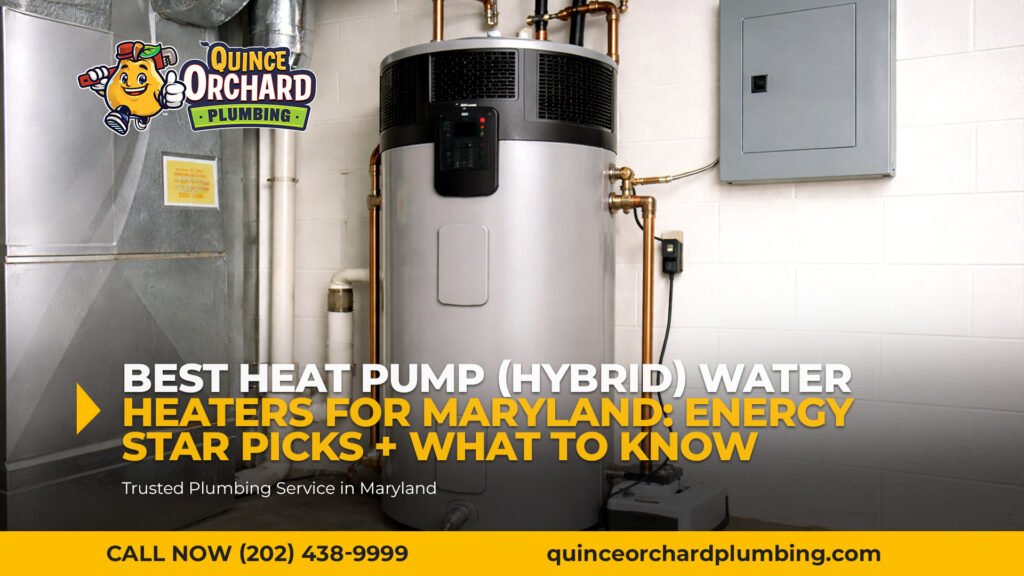
Best Heat Pump (Hybrid) Water Heaters for Maryland: ENERGY STAR Picks + What to Know

If you live in Maryland, a heat pump (hybrid) water heater can be one of the best “quiet upgrades” you make: lower electric use, strong rebates in some areas, and excellent performance for most homes with a basement or utility room. In this guide, I’ll show you how to choose the right ENERGY STAR® heat pump water heater for a Maryland home, plus a short list of ENERGY STAR-certified picks (with the exact metrics that matter). This is written for homeowners across Montgomery County—Gaithersburg (20878), Rockville, Germantown, North Potomac, Kentlands, and nearby communities—where many homes have the space and electrical setup that makes HPWHs a great fit. If you want help sizing and installing one correctly (and avoiding the common “it works, but it’s annoying” mistakes), our team handles it through Water Heater Services. Heat pump vs. “hybrid” water heater: same thing (most of the time) In residential use, “heat pump water heater” and “hybrid water heater” usually refer to the same appliance: it pulls heat from the air and moves it into the tank (like a refrigerator in reverse). Most units also have electric resistance elements that can help during high demand or very cold conditions—hence “hybrid.” The 3 numbers that matter most When comparing models, focus on: 1) UEF (Uniform Energy Factor) UEF is the efficiency metric that lets you compare units apples-to-apples. Higher is better. 2) Tank size (gallons) Most Maryland households do well in the 50–80 gallon range, depending on how many people and how “spiky” your hot water use is (back-to-back showers + laundry is the classic spike). 3) First Hour Rating (FHR) This tells you roughly how many gallons of hot water the heater can deliver in the busiest hour. For families, FHR often matters more than tank size. Maryland-specific “what to know” before you buy You need airflow and space (and these units are often taller) Heat pump water heaters need room to breathe and are commonly taller than standard electric tanks. That’s usually fine in unfinished basements (common in Rockville/Gaithersburg), but it can get tight in closets or low-ceiling utility rooms. They make condensation (you must plan a drain path) HPWHs create clean condensate water. You’ll typically run a line to a nearby floor drain or add a small condensate pump if needed. This is one of the biggest “surprise” installation items. Electrical panel capacity can matter Most standard units are 240V, but some newer designs can work with different amperage requirements. If your panel is already crowded (common in older homes), we’ll confirm your options as part of Water Heater Services. They cool and dehumidify the space This is great in a humid Maryland basement in summer. In winter, it can make the installation area cooler—so we plan placement thoughtfully. Noise is real—but usually manageable Most homeowners describe a HPWH as similar to a steady fan or dehumidifier. Placement matters a lot (e.g., not right next to a finished bedroom wall). Need a water heater sized and installed correctly? Call Quince Orchard Plumbing for fast, local help in Montgomery County, Maryland. ENERGY STAR picks (certified models worth shortlisting) These examples are pulled from the ENERGY STAR certified database. Availability changes by retailer and distributor, so think of these as a shortlist to start comparisons, not the only good options. High-efficiency 80-gallon class (great for 4–6 people, big demand windows) High-efficiency 50-gallon class (strong for 2–4 people, typical homes) Solid “balanced” picks (efficiency + strong hot water delivery) To browse and compare current certified models by size, efficiency, and features, use ENERGY STAR’s Certified Heat Pump Water Heaters Product Finder. Features that are actually worth paying for DIY vs. call a pro (quick decision) DIY might be reasonable if: Call a pro if: Need a water heater sized and installed correctly? Call Quince Orchard Plumbing for fast, local help in Montgomery County, Maryland. Where to shop (and how to avoid buying the “wrong” model) For independent reviews and lab testing, you can also cross-check on Consumer Reports’ water heater ratings/buying resources (note: some detailed ratings may require a subscription). Service Area (Maryland only) Quince Orchard Plumbing serves Gaithersburg (20878), Rockville, Germantown, North Potomac, Darnestown, Montgomery Village, Potomac (north), Derwood, Kentlands, and Washington Grove.

Savings, safety and quality

Best Water Heaters for Maryland Homes (2026): 5 Picks + Sizing Made Simple

If you’re in Montgomery County, MD—Gaithersburg (20878), Rockville, Germantown, North Potomac, and surrounding areas—choosing a water heater isn’t about buying the “most popular” brand. It’s about picking the right type, the right size, and installing it correctly for your home’s gas/electric setup. In this guide, we’ll cover: If you want help selecting and installing the right unit, start here: Water Heater Services. The 5 Picks (Maryland-friendly, 2026-ready) These picks focus on what matters most for homeowners: reliability, serviceability, efficiency, and stable hot water during higher winter. 1) Rheem — Best “all-around” pick for most homes Best for: homeowners who want wide availability, lots of configurations (gas/electric/hybrid), and easy parts support. 2) Bradford White — Best for longevity and pro-grade build quality Best for: homeowners who prioritize durability and long-term ownership. 3) A. O. Smith — Best value without going “cheap” Best for: a dependable balance of performance and price. 4) Navien (condensing tankless) — Best for larger homes and high hot-water demand Best for: multiple bathrooms, long showers, and households that don’t want to “run out” of hot water. 5) Stiebel Eltron (electric tankless / point-of-use) — Best for additions and tight spaces Best for: basement bathrooms, additions, or “far fixtures” where hot water takes too long to arrive. Important: “Best” depends on sizing and installation details (fuel type, venting, electrical capacity, and your household’s usage). Where to Buy These Water Heaters (Trusted Options in Maryland) Quince Orchard Plumbing doesn’t sell water heaters retail-style, but we do install and replace them and we can help you source the correct model through trusted channels. If you prefer buying your own, these are the most common routes homeowners use in Montgomery County. Need a water heater sized and installed correctly? Call Quince Orchard Plumbing for fast, local help in Montgomery County, Maryland. Trusted buying routes (simple and safe) Quick “where to buy” table Brand / Type Where homeowners commonly buy What to double-check before checkout Rheem (tank / hybrid) Big-box retailers; online catalogs; some supply houses Fuel type (gas/electric), physical dimensions, venting category (gas), warranty terms A. O. Smith (tank) Big-box retailers; some supply houses Retail vs pro-line model differences, warranty requirements Bradford White (pro-grade) Supply houses / contractor channels Often not sold direct-to-consumer—best sourced through a pro Navien (condensing tankless) Supply houses; authorized dealers Gas line sizing, venting route, condensate drain, commissioning Stiebel Eltron (electric tankless / point-of-use) Authorized online retailers; supply houses Panel capacity, breaker size, wire gauge, amperage requirements Local reality: many homeowners also use major supply-house networks (no links): Ferguson, Hajoca, and Winsupply-type vendors. If you tell us your current setup, we’ll point you to the safest sourcing path for that exact install. If you want a safe starting point for comparing current availability and pricing, many homeowners begin here: Home Depot – Water Heaters. Then we confirm specs before installation. DIY vs. Calling a Pro: A Simple Decision Guide DIY is usually fine for: Call a pro immediately if: Not sure what size water heater you need? We’ll help you choose the right unit and install it correctly—so you don’t waste money on the wrong model. Schedule Water Heater Service How Quince Orchard Plumbing Helps Montgomery County Homeowners Start here: Water Heater Services. Need a water heater sized and installed correctly? Call Quince Orchard Plumbing for fast, local help in Montgomery County, Maryland. Service Area (Maryland only) Quince Orchard Plumbing serves Gaithersburg (20878), Rockville, Germantown, North Potomac, Darnestown, Montgomery Village, Potomac (north), Derwood, Kentlands, and Washington Grove.

Scroll to Top