

Is a Whole-House Water Softener Worth It in Maryland? Real-World Costs and Benefits
Is hard water ruining your appliances in Gaithersburg? Discover if a water softener is worth the investment for Montgomery County homes. Pros, cons & costs.
Is hard water ruining your appliances in Gaithersburg? Discover if a water softener is worth the investment for Montgomery County homes. Pros, cons & costs.

High WSSC bills? Discover 9 professional plumbing tweaks to lower your water bill in Montgomery County, from PRVs to leak detection. Call Quince Orchard Plumbing today.

If you live in Gaithersburg or anywhere in Montgomery County, MD, you’ve probably seen “low-flow” or “WaterSense” labels on faucets and showerheads at the store. They promise to cut your water use, lower your bills, and still give you a comfortable shower. But how much can you really save in a typical home in Gaithersburg, Rockville, Germantown, or North Potomac? Is it just a few dollars a year—or does it actually move the needle on your water and energy bills? In this guide, we’ll walk through: All with a local lens on homes served by WSSC Water and similar utilities in Montgomery County. What “Low-Flow” Really Means Today Let’s clear up definitions first. Showerheads Bathroom Faucets In other words, “low-flow” doesn’t mean a sad trickle anymore. It means using current federal standards as a baseline and cutting 20–45% of the water use without sacrificing performance. How Much Water Do Showers and Faucets Actually Use? The EPA estimates that showering accounts for nearly 17% of indoor residential water use, adding up to almost 40 gallons per day for the average family. US EPA Let’s put that into a simple example for a typical Montgomery County household: With a standard 2.5 gpm showerhead: Switching to a 1.5 gpm low-flow showerhead: That’s a 40-gallon-per-day reduction, or about 14,600 gallons per year, just from showering. cranachhome.com The EPA’s more conservative calculation says that replacing a single standard showerhead with a WaterSense model can save the average family about 2,700 gallons of water per year, plus more than $75 per year in combined water and energy costs. US EPA+1 If your household takes longer showers, has more people, or upgrades more than one shower, your savings can be significantly higher than that baseline. Worried about hidden plumbing issues in your new home? Get a full plumbing inspection by trusted local experts — book yours now. What About Bathroom Faucets? Bathroom sinks get a lot of “small” use that adds up: handwashing, brushing teeth, shaving, quick face rinses, etc. According to EPA WaterSense: If you update: And because a chunk of that water is hot, you’re also trimming the energy use from your water heater. Water and Energy Savings in a Montgomery County Context In Maryland, the average monthly water and sewer bill is roughly in the mid-$40s, depending on usage and local rates. Real Estate Statistics+1 Water heating, according to the U.S. Department of Energy, typically represents about 18% of your home’s energy use, making it one of the biggest energy loads after space heating and cooling. The Department of Energy’s Energy.gov+1 Putting this together: Realistically, a household in Gaithersburg, Rockville, or Germantown that upgrades: can often save several thousand gallons of water per year, and tens of dollars per year in water and energy costs—without changing their daily habits at all. If your household has higher-than-average usage (multiple bathrooms, teenagers, long showers), the savings add up faster. “But Will My Shower Feel Weak?” – Comfort vs. Conservation This is the biggest fear we hear from homeowners: “I don’t want to stand under a drizzle just to save a few bucks.” The early low-flow models years ago did feel weak. Modern fixtures are completely different: In short: if you choose at least a WaterSense-labeled showerhead from a reputable brand, you should get a shower that feels as good—or in many cases better—than your older high-flow model, while using 20–40% less water. How to Estimate Your Own Savings: A Simple Bathroom Audit Here’s a quick DIY process you can use in Gaithersburg, North Potomac, or anywhere in Montgomery County to estimate your real savings. 1. Measure Your Current Shower Flow Use the “bucket test”: If you see ~2.5 gallons, you’re at the old standard. If you see ~2.0 or below, you may already have a WaterSense or low-flow head installed. 2. Check Your Bathroom Faucets Look for a marking near the tip of the spout or aerator: If you can’t find a marking, you can run the same 60-second bucket test in the sink (carefully), or simply plan to upgrade based on age and style. 3. Use the EPA Baselines Instead of building a complex spreadsheet, you can lean on the EPA estimates: Then adjust up or down based on your reality: Low-Flow Fixtures vs. Other Plumbing Priorities Low-flow fixtures are one of the easiest upgrades you can make:unscrew, swap, done. But they sit inside a larger plumbing picture. When Low-Flow Fixtures Are a Great First Step They’re ideal when: In these cases, a low-flow showerhead and faucet upgrade can be your “quick win.” When You May Need a Plumber in Addition to Low-Flow Fixtures If you install low-flow fixtures and still have: then it’s time to look beyond the fixtures themselves. A licensed plumber can: Low-flow showerheads and faucets help you use less water. Fixing leaks, correcting pressure problems, and updating an aging heater help ensure that every gallon you do use is doing useful work. Choosing Low-Flow Fixtures That Actually Feel Good When you’re ready to upgrade, here’s what we recommend as plumbers: If you’re planning a more involved bathroom remodel—moving plumbing, upsizing lines, or relocating your water heater—that’s a good moment to loop in a local plumber so the new low-flow fixtures are matched to the rest of the system, not just bolted onto whatever’s there. Worried about hidden plumbing issues in your new home? Get a full plumbing inspection by trusted local experts — book yours now. How This Fits into a Bigger Water-Saving Plan Low-flow faucets and showerheads are only one part of a larger picture that can include: The big picture is simple: you want the water you pay for to arrive reliably, be used efficiently, and leave your home safely. Low-flow fixtures hit the “used efficiently” part in an easy, budget-friendly way.

If you turn on a faucet and get a blast of air, sputtering water, or a weak trickle instead of a steady stream, it’s more than just annoying. Air in your plumbing lines and low water pressure often show up together—and they’re both telling you something about what’s happening inside your pipes. In Montgomery County, MD, many homes in areas like Gaithersburg, Rockville, Germantown, North Potomac, and the surrounding communities are 25–40 years old, with plumbing systems that have seen plenty of seasons and remodels. Those aging systems are more prone to leaks, corrosion, and pressure issues, which can let air into the lines or choke off flow if you don’t catch problems early. In this guide, I’ll walk you through: I’ll also point out where services like Water Line Repair, Video Camera Sewer Inspection, and Water Heater Services naturally come into play. Air in Pipes vs Low Pressure: How They Fit Together You can have: In simple terms: Your job as a homeowner is not to diagnose everything perfectly but to recognize patterns that help you decide: Signs You’re Dealing With Air in Your Pipes If you’re wondering whether there’s air trapped in your plumbing, look for these common signs: Some brief sputtering after the water has been off isn’t unusual. Persistent air, especially combined with low pressure, new noises, or dirty water, is a reason to look more closely. Experiencing air in your pipes or low water pressure? let our experts fix it fast—contact us today. Common Causes of Low Water Pressure in Montgomery County Homes Low water pressure by itself is extremely common. Before you assume the worst, it helps to sort it into categories: 1. One Fixture Only If only one sink, shower, or appliance has low pressure, it’s often a fixture-level issue, such as: These are usually good candidates for basic DIY cleaning, as long as you’re comfortable turning off water to that fixture and reassembling it. 2. One Area of the House If one bathroom or one side of the house has lower pressure: This is still diagnosable at home to a point, but it’s also where a pro starts to look at the layout of your plumbing and the materials used. 3. Whole-House Low Pressure If every faucet and shower in the home feels weak: This is where professional Water Line Repair and pressure testing come into play, so you don’t guess at leaks or start opening walls at random. 4. Low Pressure Only on Hot Water If cold water pressure is normal but hot is weak, that usually points toward: In these cases, having a plumber evaluate your heater and piping—through Water Heater Services—is often the fastest way to protect the equipment and restore comfortable flow. Experiencing air in your pipes or low water pressure? let our experts fix it fast—contact us today. Step-by-Step Basic Diagnosis for Homeowners Here’s a practical, basic diagnosis any homeowner in Gaithersburg, Rockville, Germantown, North Potomac, Darnestown, Montgomery Village, Potomac (north), Derwood, Kentlands, or Washington Grove can follow. Paso 1: Confirmar el patrón Walk the house and check: Make a quick mental note. This pattern is what you’ll eventually describe to a plumber if you need help. Step 2: Check the Easy Things First If one fixture suddenly jumps back to normal after cleaning or opening a valve, you’ve likely found the culprit. Step 3: Look for Leak Clues Low pressure can be a symptom of water escaping somewhere else. Walk around and look for: If you suspect a leak in the main line or a buried section, that’s a strong sign to bring in a professional for Water Line Repair before the damage spreads. Step 4: Consider Recent Changes Think back over the last few days or weeks: Those changes can introduce air into the system, shift debris into aerators, or leave a valve partly closed. If air and pressure issues started right after such work, it’s a clue that bleeding the lines and checking valves/aerators may be enough. If they persist, the work could have exposed a weak spot in older piping that now needs attention. Step 5: Bleed Air Out of the Lines Safely For mild, non-repeating air issues after a shutoff: If, after doing this, you still get constant sputtering, loud gurgling, or strange noises, there may be an issue that’s drawing air into the system—such as a leak or complex piping configuration that needs professional diagnosis. When Air in Pipes Is Normal (and When It’s Not) There are times when a little air in the lines is completely expected: Sputtering for a day or so, then returning to normal, is usually not a problem. You should pay closer attention and consider calling a pro when: In those situations, a licensed plumber can pressure-test the system and, if needed, use a Video Camera Sewer Inspection to see exactly what’s going on in buried lines. While camera inspections are typically for sewer and drain lines, they often come into play when we’re trying to sort out complex “air, noise, and low pressure” complaints that might involve both water and drain systems. How Air and Low Pressure Can Damage Plumbing Over Time It’s easy to treat air in the pipes as “just noisy,” but over time, these problems can lead to: In older homes around Gaithersburg, Rockville, and Germantown—many of which have galvanized or mixed piping—the combination of age, air, and low pressure is often a sign that it’s time to plan repairs or partial repiping rather than patching symptoms year after year. When to Call a Professional Plumber: A Simple Decision Guide Here’s a straightforward way to decide when to stop DIY and bring in a local pro like Quince Orchard Plumbing. You Can Usually Try DIY If: Call a Plumber Promptly If: In those cases, a professional can: How Quince Orchard Plumbing Approaches Low Pressure and Air-in-Pipe Problems When you call a local plumber for low pressure or air in your pipes, you don’t just want someone to guess. You want a
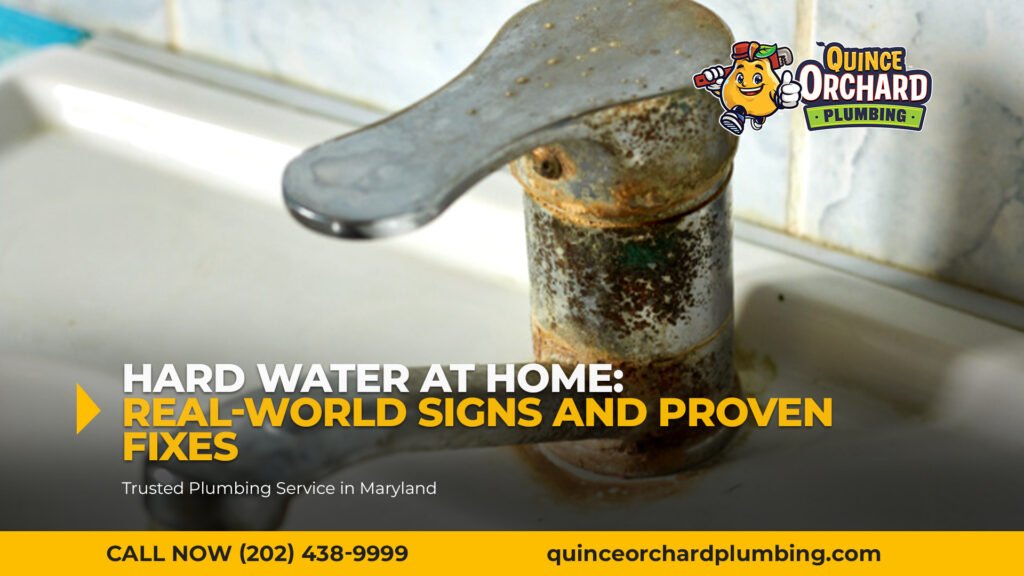
If your faucets collect a white crust, your glasses come out of the dishwasher cloudy, or showers feel… underwhelming, you’re likely dealing with hard water. Below I’ll translate the most common real-world signs into causes and fixes that make sense for homes in Gaithersburg (20878), Rockville, Germantown, North Potomac, Darnestown, Montgomery Village, Potomac (north), Derwood, Kentlands, and Washington Grove. Quick ID Guide: “What I see” → “What it means” → “What to do” Chalky white crust on faucets/showerheads → mineral scale (calcium/magnesium) → descale aerators/heads and consider whole-home softening/conditioning; scale can also narrow pipes and reduce flow. Crystal Quest Water Filters+1 Cloudy/spotty glassware, soap film on tubs → minerals reacting with soap (soap scum) → use rinse aids short-term; long-term, treat hardness to stop residue. Water-Right Dry skin/dull hair after showering → soap doesn’t lather/rinse well in hard water → conditioning or softening improves rinse-off feel. Crystal Quest Water Filters Sluggish showers / lower pressure over time → scale restricting showerheads or piping → descale fixtures; if house-wide, assess piping and heater. Water-Right Water heater rumbling, higher energy bills, less hot water → sediment/scale insulating the heat source → flush/descale and check anode; hardness accelerates wear and energy use. Matilija Pure Water Systems Rusty or green stains in bowls/fixtures → iron/copper in water or corrosion → testing + targeted filtration; inspect supply lines if staining persists. Water-Right Proven Fixes (ranked from “today” to “permanent”) 1) Today (DIY/maintenance) 2) Diagnose (fast and local) 3) Address the source (whole-home) 4) Fix side-effects (as needed) From cloudy glassware to noisy water heaters, hard water quietly damages your home every day. Let our licensed plumbers test your water, recommend the right solution, and protect your pipes and appliances for the long run. Water Heater + Hard Water: What to watch Hardness drives sediment that insulates heating surfaces, causing rumbling, longer heat-up, and higher utility costs; it can also reduce capacity. The fix is straightforward: flush/descale and monitor the anode; for tankless, plan periodic descaling. If symptoms persist, book Water Heater Services and we’ll restore efficiency or size a replacement if needed. Matilija Pure Water Systems Decision Tree (save this) Service Area (Maryland Only) We respond quickly across Gaithersburg (20878), Rockville, Germantown, North Potomac, Darnestown, Montgomery Village, Potomac (north), Derwood, Kentlands, and Washington Grove. From cloudy glassware to noisy water heaters, hard water quietly damages your home every day. Let our licensed plumbers test your water, recommend the right solution, and protect your pipes and appliances for the long run. FAQ Is hard water harmful? The minerals aren’t typically a health risk, but the scale they leave can drive up energy costs and shorten appliance life. Can I fix this without salt? Yes—salt-free conditioners can reduce new scale adhesion. For heavy hardness and best “feel,” softeners are the gold standard. How do I confirm hardness? Start with test strips; for exact numbers (gpg, iron, pH), book a professional test so we can size the solution correctly.

Choosing the right water heater temperature isn’t just about comfort in the shower. It’s a balance between safety, energy savings, and enough hot water for everyone at home. For families in Gaithersburg (20878), Rockville, Germantown, North Potomac, Darnestown, Montgomery Village, Potomac (north), Derwood, Kentlands, and Washington Grove, the right setting can help prevent scalding injuries, save money on utilities, and extend the life of your water heater. What Temperature Do Experts Recommend? Most safety and energy experts – including the U.S. Consumer Product Safety Commission (CPSC) – recommend setting residential water heaters to around 120°F (49°C). At this temperature: Many water heaters leave the factory set closer to 130–140°F, which can cause severe burns in seconds, particularly for kids and seniors. That’s why dialing down to about 120°F is widely considered the “sweet spot” for most families. Splash Plumbing+1 Balancing Safety & Comfort for Your Family I like to think about water heater temperature by household type, not just a single “magic” number. Most families (good default) Homes with young children or older adults For extra protection, you can combine a 120°F setting with anti-scald / mixing valves at showers and tubs. That’s something we can help with under our Water Heater Services and, when needed, as part of Backflow Prevention Services. Large households or high-demand homes If you’re constantly running out of hot water: That way, you increase effective capacity without sending dangerously hot water to showers and sinks. How Temperature Affects Energy Bills According to the U.S. Department of Energy, water heating typically accounts for around 18% of a home’s energy use, making it the second largest energy expense in many households. The Department of Energy’s Energy.gov That means your temperature setting has a real impact: Many sources estimate savings of roughly 3–5% on water-heating costs for every 10°F you lower the thermostat, as long as you stay within a safe range and still meet your hot-water needs. libertyhomeguard.com+1 For homes in our service area – often 25–40-year-old single-family homes and townhouses – dialing the heater down to around 120°F, insulating accessible hot-water pipes, and keeping up with maintenance can make a noticeable difference. If your heater is older, has sediment buildup, or struggles to keep up, adjusting the temperature is just one piece; it may be time for professional tune-up or replacement, which we handle under Water Heater Services. The right water heater temperature can prevent scalding injuries, extend equipment life, and reduce energy costs. Let our licensed plumbers inspect, adjust, and optimize your water heater for safe, reliable performance. How to Check & Adjust Your Water Heater Temperature Always use caution around gas and electric connections. If you’re unsure at any step, it’s safer to have a licensed plumber handle it. Step 1: Measure actual hot water temperature Step 2: Adjust the thermostat on the heater For gas tank heaters: For electric tank heaters: Tankless heaters: If your thermostat markings are unclear, the temperature swings wildly, or you see rust, leaks, or scorching, it’s a good moment to call us for Water Heater Services instead of guessing. Safety Extras: Mixing Valves, Anti-Scald & Backflow Even with the thermostat at 120°F, real-world conditions can still produce hotter water at the tap, especially if: To tighten safety and comfort, we can help with: Signs You Need More Than Just a Temperature Change Adjusting the thermostat won’t fix deeper mechanical problems. Call a pro if you notice: Those issues may indicate: The right water heater temperature can prevent scalding injuries, extend equipment life, and reduce energy costs. Let our licensed plumbers inspect, adjust, and optimize your water heater for safe, reliable performance. Quick Reference: Ideal Settings by Household Type You can keep or adapt this as a small table or bullet list in your CMS: Service Area (Maryland Only) Quince Orchard Plumbing provides water heater and related plumbing services within roughly a 13-mile radius of Gaithersburg, MD 20878, including: Gaithersburg, Rockville, Germantown, North Potomac, Darnestown, Montgomery Village, Potomac (norte), Derwood, Kentlands y Washington Grove.
Reduce the Wait for Hot Water with Recirculation: What to Know (Montgomery County, MD) Tired of waiting 30–90 seconds for hot water in the shower or at the kitchen sink? In homes across Gaithersburg, Rockville, Germantown, North Potomac, Darnestown, Montgomery Village, Potomac (north), Derwood, Kentlands, and Washington Grove, long pipe runs and uninsulated lines make that “cold-first” delay waste both water and time. A hot-water recirculation system can fix that—and when it’s set up correctly, it delivers near-instant hot water without sending your energy bills through the roof. As a local Maryland plumbing team, we install, repair, and optimize recirculation systems every week. Below, I’ll explain how they work, the options that make sense for our area’s housing stock, and how to pick the right control strategy for your routine. We’ll also point to the right service if we find other plumbing issues during an inspection—because hot water convenience often goes hand-in-hand with water heater performance, water line health, and backflow safety in older homes. Instant hot water starts here—schedule with Quince Orchard Plumbing. How Hot-Water Recirculation Works (In Plain English) A compact circulator pump moves hot water from your water heater through the supply line and back to the heater via a return path, so when you open a faucet, hot water is already nearby. There are three common setups: Key components you’ll hear us mention on site: the pump head, an aquastat/temperature sensor, check valves (often tied to backflow prevention), isolation valves for servicing, and pipe insulation to reduce heat loss in the loop. The Local Angle: What Works in Montgomery County Homes If the consultation reveals weak pressure or corrosion on the main feed, we may recommend addressing the water supply piping first—our team handles that under Water Line Repair. Controls That Keep Bills In Check Recirculation is amazing for convenience, but control strategy is everything: We’ll combine controls with pipe insulation on accessible hot-water lines to reduce standby losses. If your water heater itself needs attention, we can tune, repair, or replace it to maximize overall efficiency—see our Water Heater Services. Instant hot water starts here—schedule with Quince Orchard Plumbing. Dedicated Return vs. Crossover vs. On-Demand (Quick Comparison) Not sure which path fits your home in Gaithersburg or Rockville? Our technicians can model your run lengths and usage windows during a quick visit. What We Check During a Recirculation Assessment Local note: Our 13-mile service radius from Gaithersburg (20878) covers the north side of the Potomac (Maryland only). That keeps response times tight for emergency calls and routine upgrades in the neighborhoods listed above. Energy & Water: Getting the Balance Right A 24/7 recirculation loop can raise energy use, but that’s not the goal. The goal is instant comfort only when you need it. We dial schedules to your real habits and favor on-demand in homes with sporadic usage. With proper controls and insulation, homeowners across Germantown, Derwood, and Montgomery Village typically report excellent comfort with minimal impact on utility bills. If your home routinely runs low hot water or produces temperature swings, the recirculation project is also the perfect time to fine-tune or upgrade the heater itself (thermostat, mixing valve, expansion tank, or a new high-efficiency model)—handled by our Water Heater Services. Installation Paths (What to Expect) During install, we also verify backflow prevention and add service-friendly isolation valves. Need a compliance check or annual testing? Our Backflow Prevention Services have you covered. Troubleshooting You Might Be Experiencing When inspections point to bigger issues—like a restricted main or a slab leak—we coordinate repairs under Water Line Repair. And if sluggish drains or gurgling sounds show up while we’re there, we can run a Video Camera Sewer Inspection and, if needed, schedule Sewer Line Repair & Replacement. Quick Decision Guide (Save or Screenshot) Service Areas (Maryland Only) We serve: Gaithersburg (20878), Rockville, Germantown, North Potomac, Darnestown, Montgomery Village, Potomac (north), Derwood, Kentlands, Washington Grove—roughly a 13-mile radius from our Gaithersburg base. Ready for Instant-Feeling Showers? Tell us your schedule (morning/evening peaks), and we’ll size the right pump, set the smartest control, and make sure your heater, backflow protection, and supply lines are ready: Sewer Line Repair & Replacement
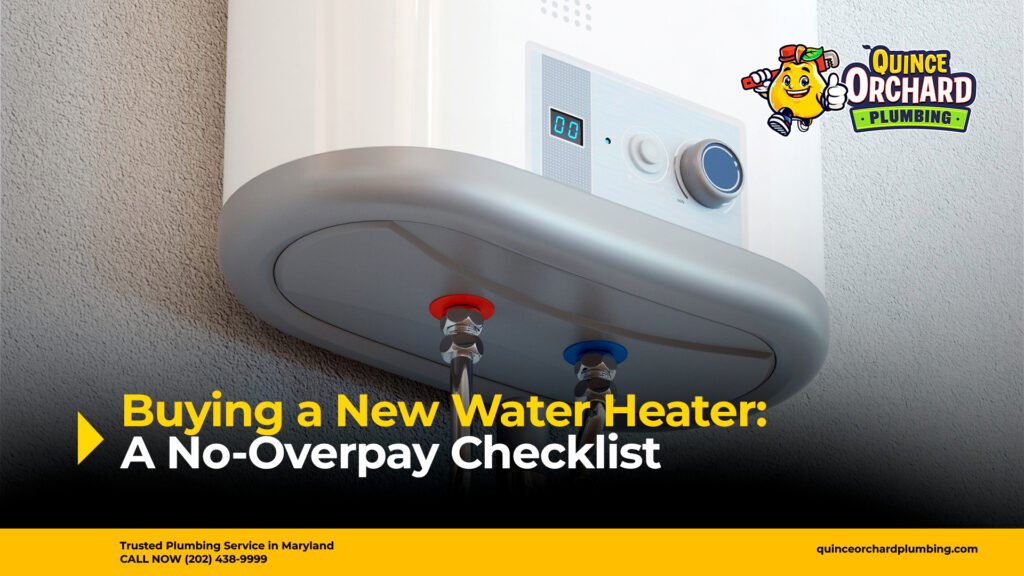
Replacing a water heater isn’t something homeowners do often—but when it’s time, it can feel overwhelming. Between tank and tankless systems, fuel types, efficiency ratings, and installation costs, there are countless details that can impact your comfort and your wallet. At Quince Orchard Plumbing, we help homeowners make smart, informed decisions about water heater replacements every day. This guide breaks down what to consider when buying a new water heater—so you can get the performance you need without overpaying. Signs It’s Time to Replace Your Water Heater Before you start comparing models, make sure replacement is truly necessary. Here are some key signs that your current system is on its way out: If any of these sound familiar, schedule a professional inspection. Our licensed technicians specialize in Water Heater Services to determine whether repair or replacement is the smarter choice. Step 1: Know Your Water Heater Options Today’s water heaters come in several types, each with advantages depending on your home’s layout, water usage, and energy goals. 1. Conventional Storage Tank The most common type, featuring an insulated tank that stores 30–80 gallons of hot water. Affordable and easy to install but less efficient than newer systems. 2. Tankless (On-Demand) Heats water only when needed, providing unlimited hot water while saving energy. It’s ideal for smaller households or those seeking energy efficiency. 3. Heat Pump (Hybrid) Uses electricity to move heat rather than generate it, making it 2–3 times more efficient than traditional units. Best for warm climates and spaces with good airflow. 4. Solar Water Heater Harnesses energy from the sun to heat water, offering significant long-term savings—but requires higher upfront installation costs. Not sure which system suits your home? Our Water Heater Services team can assess your water demand, energy usage, and budget to recommend the perfect match. Step 2: Understand Capacity and Sizing Buying the wrong size is one of the biggest mistakes homeowners make. If your unit is too small, you’ll constantly run out of hot water; too large, and you’ll waste energy keeping unused water hot. Here’s a general sizing guide: For tankless models, pay attention to flow rate (gallons per minute, or GPM). A family of four typically needs around 8–10 GPM to run multiple fixtures simultaneously. If you’ve noticed inconsistent flow or pressure, it might be worth having your water lines inspected before installing a new heater to ensure optimal performance. Step 3: Choose the Right Fuel Type Your existing fuel source often determines what kind of heater you can install, but it’s worth evaluating all options for long-term efficiency and cost savings: A professional video camera inspection can help confirm whether your gas or venting lines are properly positioned for the upgrade. Step 4: Energy Efficiency and Operating Costs High-efficiency models can reduce your utility bills significantly over time. Look for the Energy Factor (EF) or Uniform Energy Factor (UEF) rating—the higher the number, the better. Also check for the ENERGY STAR® label, which certifies systems that meet federal energy-efficiency standards. While these models may cost more upfront, they typically pay for themselves through lower monthly energy costs. If your utility bills have been rising unexpectedly, our team can assess whether leaks, line restrictions, or backflow issues are impacting efficiency. Step 5: Installation Requirements Proper installation is essential for performance, safety, and code compliance. Professional plumbers ensure: We’ve corrected many DIY installations that caused backdrafting, leaks, or even water damage. Before replacing your heater, it’s wise to have a Sewer Line Inspection or Water Line Repair done to prevent issues after installation. Need a new water heater? Get expert installation and avoid overpaying with Quince Orchard Plumbing. Step 6: Compare Total Costs—Not Just the Price Tag The purchase price is only part of the equation. Factor in installation costs, energy usage, lifespan, and maintenance when evaluating value. Here’s a simple breakdown: Professional plumbers can help you calculate the true cost of ownership—something big-box retailers often overlook. Step 7: Plan for Maintenance Even the best water heaters require routine maintenance to stay efficient and safe. Regular service can extend the lifespan of your unit by years. Key maintenance tasks include: Our Water Heater Services include all these checks plus system calibration to ensure maximum efficiency and safety. Step 8: Avoid Hidden Problems During Replacement Sometimes, water heater failure is only part of the story. Older systems may reveal underlying plumbing issues—corroded pipes, slow drains, or failing sewer lines. Before installing your new system, consider a Video Camera Sewer Inspection to identify blockages or leaks that could affect performance.If necessary, our team also provides Sewer Line Repair & Replacement to ensure your plumbing infrastructure supports your new water heater. Why Homeowners Trust Quince Orchard Plumbing At Quince Orchard Plumbing, we believe buying a new water heater shouldn’t be stressful—or expensive. Our licensed plumbers combine industry expertise with honest recommendations to help you choose the perfect system for your home. We handle everything from installation to maintenance, backed by dependable service and transparent pricing. Whether you need a tank or tankless system, we ensure your water heater runs safely, efficiently, and in compliance with local codes.
When it comes to protecting your home’s water quality, a whole-house water filter is one of the smartest investments you can make. Unlike small under-sink filters, these systems treat every drop of water entering your home—ensuring clean, safe, and great-tasting water for drinking, bathing, and cleaning. At Quince Orchard Plumbing, we’ve seen firsthand how the right filtration system can transform water quality and extend the lifespan of a home’s plumbing system. However, understanding the basics—micron ratings, flow rate, and maintenance—is essential before installation. Understanding Microns: The Core of Water Filtration The term micron refers to the size of particles a filter can trap. One micron equals one-millionth of a meter, which is about 100 times smaller than the diameter of a human hair. Different types of filters capture different contaminants depending on their micron rating: Selecting the right micron level depends on your local water conditions. If your home frequently experiences sediment or rust buildup, you might also need to check your water line for potential corrosion or leaks. The Role of Flow Rate in Whole-House Water Filters Flow rate measures how quickly water moves through your filtration system, typically in gallons per minute (GPM). Choosing the correct flow rate is critical—too slow, and your showers lose pressure; too fast, and contaminants may pass through unfiltered. For most residential systems, a 10–15 GPM flow rate works well. Larger households with multiple bathrooms or high-capacity fixtures may need systems rated up to 20 GPM. Our technicians at Quince Orchard Plumbing often inspect flow performance when we perform video camera sewer inspections or water line maintenance. Identifying pressure inconsistencies can prevent filtration inefficiencies and reduce long-term plumbing wear. Key Benefits of a Whole-House Water Filter Installing a filtration system for the entire home delivers benefits that go far beyond drinking water quality: Whole-house systems are also an excellent companion to water heater maintenance—since filtered water minimizes sediment accumulation inside tanks and improves heating efficiency. Proper Maintenance: Keeping Your Filter System Efficient Even the best water filters need regular maintenance to keep working effectively. Most systems use replaceable cartridges that must be changed based on water usage and manufacturer recommendations—usually every 6 to 12 months. Here are some maintenance best practices from our plumbing experts: Neglecting maintenance not only reduces filtration performance but can also cause costly damage to connected systems like water heaters or main supply lines. Professional Installation vs. DIY Systems While some homeowners attempt DIY installations, whole-house systems connect directly to your main water line—requiring proper pressure testing, pipe fitting, and system calibration. At Quince Orchard Plumbing, we’ve corrected numerous filtration systems that were improperly installed by non-professionals. Common issues include reduced pressure, leaks, and incorrect micron stages. A certified plumber ensures that filters are installed with the right pressure rating and proper bypass valves, ensuring safe and efficient operation. If your home’s plumbing lines are aging or have visible rust or sediment, it might be wise to pair your filter installation with a water line repair or sewer line replacement. Addressing these problems before adding a filtration system can prevent contamination and improve overall performance. Protect your home’s water system today — schedule a professional whole-house filtration assessment with Quince Orchard Plumbing and enjoy cleaner, safer water year-round. How to Choose the Right Whole-House Water Filter When selecting a system, consider these core factors: If you’re unsure which system fits your property, our team offers professional evaluations. We assess flow rates, water quality, and infrastructure to recommend systems that align with your home’s design and water demand. Why Homeowners Trust Quince Orchard Plumbing For over a decade, Quince Orchard Plumbing has been helping homeowners in the Gaithersburg area protect their water systems through expert installation, repair, and preventive care. From water heater services to sewer line repairs, our licensed plumbers bring the precision and knowledge required for complex plumbing systems. When it comes to whole-house water filters, our team ensures that your home’s plumbing, filtration, and water pressure work in perfect balance—delivering clean, reliable water to every faucet in your home.

Choosing between a storage tank water heater and a tankless (on-demand) unit comes down to three things: your household size/usage pattern, installation realities, and total cost of ownership. Here’s a clear, first-person breakdown tailored to families of 2–5 people. TL;DR — Which one fits your home? Home size & habits Best fit Why 2–3 people, staggered showers, modest baths Tankless High efficiency, endless hot water for serial use, compact. 4–5 people, frequent overlapping use High-capacity Tank or properly sized Tankless Tank gives strong first-hour output; tankless must be sized for peak GPM. Homes with limited gas line/electrical capacity Tank Lower upgrade requirements; simpler install. Tight utility closet & you value efficiency Tankless Wall-hung, frees floor space, higher EF/UFE. Lowest upfront cost needed now Tank More affordable equipment and install. If you want help sizing or pricing either option, check our Water Heater Services. 1) Purchase & installation costs (what to expect) Pro tip: If your gas meter or electrical panel is marginal today, that upgrade cost often swings the decision toward a tank. For a precise site review, book Water Heater Services. 2) Operating costs & efficiency Rule of thumb: In 2–3 person homes, tankless often wins on gas usage; in 4–5 person homes with overlapping showers, either a properly sized tankless or a high first-hour rating tank can be comparable depending on patterns. 3) Performance: first-hour rating vs. GPM sizing Need help translating your fixtures into a correct GPM spec? Our team can size it during Water Heater Services. Keep your water heater safe year-round — schedule your professional tune-up today. 4) Space, venting, and noise 5) Maintenance & lifespan Prefer a pro tune-up? Schedule Water Heater Services—we handle both types. 6) Comfort factors you’ll actually notice 7) Total cost of ownership (TCO) snapshot 8) Sizing cheat-sheet for 2–5 person homes If you lean Tank: If you lean Tankless (gas): We can confirm sizing and installation feasibility as part of Water Heater Services. 9) When I recommend each (no hype) Choose Tank if you want: Choose Tankless if you want: 10) Red flags that warrant a pro visit Print-friendly checklist (decision helper) Still undecided? Tell us how many fixtures may run at once and your home’s layout, and we’ll size both options and quote them side-by-side through Water Heater Services.