
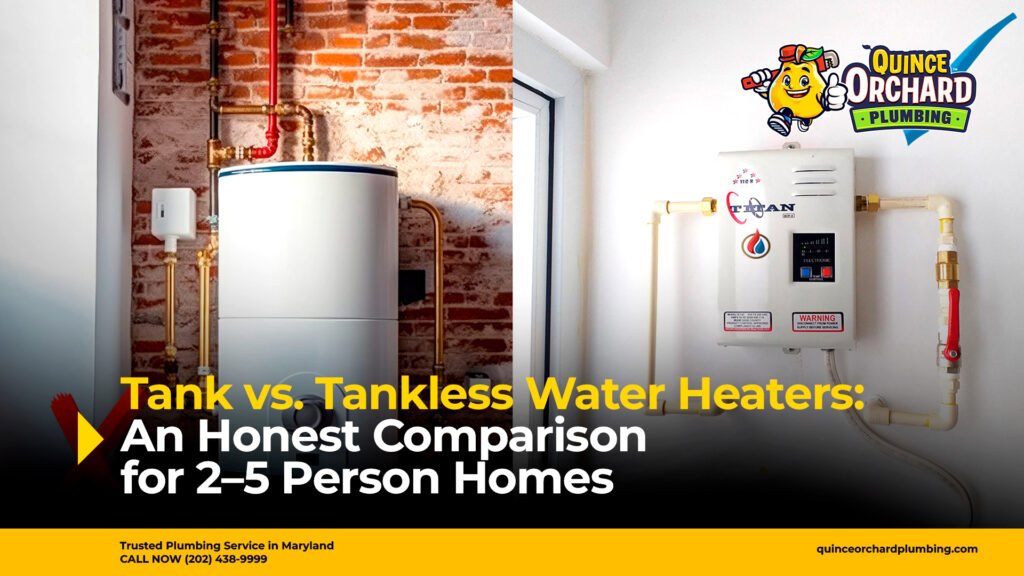
Choosing between a storage tank water heater and a tankless (on-demand) unit comes down to three things: your household size/usage pattern, installation realities, and total cost of ownership. Here’s a clear, first-person breakdown tailored to families of 2–5 people.
TL;DR — Which one fits your home?
| Home size & habits | Best fit | Why |
| 2–3 people, staggered showers, modest baths | Tankless | High efficiency, endless hot water for serial use, compact. |
| 4–5 people, frequent overlapping use | High-capacity Tank or properly sized Tankless | Tank gives strong first-hour output; tankless must be sized for peak GPM. |
| Homes with limited gas line/electrical capacity | Tank | Lower upgrade requirements; simpler install. |
| Tight utility closet & you value efficiency | Tankless | Wall-hung, frees floor space, higher EF/UFE. |
| Lowest upfront cost needed now | Tank | More affordable equipment and install. |
If you want help sizing or pricing either option, check our Water Heater Services.
1) Purchase & installation costs (what to expect)

- Tank (gas or electric): lower equipment price; install is typically straightforward. May need an expansion tank, pan, and proper venting (gas).
- Tankless (gas condensing or electric): higher equipment price; install may require gas line upsizing, Category III/IV venting, condensate drain, or electrical upgrades. Space-saving, but more parts to integrate.
Pro tip: If your gas meter or electrical panel is marginal today, that upgrade cost often swings the decision toward a tank. For a precise site review, book Water Heater Services.
2) Operating costs & efficiency
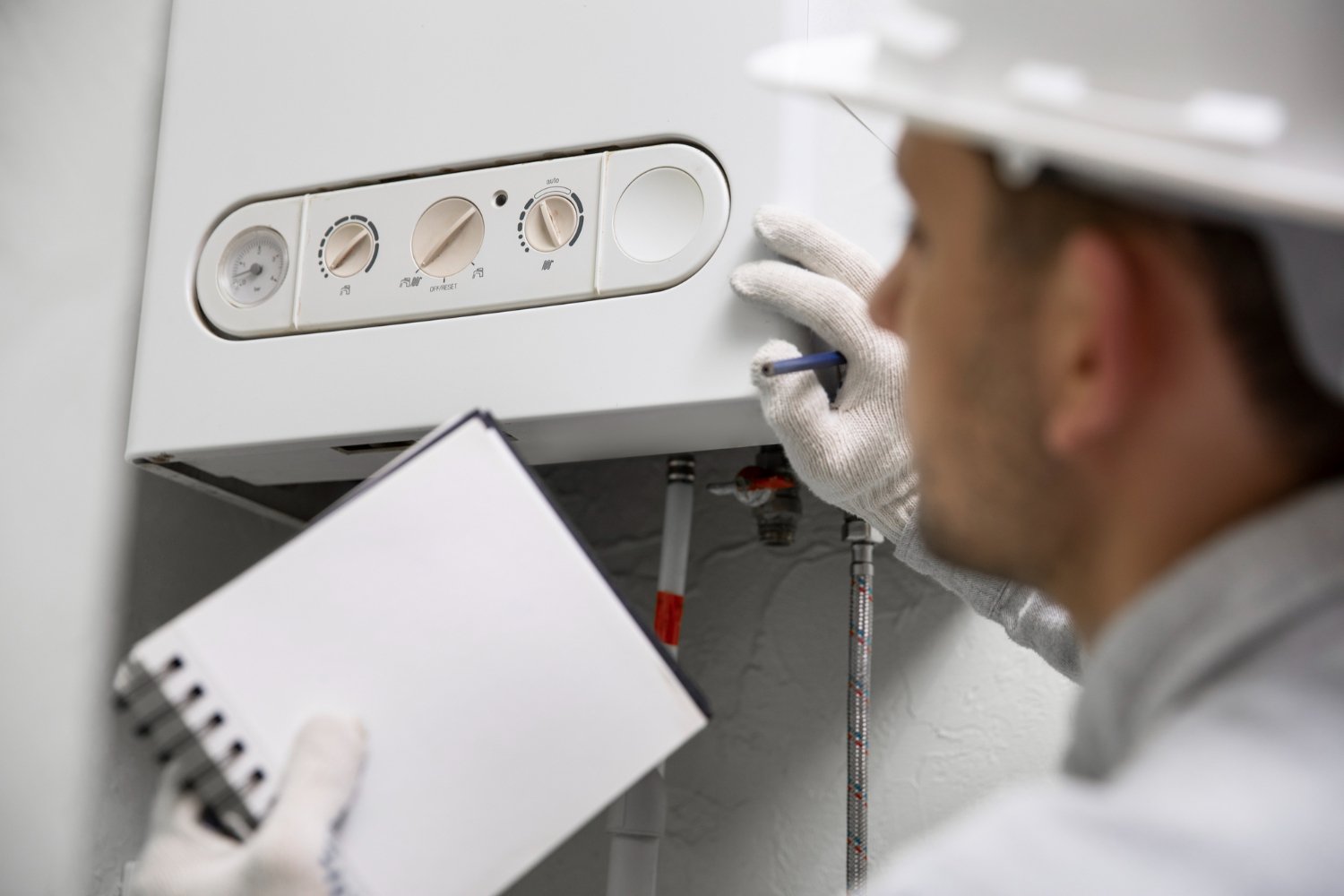
- Tank: Keeps 40–75 gallons hot all day (standby loss). Modern insulated tanks perform better, but they still reheat between draws.
- Tankless: Heats only when you open a tap—excellent for non-simultaneous use. Efficiency shines with frequent short draws (handwashing, staggered showers).
Rule of thumb: In 2–3 person homes, tankless often wins on gas usage; in 4–5 person homes with overlapping showers, either a properly sized tankless or a high first-hour rating tank can be comparable depending on patterns.
3) Performance: first-hour rating vs. GPM sizing
- Tank: Look at First-Hour Rating (FHR)—how many gallons of hot water it can deliver in the first hour starting with a full tank. A 50-gal high-recovery unit can satisfy back-to-back morning showers plus dishes.
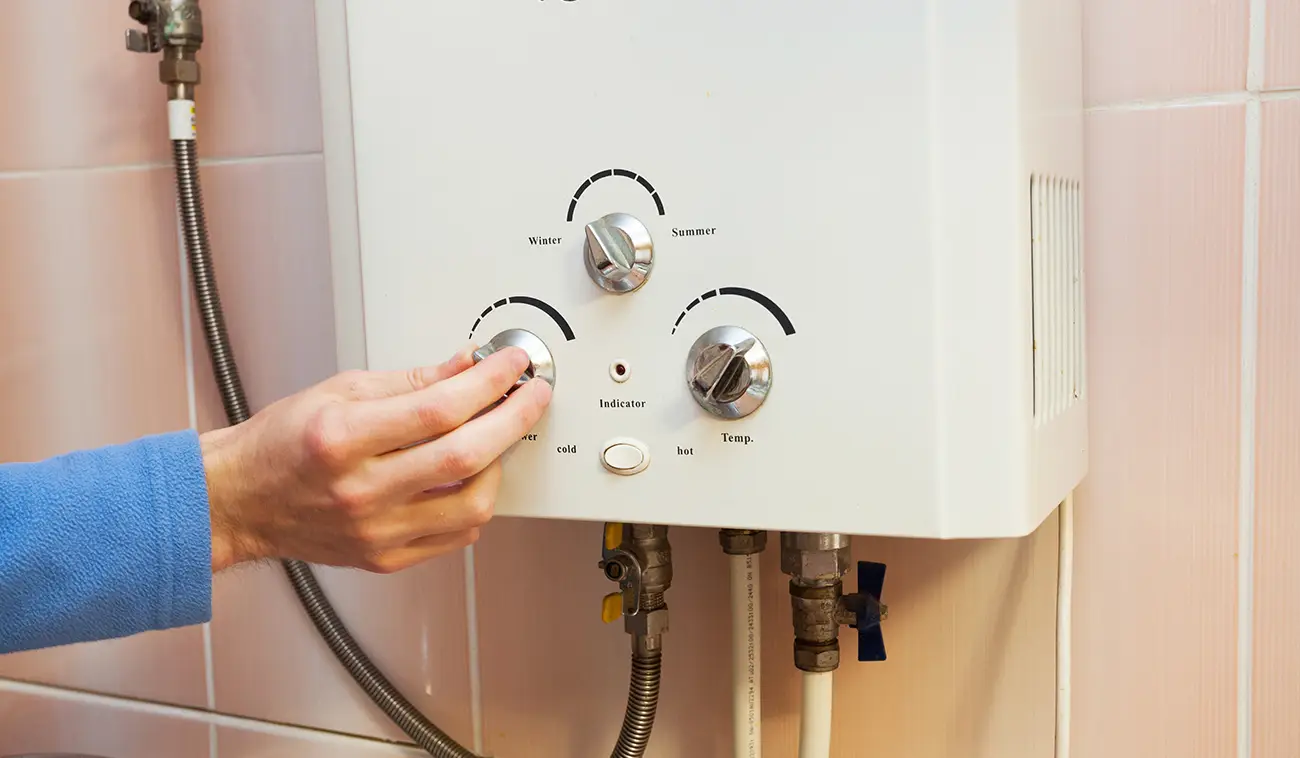
- Tankless: Size by peak flow (GPM) at your winter inlet temperature. For a typical 2–5 person home:
- Shower ≈ 2.0–2.5 GPM each
- Dishwasher ≈ 1–1.5 GPM (when it draws)
- Washing machine ≈ 2.0 GPM
If two showers may run together, aim for 5–6 GPM at a ~70–75°F temperature rise (winter). Add a buffer if a third fixture might run.
- Shower ≈ 2.0–2.5 GPM each
Need help translating your fixtures into a correct GPM spec? Our team can size it during Water Heater Services.
Keep your water heater safe year-round — schedule your professional tune-up today.
4) Space, venting, and noise
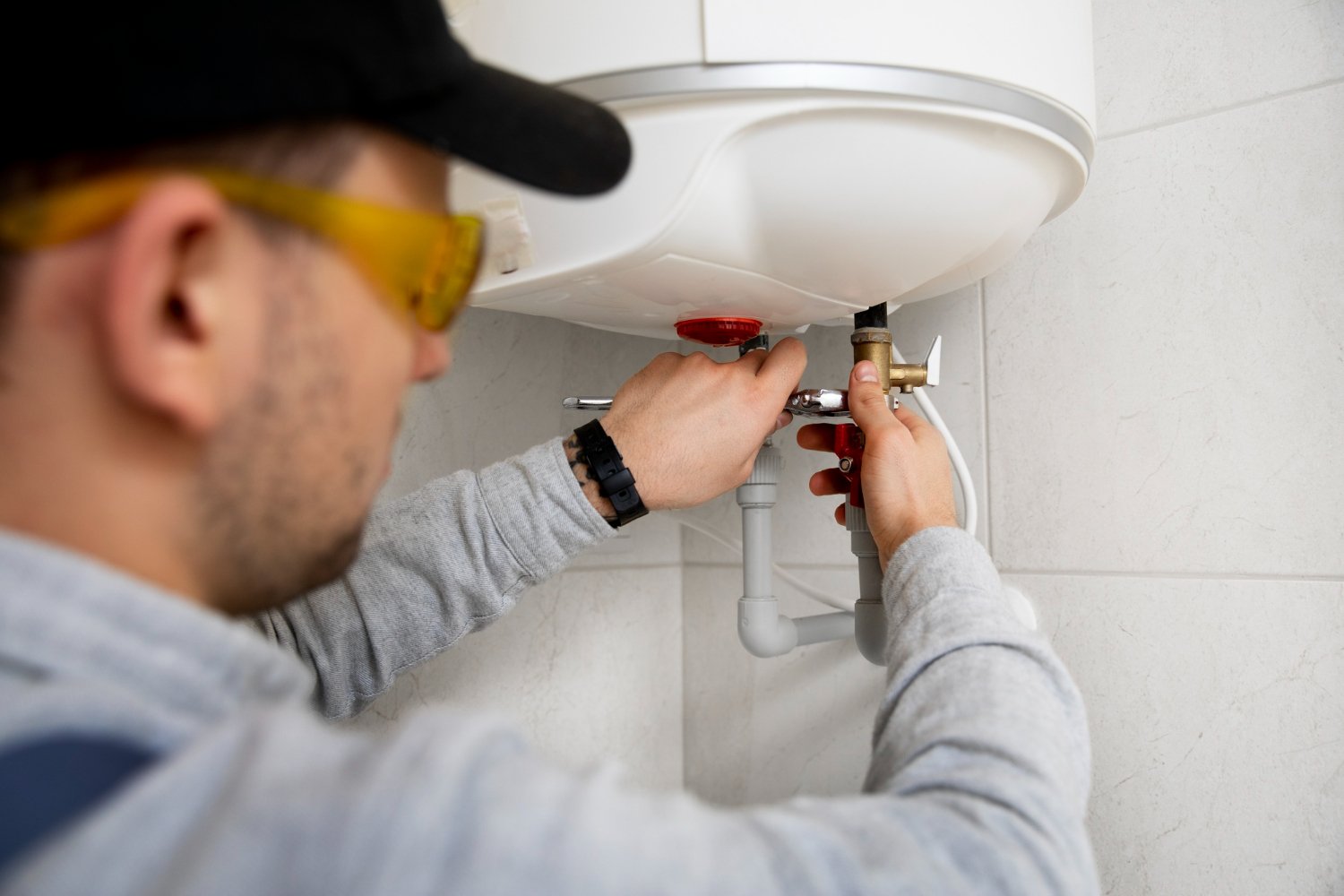
- Tank: Floor footprint; simpler venting (atmospheric or power-vent for gas).
- Tankless: Wall-hung; requires sealed combustion venting for gas, condensate handling, and a drain. High-fire operation can be audible; place thoughtfully.
5) Maintenance & lifespan
- Tank:
- Annual: set 120°F, flush a few gallons to purge sediment, test T&P valve, check/anode every 1–2 years (hard water = sooner).
- Lifespan: typically 8–12 years (more with good anode maintenance).
- Annual: set 120°F, flush a few gallons to purge sediment, test T&P valve, check/anode every 1–2 years (hard water = sooner).
- Tankless:
- Annual: descale heat exchanger (hard water), clean inlet screens, check condensate trap/neutralizer (gas condensing), verify combustion air/vent.
- Lifespan: commonly 15–20 years with regular service.
- Annual: descale heat exchanger (hard water), clean inlet screens, check condensate trap/neutralizer (gas condensing), verify combustion air/vent.
Prefer a pro tune-up? Schedule Water Heater Services—we handle both types.
6) Comfort factors you’ll actually notice
- Endless vs. burst capacity: Tankless provides continuous hot water for serial users; tanks deliver a big initial surge but can run low with many back-to-back, long showers.
- Temperature stability: Quality tankless units modulate well, but very low-flow draws may cause hiccups; tanks are stable at trickle flows.
- Hard water: Both suffer without maintenance; tankless mineral scaling shows up as lukewarm water under high flow.
7) Total cost of ownership (TCO) snapshot
- Tank: lower upfront, modest maintenance, earlier replacement cycle.
- Tankless: higher upfront, higher maintenance discipline (annual descaling), longer lifespan; efficiency savings can narrow the gap over time—especially for gas in smaller households.
8) Sizing cheat-sheet for 2–5 person homes
If you lean Tank:
- 2–3 people: 40–50 gal (look for high recovery).
- 4–5 people: 50–75 gal or 50 gal high-input model; consider a mixing valve to safely use more of the stored capacity.
If you lean Tankless (gas):
- 2–3 people: 6–8 GPM @ 70–75°F rise.
- 4–5 people: 8–10+ GPM @ 70–75°F rise (or two smaller units in parallel if space allows).
We can confirm sizing and installation feasibility as part of Water Heater Services.
9) When I recommend each (no hype)
Choose Tank if you want:
- The lowest upfront path and straightforward install.
- Strong first-hour output for overlapping use.
- Simple maintenance and fewer upgrade surprises.
Choose Tankless if you want:
- Higher efficiency for staggered use and smaller households.
- Endless hot water (serial showers, guests).
- Space savings and longer expected lifespan.
10) Red flags that warrant a pro visit
- Rust-colored hot water, rumbling tank, burning-gas smells, scorch marks, frequent resets, or lukewarm water under normal demand. Book Water Heater Services for a same-day check.
Print-friendly checklist (decision helper)
- Count simultaneous fixtures (showers, dishwasher, washer).
- Note winter inlet temp; estimate needed °F rise.
- Size by FHR (tank) or GPM @ rise (tankless).
- Verify gas line/electrical capacity and vent path.
- Compare install quotes (include any upgrades).
- Plan annual maintenance (flush or descale).
- Choose: lowest upfront (tank) vs efficiency + space (tankless).
- Schedule install via Water Heater Services.
Still undecided?
Tell us how many fixtures may run at once and your home’s layout, and we’ll size both options and quote them side-by-side through Water Heater Services.