

If you’re shopping for a new water heater in Montgomery County, MD, the question usually sounds simple: “Do I need a 40, 50, 60, or 80-gallon tank?” In reality, the right size depends on how your household uses hot water during your busiest hour—not just how many people live in the home. https://www.energy.gov/energysaver/sizing-new-water-heater.
At Quince Orchard Plumbing, we help homeowners across the Gaithersburg area choose water heater sizes that match real-life usage (and avoid the two common pain points: running out of hot water, or overpaying for capacity you’ll never use).
Quick sizing chart: tank gallons for 1–6 people
Use this as your starting point—then confirm with the “Peak Hour” method (next section).
| Household size | Typical tank size range | When to size up |
|---|---|---|
| 1 person | 30–40 gallons | Large soaking tub, frequent laundry, guests |
| 2 people | 40–50 gallons | Back-to-back showers, high-flow showerheads |
| 3 people | 50–60 gallons | 2+ bathrooms used at the same time |
| 4 people | 60–75 gallons | Morning “rush hour” + laundry/dishwasher together |
| 5 people | 75–80 gallons | Multiple showers + heavy daily hot water use |
| 6 people | 80 gallons (or consider tankless/HPWH) | High simultaneous demand or large tubs |
Important: gallons alone can mislead. Two 50-gallon tanks can perform very differently depending on recovery rate and design. That’s why the First Hour Rating is the metric we care about most.
The number that matters most: First Hour Rating (FHR)
For storage tanks (including heat pump water heaters with a tank), the U.S. Department of Energy recommends sizing using First Hour Rating—the amount of hot water a unit can deliver in an hour starting with a full tank.
How to use FHR the right way
- Identify your household’s Peak Hour Demand (the busiest one-hour block where you use the most hot water).
- Choose a water heater with a First Hour Rating that meets or exceeds that peak-hour number.
DOE also notes that the EnergyGuide label for conventional storage heaters lists FHR as “Capacity (first hour rating).”
Step-by-step: calculate your “Peak Hour” hot water demand (in 5 minutes)
DOE provides a simple worksheet approach with typical gallons used per activity. https://www.energy.gov/energysaver/sizing-new-water-heater
Quick Peak Hour worksheet (copy/paste)
Pick your busiest hour (usually weekday mornings):
- Showers: 20 gallons each × ___ showers = ___ gallons
- Dishwasher: 7 gallons × ___ cycles = ___ gallons
- Clothes washer: 25 gallons (top-loader) or 15 gallons (H-axis/front-load) × ___ loads = ___ gallons
- Hand dishwashing / food prep: 2 gallons per minute × ___ minutes = ___ gallons
- Shaving: 0.05 gallons per minute × ___ minutes = ___ gallons
Total Peak Hour Demand = ____ gallons
Now choose a unit with FHR ≥ that number.
DOE’s example shows a sample peak-hour total of 66 gallons and recommends choosing a heater with FHR of 66+ gallons.
Need help choosing the right size or replacing a water heater? Call Quince Orchard Plumbing for fast, local service in Montgomery County, Maryland.
A practical guide by household size (with real-world “rush hour” patterns)
Below are common patterns we see in Gaithersburg, Rockville, and Germantown-area homes, where plumbing layouts and fixtures can vary and change your “real” peak demand.
1–2 people: usually 40–50 gallons (but confirm your peak hour)
Most 1–2 person households do fine with 40–50 gallons, unless you have:
- A large bathtub
- Back-to-back showers every morning
- Higher-flow shower fixtures
If you want a confident pick (and a clean install), start with Water Heater Services to match capacity, fuel type, venting, and efficiency to your home.
3 people: typically 50–60 gallons
A third person often adds “overlap” (someone showers while dishes or laundry is running). Many families in townhomes in Kentlands or Montgomery Village hit peak demand in a single hour without realizing it.
4 people: 60–75 gallons is common
Four-person households are where undersizing shows up fast:
- Two showers close together
- Dishwasher after breakfast
- Laundry starting mid-morning
If your peak-hour math is near the edge, size up slightly rather than living with daily scheduling stress.
5–6 people: 75–80 gallons (or consider alternatives)
Large households can outgrow standard tank comfort quickly—especially if multiple bathrooms are used at once. This is where we often discuss:
- 80-gallon tanks, or
- tankless (sized by flow rate), or
- heat pump water heaters (efficient, but may require upsizing)
DIY vs calling a plumber: a quick decision guide

DIY is reasonable if:
- You’re only choosing a size for budgeting and planning
- You can find your current tank size and (ideally) its First Hour Rating
- You’re comfortable tracking peak-hour usage for one day
Call a pro if:
- You’re switching fuel types (electric ↔ gas)
- Venting, gas lines, or electrical upgrades are involved
- You’ve had leaks, rust-colored hot water, or inconsistent temperatures
For safe, code-compliant installation and long-term reliability, start with professional water heater installation and replacement.
When the problem isn’t the size (symptoms that point elsewhere)
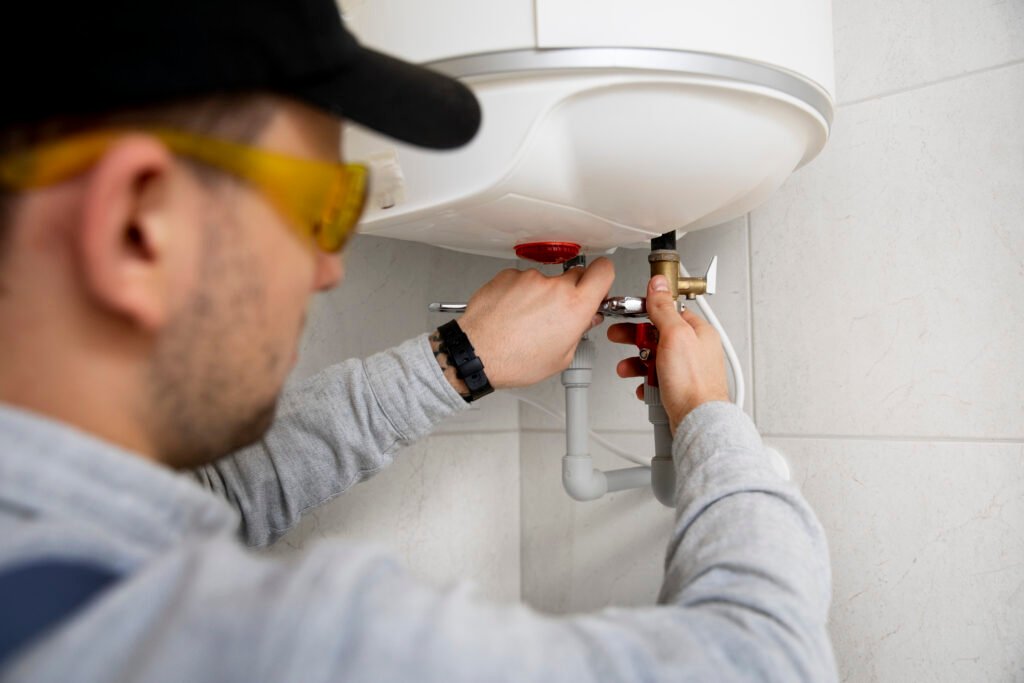
If you’re running out of hot water, the tank might not be “too small.” Common causes include:
- Sediment buildup reducing effective capacity
- Failed dip tube
- Thermostat or heating element issues
- Tempering/mixing valve problems
And if you notice pressure drops, unexplained water near the heater, or moisture issues, it’s smart to rule out supply-side problems with Water Line Repair.
If a leak or discharge is overwhelming a floor drain (or you’re seeing recurring backups), a Video Camera Sewer Inspection can identify hidden issues before they become emergencies—and if needed, we can help with Sewer Line Repair & Replacement.
Need help choosing the right size or replacing a water heater? Call Quince Orchard Plumbing for fast, local service in Montgomery County, Maryland.
FAQ: water heater sizing (Montgomery County, MD)
Is a 40-gallon tank enough for 2 people?
Sometimes—if you’re not doing back-to-back showers and laundry at the same time. If you’re close to the limit, 50 gallons is often a more comfortable “buffer.”
Should I size for the future (kids, guests, resale)?
Yes. Household size can change, and slight upsizing can make sense if you expect more simultaneous use over time.
Does climate affect the size I need?
It can. Colder incoming water increases the workload and can reduce performance if the unit isn’t sized correctly.
If I switch to a heat pump water heater, can I downsize?
Usually not. Heat pump recovery can be slower, so many homeowners maintain or increase tank size to protect comfort.
What temperature should I set my water heater to?
Safety matters. Higher temperatures (like 140°F) increase scalding risk. If you’re unsure, we can help you balance comfort, safety, and appliance needs during Water Heater Services.
Service Area (Maryland only)
Quince Orchard Plumbing serves Gaithersburg (20878), Rockville, Germantown, North Potomac, Darnestown, Montgomery Village, Potomac (north), Derwood, Kentlands, and Washington Grove.