

If you only do one “emergency-prep” task as a homeowner, make it this: find your main water shutoff valve and label it clearly. When a pipe bursts, a supply line fails, or a water heater starts leaking, knowing exactly where to shut off water can be the difference between a quick cleanup and a major repair.
I’m going to walk you through the fastest way to locate it in a typical Gaithersburg home or townhome—then how to label it so anyone in the house can find it instantly.
What the main water shutoff valve actually controls

Your main water shutoff stops pressurized water coming into your home. It helps for:
- Burst pipes
- Leaking supply lines under sinks/toilets
- Washing machine hose failures
- Water heater leaks (supply-side)
But it will not stop:
- A sewer backup coming up from a drain (different system)
If you’re dealing with repeated backups or floor drain overflow, that’s when you’d look at:
Step 1: Start where the water line enters your home
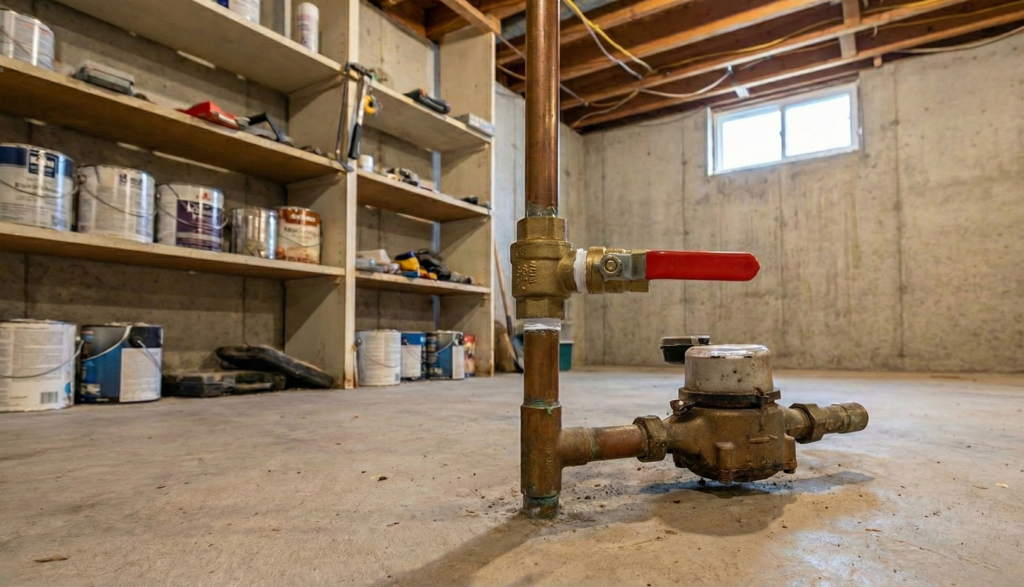
In most Gaithersburg homes, the main shutoff is located near the foundation wall where the main water line enters. Your fastest search pattern:
Common locations to check (in order)
- Basement utility area (near the front wall)
- Near the water meter (if the meter is inside)
- Mechanical room or unfinished storage area
- Crawl space (if you don’t have a basement)
- Garage utility wall (more common in some layouts)
Pro tip: Follow the largest cold-water pipe you can find. The main shutoff is usually on that line before it branches to fixtures.
Step 2: Know what you’re looking for (2 common valve styles)
You’ll typically see one of these:
1) Ball valve (best / modern)
- Has a lever handle
- Turns ¼ turn (90°)
- Handle parallel to the pipe = ON
- Handle perpendicular to the pipe = OFF
2) Gate valve (older)
- Has a round wheel handle
- Takes multiple turns
- Can be stiff or unreliable if it’s old
If your shutoff is an old gate valve, I strongly recommend planning an upgrade—especially if it’s hard to turn or doesn’t fully stop flow.
If you suspect yours is failing, stuck, or corroded, this is the right service:
👉 Water Line Repair
Step 3: Test the valve safely (so you’re not “testing” it during a flood)
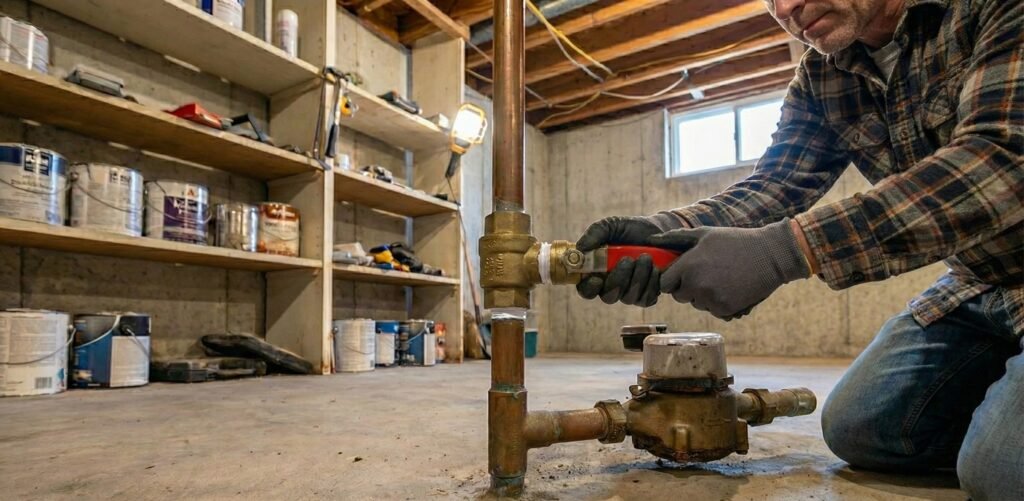
Once you think you’ve found the main shutoff, test it when everything is calm:
- Turn on a faucet (cold) to confirm water is flowing
- Turn the main valve toward OFF (slowly)
- Check that the faucet flow stops
- Turn the valve back ON
Important: If the valve feels like it’s going to snap, don’t force it. A broken shutoff becomes an emergency.
If the valve doesn’t fully stop the water, it may be failing—and that’s exactly when you replace it before you need it.
👉 Water Line Repair
Step 4: Label it so a guest could find it in 5 seconds
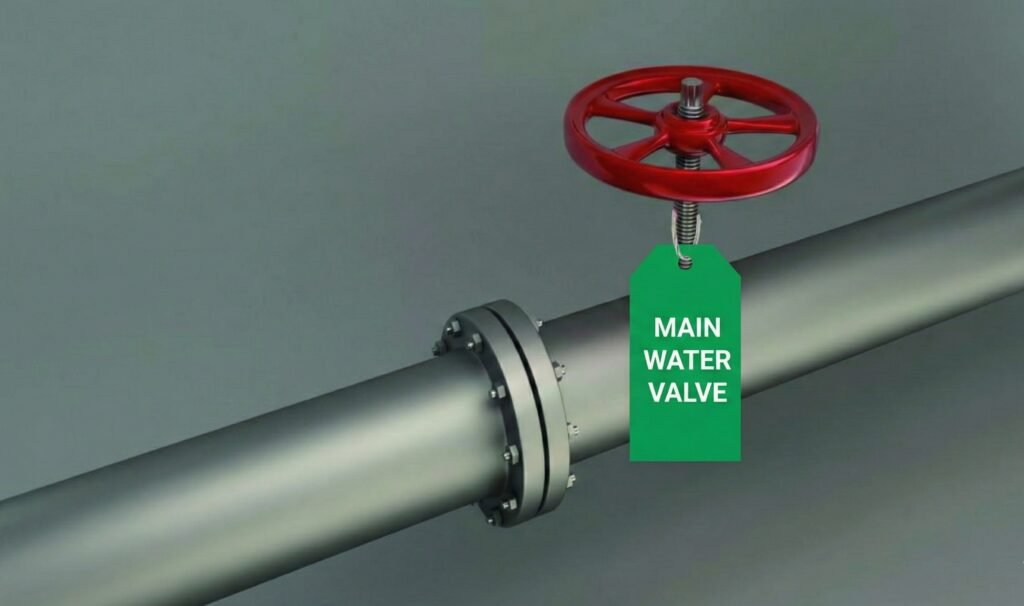
The goal is “zero confusion.”
What I recommend labeling with
- A bright tag (red or yellow)
- A label-maker sticker or permanent marker
- A simple arrow: “MAIN WATER SHUTOFF → OFF = handle across pipe”
Where to place labels
- On the valve itself
- On the wall right behind it
- Optional: one label on the door into the utility area
Do this extra step (it’s worth it)
Take a photo on your phone and share it in your family group chat with this message:
“Main water shutoff is here. Turn OFF in emergencies.”
Don’t confuse these shutoffs with the “main”
Many homes have multiple valves. Here’s the quick difference:
- Fixture shutoffs (under sinks/toilets) = local control
- Water heater shutoff = controls cold supply to heater
- Main shutoff = stops water to the entire home
If you’re trying to stop a leaking heater quickly, yes, the heater shutoff helps—but the main shutoff is still the “master switch.”
👉 Water Heater Services
Want your home to be leak-ready? Quince Orchard Plumbing can help you locate, test, and upgrade your main shutoff valve—so you’re not scrambling during an emergency.
What if your main shutoff is hidden, blocked, or hard to reach?
This is more common than you’d think—especially in finished basements or storage-heavy utility rooms.
If your valve is:
- behind drywall access you can’t reach quickly
- blocked by shelving
- located where you’d need to move heavy items
…then it’s not an emergency valve. Fix the access now.
A simple improvement is clearing the area and adding a clean path. A bigger improvement is upgrading/repositioning hardware when needed:
👉 Water Line Repair