

For many homeowners in Gaithersburg, Rockville, Germantown, North Potomac, and across Montgomery County, the idea of digging up the entire yard to fix a broken sewer line is a nightmare. Patios, driveways, landscaping, mature trees – one trench can destroy years of investment.
That’s why trenchless sewer repair has become such a popular topic in Maryland. It promises “no-dig” or “minimal-dig” solutions that can rehab or replace a buried pipe without tearing up the whole property.
But trenchless methods are not magic, and they aren’t the right choice in every situation. Sometimes they’re the perfect solution; other times, traditional excavation is still the safest long-term fix.
In this guide, we’ll explain what trenchless sewer repair is, when it typically works well for Maryland homes – and when it’s not possible or not recommended. We’ll also show you how services like Video Camera Sewer Inspection and Sewer Line Repair & Replacement fit into the picture.
What Is Trenchless Sewer Repair?
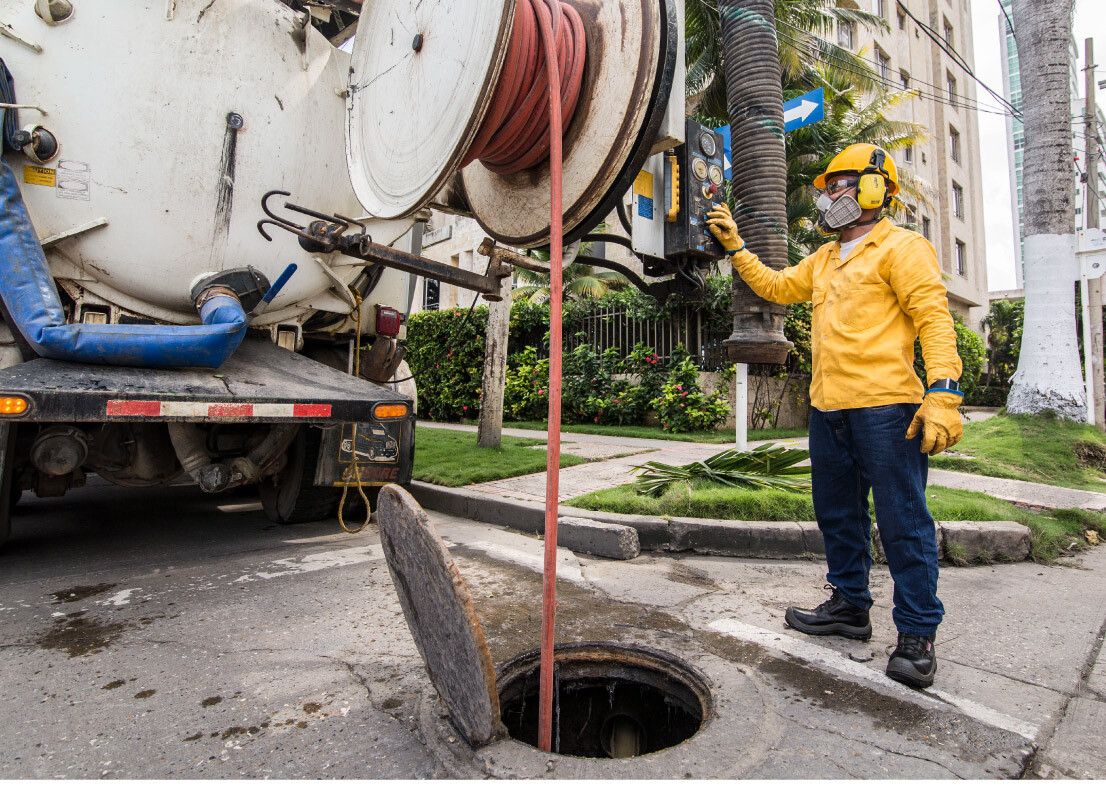
“Trenchless” simply means repairing or replacing a buried pipe with minimal digging. Instead of opening a long trench from your house to the street, the work is done through existing access points or a few small entry pits.
For residential sewer laterals in Maryland, two main trenchless methods are common:
- Pipe lining (CIPP – cured-in-place pipe)
A flexible, resin-soaked liner is inserted into the existing sewer pipe, then inflated and cured. It hardens into a new, smooth “pipe within a pipe,” sealing cracks, gaps, and small holes while resisting future root intrusion and leaks. - Pipe bursting
A conical bursting head is pulled through the old pipe, breaking it apart while simultaneously pulling a new HDPE or similar pipe into place. You end up with a brand-new sewer line in roughly the same path, often with very little surface disruption.
Both options can be excellent alternatives to full-scale excavation when the existing line still has enough structural integrity and the site conditions are suitable.
How Sewer Responsibility Works in Maryland
Before deciding on trenchless vs. traditional repair, it helps to understand who owns what:
- The public sewer main in the street is maintained by the utility (for much of Montgomery County, that’s WSSC Water).
- The sewer service lateral – the pipe that runs from your home to the main – is typically the homeowner’s responsibility, often all the way to the connection point.
When that private lateral cracks, sags, or lets roots in, you’re the one who has to fix it. Trenchless sewer repair is one of the tools that can make that repair faster and less disruptive, especially in established neighborhoods with finished basements, driveways, and mature landscaping.
When Trenchless Sewer Repair Is Usually Possible
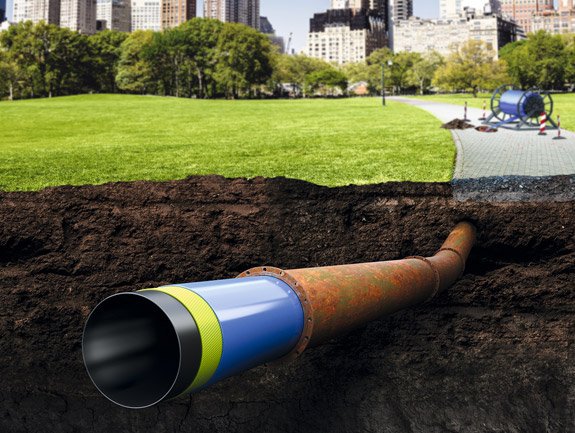
Every property is different, but in general, trenchless methods work best when the existing pipe is damaged but not destroyed. Here are common situations where trenchless repair is often a good option for Maryland homeowners:
1. The Pipe Is Cracked, Leaky, or Root-Intruded – but Not Collapsed
Trenchless lining and bursting are designed to deal with problems like:
- Cracks and small holes in the pipe
- Leaking joints that let in groundwater (infiltration)
- Tree root intrusion through existing gaps
- Moderate corrosion or wear in older clay or cast-iron lines
If the pipe still holds its basic shape and there is a clear path for cleaning equipment and a camera, trenchless repair is usually on the table.
2. There’s Enough Straight Run and Access for Equipment
Trenchless systems need access points to feed in the liner or bursting head. Often, we can use an existing cleanout, a pulled toilet, or one or two small entry pits in the yard.
Trenchless works best when:
- There is a reasonably straight or gently curving run of pipe
- There aren’t too many tight back-to-back bends
- We can safely set up equipment without interfering with foundations or other utilities
3. You Want to Protect Landscaping, Hardscape, or a Finished Basement
If your sewer line runs under:
- A finished basement slab
- Driveways, patios, or walkways
- Mature trees, retaining walls, or expensive landscaping
then trenchless repair can save you thousands of dollars in restoration costs alone. You still invest in the pipe repair itself, but you avoid re-pouring concrete, replacing hardscape, and rebuilding your yard from scratch.
4. You’re Dealing With Infiltration and Root Problems
When the main problem is groundwater or stormwater infiltrating through defects – or roots coming in through joints – lining can be an excellent solution. A properly installed liner creates a smooth, joint-free interior surface that blocks roots and stops infiltration without changing the route of the pipe.
When Trenchless Sewer Repair Is Not a Good Option

Despite the benefits, trenchless sewer repair is not possible or not advisable in certain situations. In those cases, a traditional excavation (or a hybrid approach) is often the better long-term fix.
1. The Pipe Is Fully Collapsed or Severely Deformed
Trenchless methods rely on being able to pull a cable, liner, or bursting head through the existing pipe. If the pipe is:
- Completely collapsed
- Crushed by heavy loads or soil movement
- So deformed that equipment cannot pass through
then there is no “path” to follow. In these cases, we may need to excavate and replace that section – sometimes combining open trench for the worst area with trenchless methods for the rest of the line.
2. There Is a Severe Belly (Sag) in the Line
A “belly” is a low spot in the sewer line where water and waste collect instead of flowing downhill. Lining a pipe with a significant belly often just creates a smoother belly – it does not correct the grade.
If camera inspection shows a long, deep sag that regularly holds water, full or partial excavation may be needed to re-establish proper slope and protect your home from recurring backups.
3. Major Offsets, Gaps, or Misaligned Joints
When joints are badly offset – think one section of pipe significantly higher or lower than the next – pushing a liner or bursting head through can be risky or impossible. In these cases, we may recommend:
- Digging up the worst section to realign or replace it
- Then using trenchless methods on the remaining portions, if appropriate
4. Complex Layouts or Limited Access
Trenchless repair can be challenging when:
- The line has multiple sharp bends in a short distance
- There is no realistic access point without major demolition
- Other utilities or structural elements (like footers) are too close to the route
In tight urban lots or older properties with unusual piping, conventional excavation or a hybrid strategy may simply be safer and more predictable.
5. When Local Codes or Conditions Require a Different Approach
In Maryland, work on sewer laterals still has to meet plumbing codes and any applicable utility standards. In some cases, especially near the connection to the public main, certain methods or materials may be required or prohibited.
That’s why any trenchless plan needs to be designed and permitted by a licensed contractor who understands local requirements – not just a “one size fits all” national solution.
How We Decide Between Trenchless and Traditional Repair
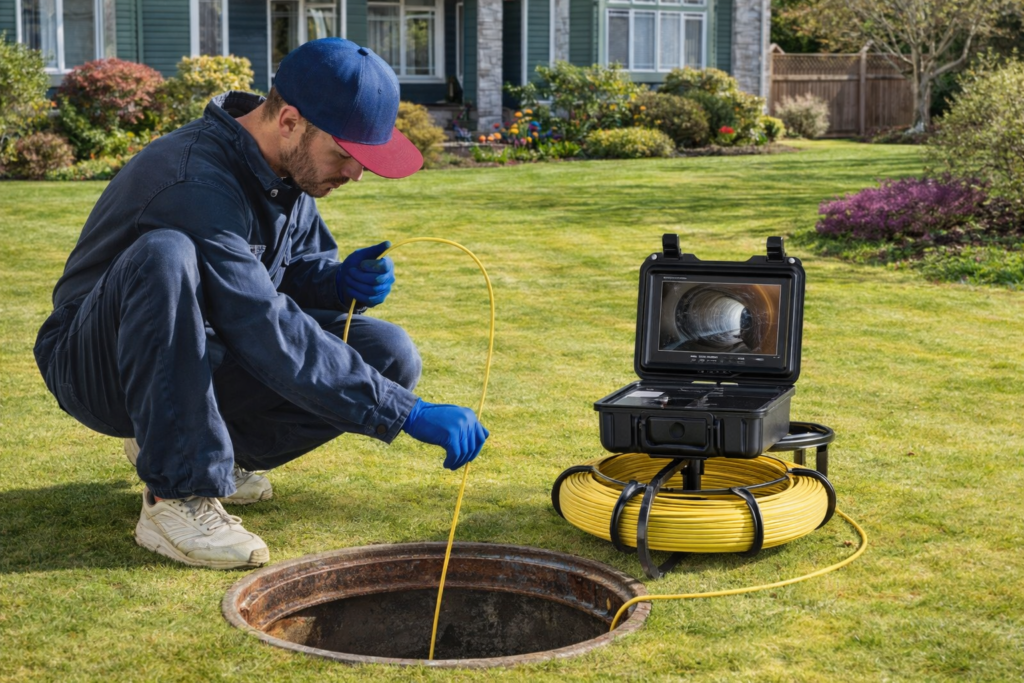
At Quince Orchard Plumbing, we don’t lead with a specific method. We start with a simple goal: find the most reliable, cost-effective way to fix your sewer line for the long term.
That usually begins with a Video Camera Sewer Inspection. During the inspection, we:
- Locate the route and depth of your existing line
- Identify cracks, roots, sags, and joint issues
- Measure pipe diameter and material
- Determine where access points are and whether trenchless gear can reach
From there, we can walk you through options, which often fall into one of these categories:
- Full trenchless repair or replacement (lining or bursting)
- Hybrid solution – dig up the worst section, then use trenchless for the rest
- Conventional excavation when that is clearly the safest and most durable solution
Pros and Cons of Trenchless Sewer Repair for Maryland Homeowners
Benefits of Trenchless Methods
- Minimal surface disruption – less damage to lawns, driveways, patios, and landscaping
- Faster completion – many jobs can be done in a day or two once everything is prepared
- Durable new pipe – liners and new HDPE pipes are designed to resist corrosion, roots, and leaks
- Smaller work zones – especially helpful on tight lots or busy streets
- Potential savings on restoration – avoiding large trenches often saves thousands in concrete and landscaping work
Limitations to Keep in Mind
- Lining slightly reduces the internal diameter of the pipe (usually not a problem, but something to evaluate)
- Significant bellies or severe collapses still require excavation to correct slope or remove failed sections
- Not every layout or site allows safe use of bursting equipment
- Trenchless cost per foot can be similar to or higher than traditional methods – the savings often come from reduced restoration, not the pipe itself
The key point: trenchless repair is a tool, not a magic wand. Used in the right situations, it’s fantastic. Used in the wrong situations, it can waste money or create future headaches.
Not sure if trenchless sewer repair is right for your Maryland home? Call Quince Orchard Plumbing today for an honest, expert assessment in Montgomery County.
What About Water Lines and Other Underground Pipes?

Although this article focuses on sewer lines, many homeowners also ask about trenchless options for leaking or failing water service lines. In some cases, similar “pull-through” or directional methods can reduce digging for water pipes as well.
If you’re seeing signs of a leaking water service – such as unexplained wet patches, very high water bills, or low pressure – we can investigate and recommend solutions through our Water Line Repair services.
DIY vs. Calling a Pro: When to Get Help

You can’t DIY trenchless sewer repair – the equipment, training, and permits are specialized. But you can stay alert for warning signs that it’s time to call a professional:
- Recurring sewer backups, especially in a basement or lower-level bathroom
- Multiple slow drains or gurgling toilets throughout the home
- Sewer smells in the basement, yard, or near cleanouts
- Soggy or sunken patches of yard along the route of the sewer line
- Known history of root intrusion or previous spot repairs
When you see these signs, the smartest next step is a camera inspection and a conversation about all of your options – trenchless and otherwise – instead of just calling for another “quick snake” that doesn’t address the real problem.
Service Area: Quince Orchard Plumbing proudly serves Gaithersburg (20878), Rockville, Germantown, North Potomac, Darnestown, Montgomery Village, Potomac (north), Derwood, Kentlands, and Washington Grove.
Not sure if trenchless sewer repair is right for your Maryland home? Call Quince Orchard Plumbing today for an honest, expert assessment in Montgomery County.
Wondering if trenchless sewer repair will work for your Maryland home?
Quince Orchard Plumbing can inspect your line with a video camera, explain whether trenchless repair is a good fit, and design a long-term solution tailored to your property in Montgomery County.